By Stephen Appezzato
A new program aims to bring profound stories of resiliency and legacy at local landmarks to life.
Three Two River-area historic sites were selected for the pilot round of the New Jersey Black Heritage trail. The legislation establishing the trail was signed in 2022 to highlight Black heritage through historical markers and a path connecting stories of Black life and resiliency across history.
The Cedar View Cemetery in Lincroft and the Count Basie Center for the Arts and T. Thomas Fortune Cultural Center in Red Bank are among the 32 initial locations selected across the state for inclusion in the trail. Also in Monmouth County – tied with Mercer County for the most sites in this round of the project – are Turf Club in Asbury Park and the U.S. Army Black Brain Center in Wall Township.
In Lincroft, tucked in a wooded plot behind the Saint Leo the Great property, is the Cedar View Cemetery. “It was a cemetery that was sold to 14 free Black men by a white landowner, George Crawford. That was something that was unusual at the time,” explained John Smack, president of Friends of Cedar View, who said the cemetery began around 1850 when Crawford sold 2.05 acres to Alexander Frost for $60.
“The people buried there are people from the community, from Lincroft, from Middletown, surrounding areas, that helped to actually form the community,” Smack said. They include laborers, craftsmen and Civil War veterans who served with the U.S. Colored Troops.
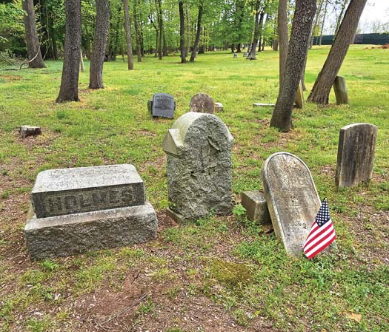
“There are former slaves who were also buried there. There’s a lot of history there,” he added. Charles Reeves, a prominent Lincroft resident and formerly enslaved person, and his wife Hannah Van Clief are buried in one of the cemetery’s 24 plots.
“It’s significant. It’s one of the oldest African American cemeteries in this area,” Smack said, adding a lot of Black churches at the time did not own property for burials. Each family buried at Cedar View owns its plot.
In 1946, Smack’s aunt Hannah was the final burial at the cemetery.
From that point on, the grounds became overgrown and largely forgotten.
“No one even knew it was there except for immediate families, Smack said. “A lot of people went to school at Saint Leo’s, lived in the area and had no idea there’s a cemetery there.”
In 2015, Monmouth University professor Joelle Zabotka, Ph.D., joined by local Scouts and other organizations, began cleaning up the property to preserve its historical significance. The property, located up a small path off Hurleys Lane, is now easily accessible to historians and those curious about Monmouth County’s past.
To the east, the 2.16-square-mile Red Bank is home to two Black Heritage Trail sites, highlighting the borough’s significance in Black history. Both the Count Basie Center for the Arts on Monmouth Street and the T. Thomas Fortune Cultural Center on Dr. James Park Boulevard were chosen as initial locations along the trail.
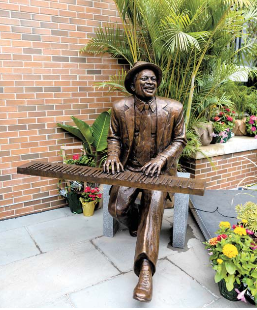
Red Bank-native William James “Count” Basie “was one of the icons of music and jazz and, of course, jazz represents a cultural heritage of America,” said Basie Center president Adam Philipson.
The historic theater originally opened in the early 1920s. In 1973, the Monmouth Arts Council purchased the theater, renaming it the Count Basie Theatre in 1984. In 1999, a nonprofit was formed to manage, maintain and preserve the theater’s history. After a $26 million expansion, the theater underwent another name change and became Count Basie Center for the Arts. Hackensack-Meridian Health bought the naming rights to the main auditorium; a second, smaller venue, The Vogel, named after philanthropists Sheldon and Anne Vogel, opened in 2020.
Basie is a member of the New Jersey Hall of Fame and the Blues Hall of Fame and has a star on the Hollywood Walk of Fame. He is widely credited with introducing generations to the Big Band sound.
“We’re just incredibly honored that we could be on the trail of places that are of note about the history of this country, and especially in New Jersey,” Philipson said.
A short drive from the Count Basie Center for the Arts is another stop on the Black Heritage Trail. The T. Thomas Fortune Cultural Center was named after the pioneering African American newspaper publisher, journalist, activist and organizer T. Thomas Fortune. Fortune was born into slavery in Florida in 1857. After the Emancipation Proclamation was signed in 1863, Fortune, a free man, headed North, eventually moving to his Maple Hall home in Red Bank. The leading African American journalist was a close associate of Booker T. Washington and an original advocate for the term African American.
Gilda Rogers, executive director of the foundation, said being added to the trail is significant “because this is not information that we’re often presented with in school, or educated about, especially on a local level, but even on a national level.” Rogers, who teaches African American History at Brookdale Community College, noticed this throughout her tenure.
“It’s helping to break down barriers so that we get a full understanding of the contributions and the importance of Black culture and heritage as it applies to being an American,” she said.
Fortune founded numerous equal rights organizations, including the Afro-American Council, while he lived in Red Bank and led multiple major news organizations in New York City.
“If you’re an American, born here in America, people who came here were enslaved people, their history has not been really explored and examined by other cultures,” said Rogers.
The foundation, headquartered in the renovated Maple Hall, promotes Fortune’s legacy of social justice advocacy for racial equality.
“With this Black Heritage Trail, which we’re so honored to be a part of, it gives the opportunity to invite people to come out and learn more and educate themselves. And I appreciate that the State of New Jersey thought it was important to make this happen at this particular time,” Rogers said.
The article originally appeared in the May 9 – May 15, 2024 print edition of The Two River Times.