
By Sunayana Prabhu
It may sound like an anomaly in a world driven by smartphones, but it is happening IRL (in real life). A group of high school students in New York are leading a movement to break free from smartphone addiction, and their story is the focus of a new documentary film.
“Luddite,” directed by former teacher Amanda Hanna-McLeer, follows the formation and activities of the Luddite Club at Edward R. Murrow High School in Brooklyn. The club, founded by students Logan Lane and Jameson Butler when they were just 14 and 15 years old, encourages teens to ditch their smartphones and social media in favor of more analog activities.
“These kids are amazing. They’re highly principled and eloquent and thoughtful and inclusive,” McLeer said, noting that the teens are not doing this for attention but because they genuinely believe smartphones and social media are harming their generation. “It is a movement of teens against the abuse of technology.”
In the Two River area, parents, educators and even students have grappled with ways to manage smartphone usage.
“Smartphone usage has dramatically changed the landscape of schools,” said Zach Klausz, director of A Child’s Place School in Lincroft. “The problem is that there is a real world going on around them that they are missing. This real world is imperfect and requires humans to communicate and collaborate to solve problems. When this happens, the humans learn skills that can be used again and again – some call this resilience.”
Klausz, who is not involved with the documentary, said smartphones don’t foster resilience. They “foster the idea that entertainment needs to be provided at any point just to get through the day,” he said.
McLeer said the term Luddite is often used derogatorily to label someone as being anti-progress or anti-technology but the teens in her documentary are reclaiming its true origin.
The original Luddites were a group of 19th-century textile workers in England who protested workplace abuses during the Industrial Revolution. To protect their identities, they signed letters and petitions to the government as “Nedd Ludd,” a folkloric figure.
By naming her documentary “Luddite,” McLeer wants to draw similarities between the historical Luddite movement and the modern-day teens in her film who are rejecting not the technology itself but the negative impacts it has on their generation.
The documentary explores technology’s effects on youth, including increased anxiety, depression and sleep deprivation. “The impact on sleep is irrefutable,” McLeer said. Some of her students would clock 20 straight hours of screen time and couldn’t sleep. But once some gave up their smartphones they experienced positive changes.
“A lot of the Luddites were diagnosed with ADHD (Attention Deficit-Hyperactive Disorder), and one even had a reversal of her diagnosis when she went on a flip phone,” McLeer said.
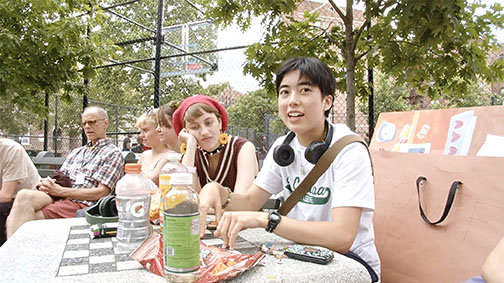
She was inspired to make the film after seeing the Luddite Club’s posters around the school and realizing she shared their anti-smartphone views.
“I had been called a Luddite for years, and I always railed against that,” McLeer said. “But then I saw these posters and I thought, ‘Oh my gosh, if this is what I think it is, I’m so excited.’ ”
McLeer, who previously worked in the film and television industry, left her teaching job to focus on the documentary full-time. She’s been funding the project through a successful $150,000 Kickstarter campaign, seven times the typical amount raised for such films.
The documentary features McLeer and Ava de la Cruz, a 19-year-old freshman at the School of Visual Arts who serves as the film’s producer and camera operator. The rest of the cast consists of real teens, ranging in age from 16 to 20, who are part of the Luddite Club.
While McLeer agreed some “positives (can) be gleaned from smartphone use and social media,” like connecting people in remote communities or providing a platform for marginalized voices. “There’s some good for sure, but for me, there’s a blatant abuse of tech happening right now. The negative outweighs the positives for me,” she said. Even if the technology is meant to connect people, McLeer said there have to be better ways to communicate and build community.
“All of these devices and applications were built to be addictive,” she said.
As Klausz explained, “The ultimate test is to go to a school cafeteria during lunchtime. Visit one school that allows phones and you will see hundreds of humans sitting in absolute silence. Go to the school that bans the phones and you will see lively conversations going on all over the place. People meeting each other, validating each other and making new connections.”
McLeer is currently at Stanford University to film an experiment being conducted related to the documentary involving “light phones,” the opposite of smartphones. McLeer is filming this experiment and getting testimonials from the college students participating in the study which will be included in Luddite.
“We’re really trying to show that it’s not a privileged position to get rid of your smartphone. If anything, having a smartphone is privilege because they’re so expensive.”
McLeer suggests anyone can detach a little bit and mediate their relationship with their phone. “Just put it down for a second to go to the park, to have a meal with friends. That doesn’t have to be out at a restaurant. It could be at home. You can bake bread together, you can draw together, play a board game, these are all things that aren’t expensive to do.”
The film is currently in post-production, with the goal of meeting the Sundance Film Festival deadline in September 2025. McLeer hopes the documentary will help shine a light on the Luddite movement and inspire other teens to reconsider their relationship with technology.
“When I speak with parents at my school about this, I tell them that these smartphones might be the cigarettes of our time,” Klausz said. “My parents smoked and told me not to and it took generations for us to realize the harm cigarettes were doing. Will we wake up one day and think we were crazy for handing these things to our children at such a young age?
The article originally appeared in the November 7 – 13, 2024 print edition of The Two River Times.