‘Mrs. Thompson Saves the Day’ – and Jane Scimeca Tells the Tale
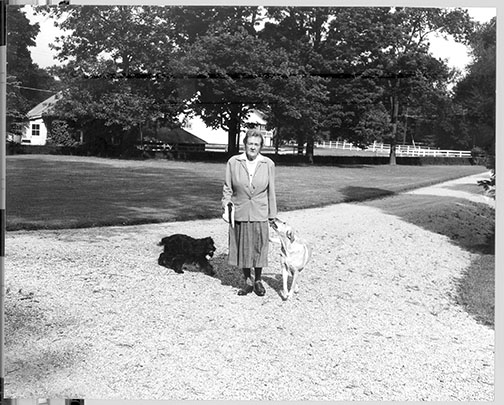
By Eileen Moon
During the years she was growing up in Holmdel, Brookdale Community College professor Jane Scimeca often traveled past Thompson Park, a pastoral blanket of land with a white-columned mansion overlooking Newman Springs Road.
For more than 70 years, the property was the home of Geraldine Livingston Morgan Thompson, a diminutive woman whose accomplishments stand tall in the history of Monmouth County and the state of New Jersey. But it wasn’t until recently that Scimeca fully understood who Geraldine Thompson was and what she accomplished.
For the past four years, Scimeca, who has been teaching women’s history and world history at Brookdale since 1994, has been writing a biography of Thompson that is presently under consideration by Rutgers University Press.
“They’ve been very positive,” she said. “There’s a great deal of women’s history and New Jersey history in the book.”
Among a multitude of accomplishments, Geraldine Thompson was the driving force behind the preservation of Island Beach State Park and the development of health and social welfare resources locally and throughout the state.
In 1912, Thompson established the Monmouth County Organization for Social Services (now known as the VNA) to provide a constellation of health care services that didn’t exist before she took up the cause.
Born into wealth at the height of the gilded age in 1872, Geraldine Livingston Morgan evolved from a debutante, dancing within the whirl of the social elite, to a quiet revolutionary committed to public service – often acting as the power behind the thrones of those who held political office. “She was very aware that she was a woman in a man’s world,” Scimeca said.
Scimeca’s curiosity about Geraldine Thompson was aroused a few years ago when she was teaching a women’s history class about Eleanor Roosevelt. For many years, the wife of former President Franklin Delano Roosevelt wrote a newspaper column titled “My Day” that was published across the country.
In one of those columns, Mrs. Roosevelt wrote about visiting her friend, Geraldine Thompson, at Brookdale Farm.
“I started looking into Geraldine Thompson’s life,” Scimeca said. “She had really been overlooked. There had been no real study of her life and work.”
Scimeca committed herself to correcting that. “After that, I was off to the races.”
“I grew up three miles from Mrs. Thompson’s house,” Scimeca said. “I do feel like she’s been under my nose my entire life.”
Over the past four years, Scimeca has spent her weekends, holidays and summers researching Thompson’s private and public life. It’s a project that has taken her to Harvard University, Amherst College, Wesleyan University, the New Jersey State Library, the FDR Archives in Hyde Park, New York, to the homes of some of Thompson’s 40 great-grandchildren and to every other archival nook and cranny that may hold some part of her life history.
Scimeca also relied heavily on the help of librarians at Brookdale, the Monmouth County archives, and on the work of the volunteers from the AAUW, who created the book, “A Triangle of Land,” that included interviews with people who knew Thompson firsthand.
Compassion and Action
Within the quiet acreage along Newman Springs Road, Thompson led an active, involved, revolutionary and occasionally startling life, Scimeca discovered.
Her former estate, now part of the Monmouth County Park System, was established as Brookdale Farm in the 1870s by David Dunham Withers, a celebrity horseman and a founder of Monmouth Park Racetrack. The property was later purchased by Thompson’s father-in-law, William Payne Thompson, and passed down to his son, Lewis, Geraldine’s husband, following William’s death.
Following her marriage to Lewis S. Thompson in 1896, Geraldine made Brookdale Farm her home for the next 70 years. There she raised four children of her own and five other children who needed her care.
Born into incredible wealth, Thompson also had a wealth of compassion.
As a teenager, she had been diagnosed with tuberculosis, a disease for which no treatment existed then but fresh air, exercise, good nutrition and luck.
“Thompson’s husband was a sportsman,” Scimeca said. Whether it was fishing in the Florida Keys or big game hunting in the wild, “he was a celebrity. He was Mr. Field and Stream,” Scimeca said.
As a “gentleman farmer,” he leased out the racing stables that would earn renown on their own as a premier stud farm and thoroughbred training center.
Geraldine’s outlook on life was far more serious. She grew up in a family of social reformers, learning at her grandmother’s side the rewards of working for the good of others. Her grandmother, Geraldine Livingston Hoyt, was a founder of the New York State Charity Aid Society and helped to establish a nursing program at Bellevue Hospital.
At a time when there were few societal safety nets, Thompson set out to improve the health and welfare of her fellow human beings and the environment they shared. In 1910, she became a board member on the State Charities Aid and Prison Reform Association, working to improve conditions at the Monmouth County jail.
In 1912, at the time she established what is now the VNA, Scimeca said, “The only institution in the whole county was the jail. There was no juvenile justice system, no homes for ‘wayward’ or orphaned children.”
Thompson repeatedly stepped forward to find ways to alleviate suffering caused by poverty, prejudice, neglect and disease. And she learned how to wield political power without ever holding office. In 1923, she became the first female delegate to the Republican National Convention. Thompson would ultimately become the most influential Republican woman in the state; a woman that one prominent politician, Sen. Alfred Beadleston, referred to as a “cyclone.”
“She was in the papers almost every day,” Scimeca said. “She was a mover and a shaker.”
Thompson, who had grown up “down the street” from FDR, was a close friend of Eleanor Roosevelt. Although Eleanor was a Democrat, “They were very good friends and very good colleagues,” Scimeca said. On one occasion, Mrs. Roosevelt asked Mrs. Thompson to deliver $5 to a person who had contacted the first lady for help. Thompson took care of it.
And when Thompson needed to raise money for her social service organization, Roosevelt came to Red Bank and gave a speech. “People would come by the thousands to see Eleanor,” Scimeca said.
Like most people, Thompson’s personal life was not without tragedy or intrigue. As she made her way through boxes and boxes of material, Scimeca stumbled upon a secret hidden for many decades.
In addition to her 40-year marriage to Lewis Thompson, who died in the 1930s, Geraldine had a long-term relationship with a woman who shared her commitment to public service: Miriam Van Waters was a well-known advocate for prison reform and juvenile justice who served as the superintendent of three prisons.
While Thompson’s personal papers were destroyed after her death, Harvard University held Van Waters’ archives, which included more than 300 letters between the two women over 40 years, from the 1920s through the 1960s. “It was very romantic and very emotional,” Scimeca said.
An Important Legacy
In a lifetime of achievements, one of the major accomplishments credited to Geraldine Thompson is the preservation of Island Beach State Park.
Following World War II, the property’s owners were poised to sell it to developers. Thompson successfully lobbied then-New Jersey Gov. Alfred Driscoll to save the 2,200-acre property, which now attracts thousands of visitors each summer. Scimeca said it is the last stretch of undeveloped land on the Atlantic Coast.
In recognition of her efforts, Thompson was sitting on the dais next to Driscoll July 1, 1953, the day the state celebrated the purchase of the property.
“When I think of her big accomplishments, I think of her environmentalism and her commitment to democracy and civic engagement,” Scimeca said.
Thompson died in 1967 at the age of 95. Following her death, the Thompson Family donated 215 acres of her estate to Monmouth County for the establishment of Thompson Park.
At the 2025 commencement ceremony on May 15, Brookdale Community College will present Geraldine Thompson with an honorary degree in recognition of her achievements; one of her great-grandsons will accept it on her behalf, Scimeca said.
In another Thompson-related event, the county park on Newman Springs Road opened its recently renovated historic horse barn to the public for the first time May 3. Exhibitions in the barn tell the story of thoroughbred racing in Monmouth County at what was once among the premier stud farms and thoroughbred training facilities in the nation. The stable is open Fridays from 10 a.m. to 7 p.m. and Saturdays and Sundays from 10 a.m. to 4 p.m. through Oct. 19.
Meanwhile, with the semester behind her, Scimeca will return to work on the biography she has titled “Mrs. Thompson Saves the Day,” after a headline on a story taken from the archives of the Long Branch Daily Record that recounts Thompson’s role in helping Red Bank’s Westside fire company save their fire truck from repossession. “They went to Brookdale Farm and asked Mrs. Thompson to help them, and she helped them get their fire truck back,” Scimeca said.
The article originally appeared in the March 15 – 21, 2025 print edition of The Two River Times.