By Sunayana Prabhu
ASBURY PARK – Wide beaches and healthy dunes will be welcoming visitors and the Two River community as the summer tourism season begins. Officials have announced the Jersey Shore is “beach ready” due to a mild winter and minimal storms.
However, all is not sunny as experts predict storms – both literal and financial – on the horizon.
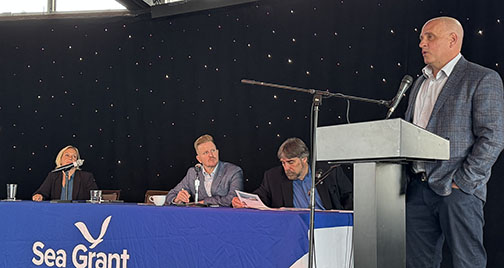
At the 23rd annual State of the Shore press conference organized by the New Jersey Sea Grant Consortium (NJSGC) May 22, Shawn LaTourette, commissioner of the New Jersey Department of Environmental Protection (NJDEP), declared the state’s beaches and lakes open and ready for summer business.
NJSGC released its annual outlook report, which outlines beach readiness and water quality across the state. The report is meant to inform the public and beach communities about beach conditions and tropical storm outlooks to help plan their time at the Jersey Shore.
According to the report, the Jersey Shore has maintained healthy, wide beaches and robust dunes due to the combination of a mild winter with no major storms and a reduced number of erosion events.
“Our beaches are very much ready for residents and visitors to enjoy again,” LaTourette said. “Our coastal monitoring program data indicates the water quality is excellent.”
However, just moments later, officials shared more serious concerns, not only warning of an unusually active hurricane season this year but also the potential loss of coastal monitoring data provided by the National Oceanic and Atmospheric Administration (NOAA), the federal climate monitoring agency, due to federal budget cuts proposed by the Trump administration.
“We’re going to have a more active than normal hurricane season,” said Jon K. Miller, Ph.D., a coastal process specialist for the NJSGC and director of the coastal engineering research group at Stevens Institute of Technology. He cited projections from Colorado State University that predict 17 named storms, including nine hurricanes and four major hurricanes.
He further warned that potential reductions in federal funding for NOAA could severely impede coastal planning and climate change preparedness. The mission of NOAA, which falls under the Department of Commerce, is to understand and predict changes in climate, weather, oceans and coasts and to conserve and manage coastal and marine ecosystems and resources.
NOAA scientists utilize various tools, such as radar systems, satellites and ocean buoys, among other data-collection devices, to track critical short- and long-term weather forecasts, climate trends research and coastal monitoring, all of which are used for resilience planning and emergency management protocols during extreme weather events.
“It’s concerning,” Miller said. “Without that data, it’s really difficult, if not impossible, to plan and construct good projects. Communities can’t prepare.” Miller said information, such as understanding the condition of the beaches and the ability to model and predict the future to alert communities of coastal flooding or coastal erosion, is “dependent on resources from the National Weather Service, the National Hurricane Center, NOAA, at large, so there are potentially some dramatic impacts to coastal communities if those resources may not be available.”
The National Weather Service, NOAA, and the Building Resilient Infrastructure and Communities (BRIC) program all face potential funding reductions under proposed federal budget adjustments. These cuts would hamper ongoing and future shoreline monitoring and protection efforts.
“We’ve already received notice of potential withholding of funding under what’s called the Building Resilient Infrastructure and Communities program, which would be incredibly harmful to our resilience-building efforts,” LaTourette said. BRIC is an initiative of the Federal Emergency Management Agency (FEMA) that provides annual funding to states, municipalities, and other entities to support hazard mitigation projects. Its goal is to help communities prepare for natural disasters like floods, hurricanes and wildfires by investing in resilient infrastructure and reducing long-term risks.
FEMA has invested over $200 million in critical climate resilience projects here in New Jersey. “That’s not wasteful governance spending. That’s investment in the good health of our people and the security of our coastal and riverine economies,” LaTourette said.
The potential losses arise as the state continues to invest in coastal fortification to protect its coastline, which stretches across nearly 1,800 miles, with 53% of the state’s population residing in the coastal zone.
The DEP recently secured a $72.4 million federal grant for climate resilience projects. State initiatives, such as the Blue Acres Program and Resilient NJ, aim to manage flood-prone properties and develop adaptive infrastructure strategies – plans that rely on continued financial support.
Despite the worrying predictions, preparations are well underway to ensure safe recreation both on and off the shores. For example, lifeguards will return to the Two River-area beaches through Labor Day, Sept. 1. For the first time, the public can view real-time updates on freshwater beach conditions, including bacteria advisories and Harmful Algal Bloom (HAB) alerts, online at njbeaches.org.
The NJDEP’s commitment to lake safety includes extensive surveillance and a network of monitoring buoys operating 24/7 across certain bodies of water, like Lake Hopatcong and Greenwood Lake. NJDEP officials have also confirmed that they are evaluating the most strategic locations to deploy data monitoring buoys in the Navesink River next year.
According to the NJDEP, during the 2024 season, 193 ocean beaches, along with 18 bay and six river stations, reported no closures due to bacterial exceedances. The state also continues to work with the U.S. Army Corps of Engineers on beach nourishment projects.
“Our beaches this year are in pretty good condition moving into the summer season, I would say excellent condition,” said Miller, crediting a lack of recent storms and proactive replenishment efforts by local, state and federal authorities resulting in “robust dunes.”
“Those are the things that protect us from these storms. That’s our first line of defense,” Miller said.
The article originally appeared in the May 29 – June 4, 2025 print edition of The Two River Times.