By Alli Tretina
OCEANPORT – A national bookrecycling initiative, BookDrop, is giving thousands of unwanted books a second life, saving them from landfills, fueling library sales and supporting charities at home and abroad.
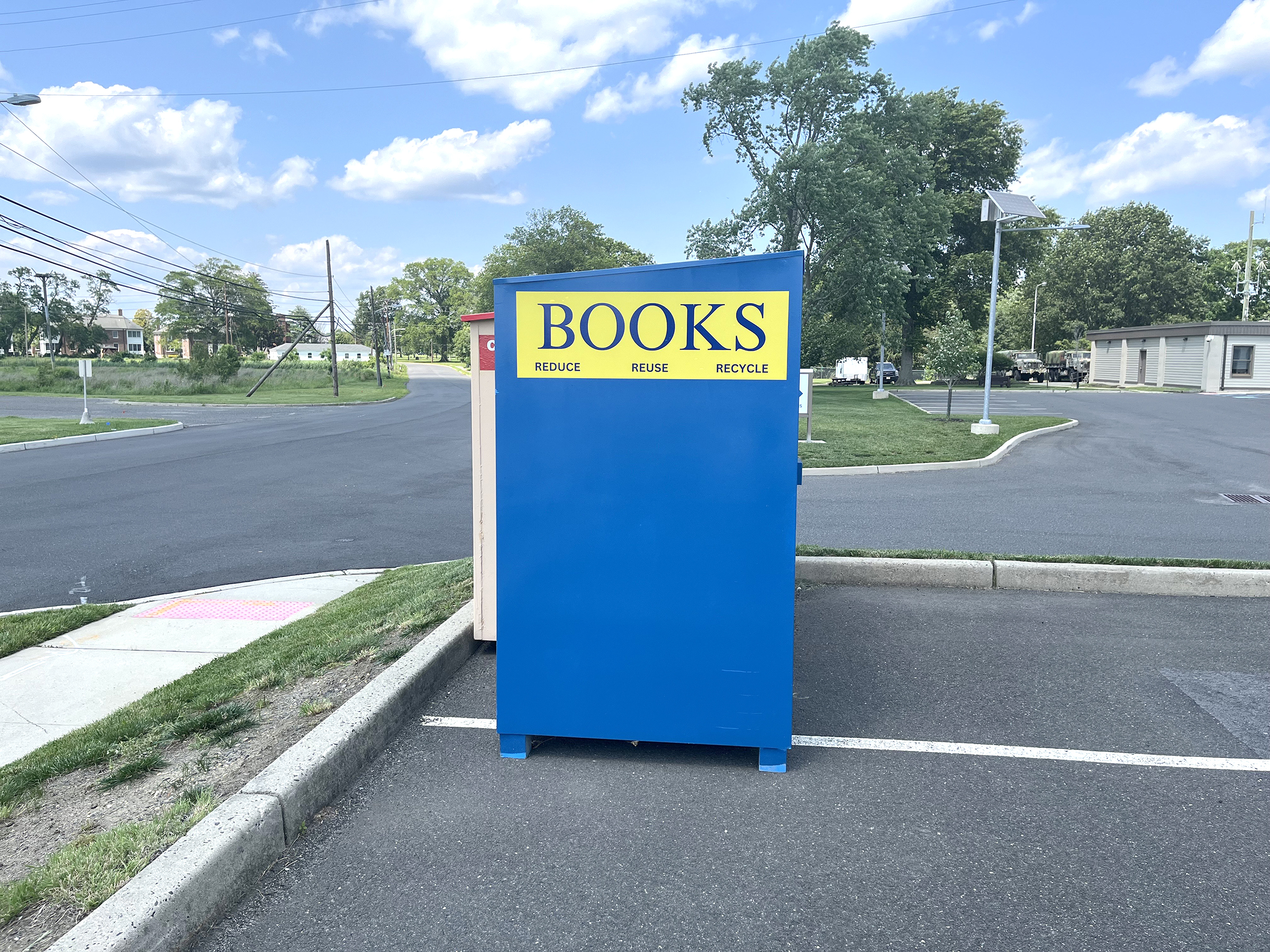
And the Borough of Oceanport has joined the program, with a drop-off location at the borough hall.
“It’s a great opportunity for people to recycle their books and keep the books out of the landfill and share them with other people,” said Donna Phelps, Oceanport borough administrator, who sourced the company and coordinated the container location at borough hall on the grounds of the former Fort Monmouth.
BookDrop recovers everything from children’s picture books and encyclopedias to Bibles, collecting them in six-foot bins before sorting them and distributing them to receptive audiences.
“Anything we can find a home for,” said John Toy, the regional recycling coordinator for BookDrop, based in Hatboro, Pennsylvania. His son, Jack Toy, helped cofound the company.
“We want to keep books that are good out of the landfill.”
The company started in 2018 as a college book purchasing service for students in Utah. It now spans multiple states across the country, including Pennsylvania, Delaware, Maryland and New Jersey, as well as globally.
“We will actually donate books for book sales,” said Toy. “We are able to sort the books according to genre so we can help supply books for book sales, usually through Friends of The Library.” The company also works with a children’s book charity based in South Jersey. “We work with BookSmiles,” said Toy, referring to the charity. “They go to libraries in South America, Africa, and anywhere books are needed.”
Through its connections with local Friends of the Library groups, Toy said, “We will actually donate the books for a book sale. So I can kind of pick and choose what we want to send as far as a genre. We supply to a number of Friends groups. I’m constantly putting aside books for them.”
These organizations use book sales to raise funds for their libraries. With limited on-site space, they rely on the program to collect unsold volumes after sales end. “When they’re done (with) the sale, we even come in and clean it up,” he said.
By reporting recycling tonnage back to townships like those in New Jersey, the program helps communities meet state sustainability goals – and earn grant funding. “The townships really appreciate it as well,” Toy said. “One of our bins holds about 1,000 pounds. It’s almost 6 feet tall.”
In Pennsylvania, recyclers produce chipboard from book materials that are not easily recyclable, thereby avoiding the state’s requirement to remove book covers before disposal. “They make chipboard, so that’s one of the reasons they don’t have to rip the covers off,” the coordinator explained.
Books are generally considered recyclable under New Jersey’s recycling framework, as they fall under the category of “mixed paper” or “paper products.” However, there are specific restrictions and guidelines for processing books, particularly regarding hardcover versus softcover books.
These restrictions stem from the 1987 New Jersey Statewide Mandatory Source Separation and Recycling Act, which requires recycling plans for each county and municipality, including how paper products are handled.
While some BookDrop donations are sold or shipped overseas, others are processed locally — whether reused, upcycled or properly recycled. “If we can, then it’s donated. If not, then it’s recycled,” said Toy. “We move thousands and thousands of pounds, so the less we can send to the recycling, the better.”
The program processes massive volumes annually. “We have 100,000 books in our library. We’ll probably do over a million pounds of recycling,” he said.
That effort is worth it, however. Toy says it keeps books in readers’ hands and out of landfills – a mission that resonates from neighborhood libraries to far-flung communities around the globe.
The article originally appeared in the July 17 – July 23, 2025 print edition of The Two River Times.