By Stephen Appezzato
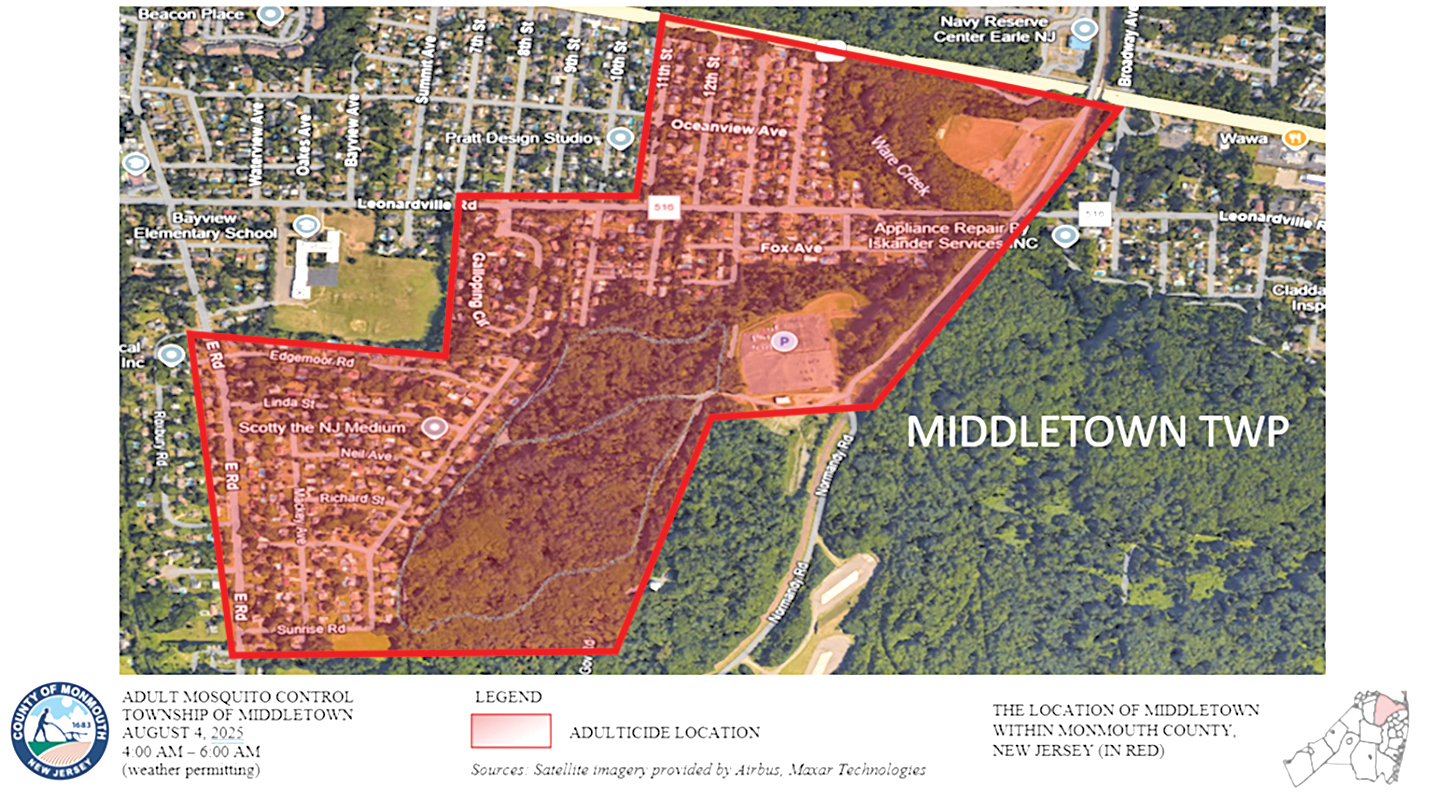
MIDDLETOWN – The Monmouth County Mosquito Control Division conducted a community-wide adult mosquito control operation in sections of Middletown Township this week after mosquitoes collected locally tested positive for West Nile virus.
The targeted treatment area included residential neighborhoods west of Naval Weapons Station Earle waterfront, east of East Road, north of Sunrise Road, south of Leonardville Road, east of 11th Street and south of Route 36.
“Through proactive surveillance, precision treatments, and constant monitoring, our mosquito control operations reduce the risk of mosquito-borne illnesses for residents,” said Monmouth County Commissioner Director Thomas A. Arnone.
Monmouth County also dispatches inspectors to visit properties to identify standing water sources that support mosquito larvae.
“If larvae are found, the inspectors will either treat the water or remove the source,” Arnone said in a statement.
The division applied Duet, a chemical mixture that kills adult mosquitos, using ultra-low volume (ULV) sprayers mounted in the bed of a pick-up truck. A detailed map of the treated areas and a fact sheet are available on the Mosquito Control Division’s website.
According to the county, because Duet is applied at low concentrations, it is unlikely to have adverse health effects, although residents should take common-sense steps to minimize exposure.
“August through September is peak time for West Nile virus activity,” said commissioner Deputy Director Susan M. Kiley, who serves as liaison to the county Department of Health and Human Services.
Residents are urged to take precautions against mosquito exposure during peak season and can assist in reducing breeding grounds by eliminating standing water on their properties, the county said.
“When outdoors, people should take precautions like using repellents or wearing long sleeves and long pants to avoid mosquito bites. Residents can also reduce mosquitoes by dumping any containers holding water around their property,” Kiley said.
According to Johns Hopkins Medicine, West Nile virus is spread to humans through the bite of an infected female mosquito. The mosquitoes become infected after feeding on infected birds, particularly crows and jays, but at least 110 other bird species can also carry the virus.
The West Nile virus can infect humans, birds, mosquitoes, horses and some other mammals. Infections typically occur in mid- to late-summer and early fall in temperate regions but can happen year-round in warmer southern climates.
Most individuals infected with West Nile virus will not develop symptoms. However, approximately 1 in 5 infected individuals may develop West Nile fever, a flu-like illness characterized by fever, headache, body aches, skin rash on the trunk of the body and swollen lymph glands.
In severe cases, the virus can cause life-threatening neurological illnesses such as encephalitis (inflammation of the brain), meningitis (inflammation of the lining of the brain and spinal cord) and meningoencephalitis (inflammation of the brain and its surrounding membrane).
The severe form of West Nile virus predominantly affects older adults, especially when the virus crosses the blood-brain barrier.
Arnone said residents can schedule a county inspector by calling the Mosquito Control Division at 732-542-3630.
The article originally appeared in the August 7 – 13, 2025 print edition of The Two River Times.