By Mary Ann Bourbeau
SHREWSBURY – In 1911, when the Mona Lisa was stolen by a handyman who worked for Paris’ Louvre Museum, it wasn’t a well-known painting. Vincenzo Peruggia was the ringleader of the gang that included brothers Vincenzo and Michele Lancelotti. The trio hid in an art supply closet until the museum closed, then removed the painting from its case and frame, covered it with a blanket and left the building.
Leonardo da Vinci painted the woman with the mysterious smile in 1507, but it was far from the most famous painting in the Louvre. In fact, it took more than 24 hours for workers to even notice it was gone. But after the newspapers got wind of the theft, it became a world-famous painting overnight. Everyone wanted to know who stole it, and some unlikely people became suspects, including Pablo Picasso. Paris was in a frenzy, and hordes of people came to see the empty wall where the painting known as “La Gioconda” once hung.
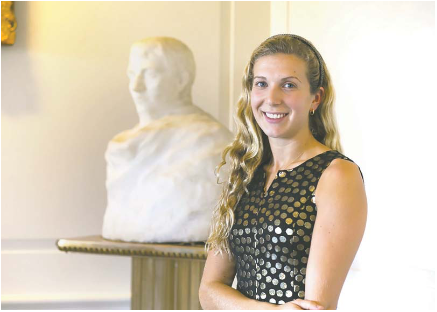
This is just one of the stories told by art historian and educator Mallory Mortillaro when she hosts the lecture “How to Steal a Masterpiece” at 1:30 p.m. Monday, Sept. 22, at the Monmouth County Library’s Eastern Branch in Shrewsbury. Mortillaro is nationally known for her rediscovery of Auguste Rodin’s bust of Napoleon, which had been hiding in plain sight for years in the borough hall in Madison, New Jersey.
Mortillaro was 22 at the time, having just graduated from Drew University with an art history degree. She answered an ad for a part-time archivist to take inventory of the art in Madison’s stately borough hall. Known as the Hartley Dodge Memorial Building, it was built by philanthropist Geraldine Rockefeller Dodge as a tribute to her late son, Marcellus Hartley Dodge Jr. The building, fronted by large marble columns, looks as if it could be a museum.
“No one goes inside for the first time and isn’t blown away,” said Mortillaro.
Dodge filled it with art from her own collection, including large oil paintings and a desk that belonged to Abraham Lincoln. A 700-pound bust of Napoleon sat inconspicuously in the back corner of council chambers.
“In a room filled with beautiful chandeliers, sculptures and paintings, it was easy to miss,” said Mortillaro. “It just blended in like part of the landscape.”
One day, Mortillaro noticed a faint signature on the back that read “A. Rodin.”
“There was no documentation kept on it, so I started digging,” she said. “I connected with a Rodin expert in Paris and, after a year of research, we were able to authenticate that it was lost artwork from the 1930s. It was so exciting! I always thought it was authentic, but I needed to find someone who believed me.”
In 2015, when the bust was finally authenticated, it was determined to be valued at $4 million to $12 million. The notoriety Mortillaro gained from the discovery was worldwide.
“It was a whirlwind,” she said. “For a second, it was all people were talking about. It was neat that people really cared about the story, the piece and also Mrs. Dodge.”
At her lecture, Mortillaro will speak about the underworld of stolen art and exploring little-known stories of history’s greatest art heists. Attendees will discover some of the most shocking art thefts of the last century and a half, including the 13 pieces stolen in 1990 from the Isabella Stewart Gardner Museum in Boston, all of which are still missing. They are valued at $500 million. Two men claiming to be policemen responding to a disturbance call entered the museum, bound the guards and took off with the artworks, which included several Rembrandts, a Vermeer and a Manet. The museum is still offering a $10 million reward for information leading directly to the safe return of the stolen works.
As for the Mona Lisa, Peruggia had hoped to hock the painting, but because of the publicity, it became too hot to sell. Rewards were being offered and he thought about claiming one, but he was afraid of being found out, so he hid the painting in the false bottom of a trunk in his Paris boardinghouse for more than two years. When he finally tried to sell it to an art dealer in Florence, the dealer saw the stamp of authenticity and Peruggia was subsequently arrested; he spent eight months in jail for the heist and the Mona Lisa went on to become perhaps the most famous painting in the world.
Mortillaro’s lecture “How to Steal a Masterpiece” will take place at 1:30 p.m., Monday, Sept. 22, at the Monmouth County Library, 1001 Route 35, Shrewsbury.
The article originally appeared in the September 18 – September 24, 2025 print edition of The Two River Times.