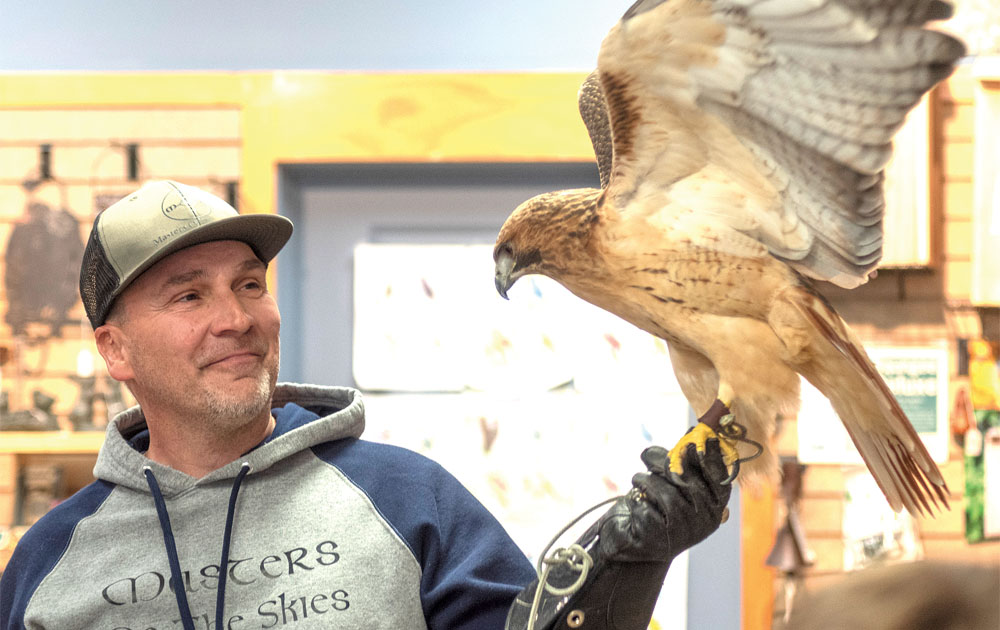
Falconer Gregory Wojtera with William, a Harris hawk, at a program he gave recently at Wild Birds Unlimited in Middletown. It’s estimated that a hawk like William can see a newspaper headline from a half-mile away. Photo by Emily Schopfer 
Athena is an 8-year-old female American barn owl. Owls may be known for their wisdom, but Wojtera describes them as more moody than wise. Photo by Emily Schopfer
By Emily Schopfer
MIDDLETOWN – Gregory Wojtera has a cherished bond with his animal companion, Bharti. Quality time out in the brisk autumn air of the eastern Pennsylvania wilderness is a great way to strengthen that bond.
But first he needs to don a very thick leather glove because Bharti is a red-tailed hawk. Wojtera is one of only 5,500 licensed falconers in the United States and there is nothing conventional about his career – or his companion.
A falconer is someone licensed in the ancient sport of falconry, a hunting sport traced back to 300 B.C. and mentioned by the philosopher Aristotle. Flash forward to 2010, when UNESCO (United Nations Educational, Scientific and Cultural Organization) recognized the sport as an “intangible cultural heritage of humanity.” Nov. 16 was designated World Falconry Day to commemorate the recognition.
This year, to celebrate World Falconry Day, Wild Birds Unlimited in Middletown hosted Wojtera, a master falconer who operates Masters of the Skies, a hands-on falconry experience in the Poconos, to educate the community about falconry’s history and practices and to dispel common misconceptions about the sport.
Karen Farawell, owner of Wild Birds Unlimited, invited Wojtera to the store after he ran a similar program at another store. Farawell said these events serve her customers’ interests. A program on ornithology (the scientific study of birds) will take place at the store in January.
Joining Wojtera and Bharti, a female, were two more avian assistants: Athena, a female American barn owl, and William, a male Harris hawk. Athena and William, also raptors, are not used for hunting. They were both born and raised in captivity to be used for educational purposes by Masters of the Skies.
Falconry, although still a hunting sport, has expanded through experiences like these that educate and engage the public. Falconry involves hunting with birds of prey – various species of falcons, hawks and eagles. Bald eagles, although skilled hunters, are not used in falconry due to their hunts over water for fish, Wojtera explained in his talk. While none of the birds present during the Middletown meet-and-greet were, in fact, falcons, they are all birds of prey.
Learning about Falconry
Gender plays a role within the sport, Wojtera said. Raptor society is a matriarchal one, where the females are bigger, heavier and more powerful and therefore more effective hunters, able to catch larger prey. As Wojtera puts it, “With all birds of prey species, it’s all about girl power.”
It’s safe to say Wojtera is an expert in avian girl power after working with Bharti, whom he caught and trained a few years ago. From the time of capture to the first hunt, it is only a four-week process, he said. But building trust depends on the unique bond between an individual bird and its falconer.
The ancient sport does have its modern detractors. PetaUK, a group notorious for its animal rights activism, called the sport “cruel,” with the birds of prey treated as “living props.”
But Wojtera describes the sport more as “interactive bird watching,” noting that it is actually the falconer who works more for the bird than vice versa. “I pretty much work like a dog for the bird” while hunting, he said. “The bird is going to be sitting somewhere on top of a tree branch, I have a stick in my hands, and I quite truly beat the bush, and the idea is I’m going to flush something out.” The bird then flies down, catches its prey and keeps it for themselves, he said.
The sport of falconry is also about the art of trust. “The only thing I really trained this bird to do was to trust me and make her understand that we pretty much had the same goal in mind. She’s going to catch dinner for herself, and I just want to be around and try to help,” Wojtera said.
He also clarified that the birds are free-flying and, whether they are wild-caught or captive-bred, there is always the possibility they won’t return.
The sport of falconry is also strictly regulated. According to the North American Falconer’s Association (NAFA), new falconers must be sponsored for at least the first two years of their career, take (and pass by 80%) a written examination, and obtain all necessary licenses and permits. Even then, it’s not smooth flying for these falconers, who have to renew their licenses every few years (three years in New Jersey) and undergo home and facility inspections regularly, often without announcement or warrants.
Particularly in the United States, these unannounced and unwarranted inspections have become a source of contention for falconers. Last year, this issue came to a head in the case of Peter Stavrianoudakis v. USFWS (U.S. Fish and Wildlife Service.) The plaintiffs, including several falconers and the American Falconry Conservatory, challenged both state and federal regulations that required them to comply with unwarranted searches on the grounds they violated Fourth Amendment Rights.
While the plaintiffs’ claims were eventually dismissed, the case still serves as proof that being an unethical falconer, at least in the U.S., is not something one is likely to get away with for long.
Threats to Raptors
Environmental impacts have also been a concern in falconry. Wojtera spoke about the threats to raptors’ lives during the program, explaining that concern for these birds should lie less with falconers and more with society as a whole. He said three specific actions can contribute to the significantly high mortality rate among wild raptors: rat poison, roadside litter and outdoor cats.
Our feline friends, although kept by about a quarter of U.S. households, are an invasive species in North America, according to Wojtera, and are more to blame for the unjust deaths of birds than any falconer.
The greatest threat to the wild raptor population is not falconry; it’s starvation, he said. And birds that can catch dinner face other obstacles. Raptors eat rats, but those pests may be poisoned by humans, which can be passed on to the birds. If dinner is roadside leavings, a raptor can be at great risk from speeding cars.
The solutions to these problems appear rather simple, Wojtera said: Keep your cats inside, don’t litter and, instead of using rat poison, support the natural bird population by putting out a nest box. While an owl or a hawk may not be the neighbor you expected, they do come with the perk of free and year-round natural pest protection.
Falconery is not a career to choose on a whim. It takes time, dedication and money. But there are many rewards. North American falconry is credited with helping the peregrine falcon recover in the wild, which was removed from the endangered list in 1999 thanks to conservation efforts and a ban on the pesticide DDT.
If you’d like to help raptors without making it a career, doing so can be as simple as being more mindful about your actions.
For falconers like Wojtera, the joy of the sport comes from the personal connections he forms with magnificent birds – and his connections with the public, “especially the younger generations,” he said.
“I really believe that, if they love it, they’re going to want to protect it.”
The article originally appeared in the November 27 – December 3, 2025 print edition of The Two River Times.