By Sunayana Prabhu
LITTLE SILVER – Borough officials have amended a zoning ordinance to permit a 13-unit townhouse development, including three affordable units, on a long-vacant lot near the train station at 1 Sycamore Ave.
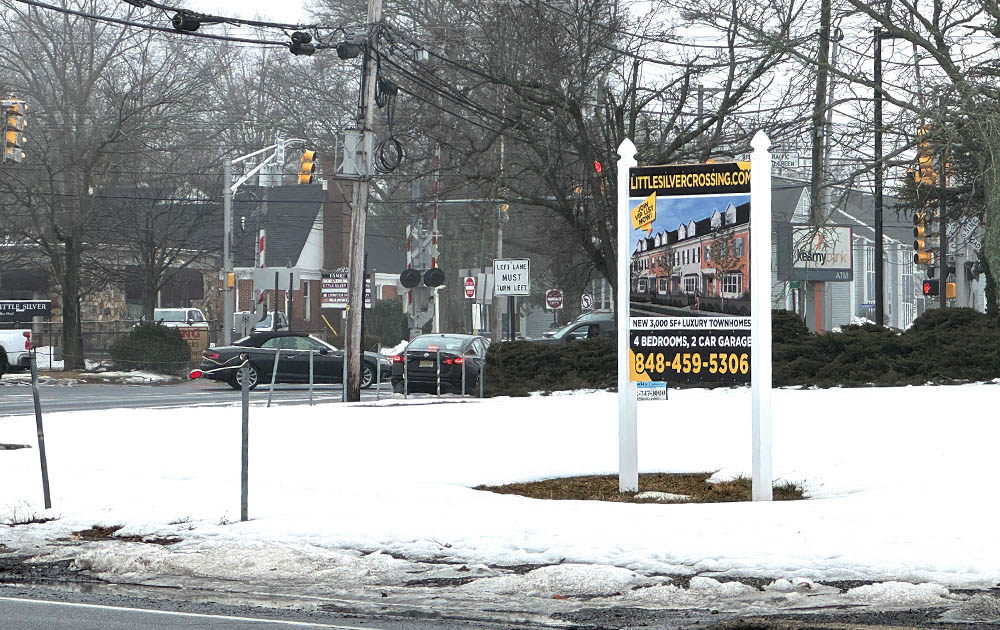
The nearly 1-acre property sits at the intersection of Willow Drive and Branch Avenue. The developer for the townhouse project, named Little Silver Crossing, will now follow planning board processes before construction can begin. According to an estimated timeline shared by Mayor Bob Neff at the Feb. 9 borough council meeting, construction could be expected by spring. The site currently displays a sign advertising occupancy in fall 2026.
The community will include three two-story buildings with a total of 13 townhomes, three of which will be designated as affordable housing. The remaining 10 market-rate units are planned as four-bedroom luxury townhomes, each with about 3,000 square feet of living space and a two-car garage.
The property is included in Little Silver’s fourth-round affordable housing plan, which must be submitted to the state by March 15.
In New Jersey, affordable housing obligations are recalculated every 10 years in cycles known as “rounds,” stemming from the Mount Laurel doctrine, a series of 1970s state Supreme Court rulings requiring municipalities to provide housing opportunities for low- and moderate-income residents. The fourth round, enforced by the New Jersey Department of Community Affairs, began July 2025 and runs through 2035. Towns that are compliant with state mandates are granted immunity from builder’s remedy lawsuits. If not, developers can sue municipalities that fail to meet their obligations and, if successful, override local zoning to build higher-density housing.
Little Silver’s fourth-round obligation totals 98 affordable units, which includes 25 new units to be constructed over the next decade and 73 units carried over from prior rounds, classified as the borough’s “unmet need.”
According to the borough’s plan, the 25 new units would come from several projects: eight units at Carriage Gate; six to seven townhomes by Habitat for Humanity at 43 Birch Ave.; four accessory apartments; and three units at 1 Sycamore Ave. Carriage Gate and the Birch Avenue project qualify for bonus credits – three and one units, respectively – bringing the total to 25.
To address its unmet need, the borough has adopted seven Inclusionary Housing Overlay (IHO) zones and plans to add an eighth along White Road.
At the Feb. 9 meeting, one of the existing IHO zones was replaced with a new Townhouse Zone for the 1 Sycamore Ave. property amid strong pushback from residents. The measure passed at this second reading after a public hearing.
The site is less than 500 feet from the train station and near commercial uses, single-family homes and the Carriage Gate inclusionary development. Borough officials said the developer approached the town seeking zoning that would permit additional density on the nearly 1-acre parcel. The property has no known environmental constraints and was previously developed for commercial and residential uses.
The new zoning permits 13 townhouses, with three units set aside as affordable housing – about 20% of the total – and the remaining 80% at market rate.
Neff and council members said the ordinance follows years of negotiations with the property owner, state housing officials and county engineers and represents the least disruptive option while preserving the borough’s immunity from lawsuits.
The objective of the zoning change “is to accommodate a development on that site, which has been vacant forever, and to assist the town in complying with affordable housing requirements,” Neff said.
Residents’ Concerns
Residents living near the site questioned both the borough’s approach to meeting its housing obligation and the rezoning’s potential impact on their neighborhood.
Several Willow Drive residents argued the proposed density and bulk standards are out of scale with surrounding homes.
John O’Hern, a resident, said he and his wife do not oppose development but believe the plan is too intense for the site. “Thirteen dwelling units on a parcel that is smaller than 1.1 acres is excessive,” he said.
O’Hern noted the new townhouse zone would allow 12.5 units per acre – about 42% denser than the nearby Carriage Gate development, which he said was built at 8.76 units per acre.
The density is “arbitrary and capricious,” O’Hern said, urging the council to reduce it to 9.5 units per acre and tighten limits on impervious and lot coverage. He submitted photos showing ponding on the property during recent storms and warned that additional pavement could worsen flooding.
“We do not need more paved surface,” he said. “Otherwise we’re approving a zoning ordinance that knowingly will flood our property.”
O’Hern also objected to a 13-foot minimum setback where other borough standards require 15- and 40-foot buffers between multifamily and residential lots, and criticized language that allows parking within 8 feet of his property line.
Residents also cited concerns about the loss of mature trees, traffic congestion and building height.
O’Hern asked officials to preserve two large trees on the property, including what he described as a 60-year-old American holly.
Natalie Scharmann, another resident, said the rear of her property is classified as wetlands by the New Jersey Department of Environmental Protection and already floods during storms.
“There is a lot of flooding back there, and that is a concern that I have with the buildings and the amount of impervious surface,” she said.
She also questioned whether townhouses up to 35 feet tall would dwarf nearby homes.
Traffic was another concern. Residents described backups along Willow Drive during school and commuter peak hours and difficulty turning near the train tracks.
“It seems like a safety hazard,” resident Eric Scharmann said of vehicles exiting the proposed development.
Officials Cite Constraints
Council members said they understand residents’ concerns but are constrained by state law and court rulings.
Councilmember Don Galante said the council has had to “push back” developers inquiring about five-story buildings. “We have to abide by legislative rules that have been put forth on us. We have to adapt and find compromises and solutions.” Galante said the borough faces “a hard deadline” of March 15 from the state. Borough officials have spent “hundreds of hours” over the last four months working with a judge to revise a plan that had been objected to. The result, he said, is a set of compromises that are “not what we wanted specifically for our community, but it’s close enough that we think we can tolerate it and gain that indemnity for the next 10 years so somebody doesn’t come in and build a five-story building.”
Neff said an earlier proposal from another developer at the same site at 1 Sycamore Ave. envisioned 36 units and taller buildings as part of a transit-oriented development concept, but that plan was rejected.
The current proposal is “not a perfect development,” he said, but one the borough believes it can accept while maintaining immunity from builder’s remedy lawsuits.
On drainage, officials said borough engineers reviewed and modified the developer’s stormwater plans, including on-site retention systems, to prevent worsening conditions.
Regarding traffic, officials said they are coordinating with the county, which controls the intersecting road and requires a two-way entrance. Restrictions such as limiting left turns during peak hours could be considered.
After more than an hour of public comment, the council adopted the ordinance. The developer will still have to go through the planning board for site plan approvals and the public will be able to participate in the process.
The article originally appeared in the February 26 – March 4, 2026 print edition of The Two River Times.