By Sunayana Prabhu
TRENTON – Gov. Mikie Sherrill’s proposed state school aid package for fiscal year 2027 rolled out a record $22.5 billion in funding for pre-K through 12th-grade education, an increase of $222.6 million over the previous year.
According to the budget summary posted on the state’s official website, the budget includes direct payments for pension and health benefits for educators, and is the “highest amount of school aid funding provided in New Jersey history.”
Monmouth County will see an overall 0.98% increase in aid figures, but many school districts, including some in the Two River area, are facing severe budget cuts despite the increases.
The proposed state aid for schools comes out of Sherrill’s $60.7 billion overall state budget plan, her first since taking office. The budget will now be reviewed by state lawmakers who may introduce legislation to negotiate the plan over the next few months during the budget approval process. A final draft of the negotiated budget will then be approved by the governor before July 1, which marks the start of the new fiscal year.
Out of the total state school aid, $12.43 billion is allocated for K-12 education, a 3.1% increase from the prior year, according to state figures.
The proposed budget includes $1.4 billion for preschools, $15 million to expand high-impact tutoring to more districts, and $33 million to provide new youth mental health services.
Following last year’s school funding formula, most state aid increases were capped at 6%, and aid cuts at 3%.
School Aid Figures
On March 12, the state Department of Education (DOE) released K-12 state aid figures for each public school district.
Districts in the Two River area that will receive the full 6% bump include Middletown Township; Henry Hudson Regional School, which serves both Highlands and Atlantic Highlands; Shrewsbury; Monmouth Regional, which serves Tinton Falls, Eatontown and Shrewsbury Township; Red Bank Regional, which serves Red Bank, Little Silver and Shrewsbury; and Tinton Falls School District. Oceanport is set to receive a 5.63% increase. Holmdel Township will see a more modest 1.46% increase in state aid.
On the other side of the ledger, several school districts in the area will have to absorb cuts. Red Bank, Fair Haven, Little Silver, Rumson, Rumson‑Fair Haven Regional and Monmouth Beach are listed among those facing the 3% cut in state aid. The Colts Neck school district is projected to lose 5.4% in aid.
“The budget includes a record level of K-12 school funding,” Sherrill said in the press release announcing the school aid figures. While acknowledging that “much more work is needed to make sure students and taxpayers get the best return on our investment. It lays the foundation for future improvements – like stronger academic and mental health outcomes, shared services, and more efficient spending – to better support children from birth through graduation and strengthen schools statewide.”
Education Commissioner Lily Laux supported the spending plan. “I look forward to continued conversations with stakeholders from across the state as we work to modernize and stabilize the school funding formula. Our core commitment remains: Funding will continue to follow students and their needs, a principle central to New Jersey’s education system,” Laux said in the release.
The budget plan also continues recent technical changes to the state’s school funding formula. Special education aid is now based on a district’s actual special education enrollment, rather than a statewide census‑based average. The state is using a three‑year average of property wealth and income to calculate the “local fair share” districts are expected to raise, an attempt to soften sharp cuts like the 19.59% aid cut that blindsided Red Bank Borough in 2024 after sudden changes in property valuation measures.
Shared Services and
District Consolidation
State Sen. Vin Gopal (D-11), who chairs the Senate Education Committee, has recommended modernizing the school funding formula, in addition to mandating shared services and regionalizing schools to reduce the financial challenges and expand services. “With significant uncertainty surrounding federal education dollars, school funding formula changes will provide much-needed stability to New Jersey’s school funding streams. No school should have to build a budget while uncertain about how much aid they will receive,” Gopal said in an email to The Two River Times.
Sherrill has encouraged shared services and district consolidation, arguing that New Jersey, with more than 600 school districts and 564 municipalities, can benefit from regionalization.
A school regionalization bill sponsored by Gopal was introduced Nov. 13, 2025, and referred to the Senate Education Committee, where it remains under review. Lawmakers have until the end of the current legislative session to advance or pass the measure. Since the ongoing state budget approval process is expected to dominate the agenda in the coming weeks, quick movement on the bill is unlikely, according to Gopal’s office.
Gopal also suggested a 10-year plan on shared services of contracts with neighboring districts. “If Hazlet, Middletown and Union Beach came together to do one healthcare broker and set the same plan for all their employees, taxpayers would save a lot of money,” he said. “With 600 plus districts – by mandating regionalizing costs such as healthcare, waste management, snow removal, IT, administrative costs, special education, mental health and so much more – we can save tens of millions for taxpayers while also improving the quality of education for our students.”
That idea remains controversial in some districts in Monmouth County and across the state, where officials strongly value local control. At the Jan. 7 Colts Neck reorganization meeting, board of education members pushed back against proposed consolidation.
Meanwhile, some efforts have succeeded, including the 2024 consolidation of Highlands and Atlantic Highlands schools into the Henry Hudson Regional School District, after voter approval.
Budget Challenges Remain
The budgetary caps on state aid were established by former Gov. Phil Murphy last year and renewed this year to cushion the blow of deeper reductions. According to the state, “These guardrails provide funding stability while the state undertakes the important, long-term work of modernizing the current formula to better reflect today’s educational needs and ensure a fair, sustainable approach to school funding in the coming year.”
Some elected officials have criticized the school funding formula, noting the budget caps do not erase underlying budget stress.
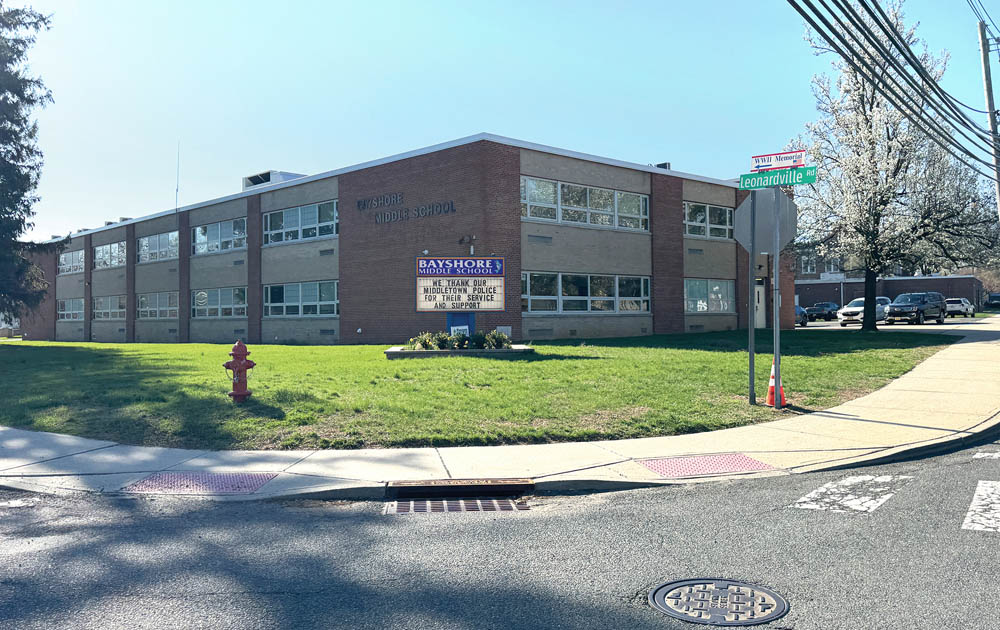
Middletown Township, for example, despite receiving a maximum 6% state aid boost, recently approved two elementary school closures and reassignment of middle school students from their existing building to two other middle schools nearby. The township’s BOE said it was necessary to control long‑term operating costs.
Some other districts getting a modest increase in state aid were already struggling to keep essential services, with rising special education costs, employee health insurance, transportation and contracted services costs outpacing new dollars.
Holmdel School District, for example, is considering at least 26 staff cuts, elimination of courtesy busing, and a potential 7% tax‑levy to meet high transportation and health benefits costs. The district received a moderate increase of 1.46% in state aid.
State Sen. Declan O’Scanlon (R-13), said the budget caps unfairly limit aid to districts that the formula says should receive more, while softening reductions for districts that long benefited from higher aid.
“Now that the formula would finally deliver long overdue increases to districts that were shortchanged, the State budget overrides the formula to artificially cap the aid increases that are rightfully due,” O’Scanlon said in a statement March 12, responding to the new figures. “At the same time, reductions to districts that received excessive aid remain limited to just 3%, protecting those massive, ill‑advised gains.”
He called the result “simply unfair” to communities that “have been carrying the burden for far too long” and vowed to “fight like hell for fairness” in the budget.
The article originally appeared in the April 9 – 15, 2026 print edition of The Two River Times.