By Emily Schopfer
MIDDLETOWN – Residents who live along Route 36 near Atlantic Highlands and along Newman Springs Road may have some additions to their scenic landscapes – a trio of 40-foot-tall LED billboards. A proposal for the billboards was put before the Middletown Planning Board at its June 3 meeting by New Jersey-based developer and real estate firm IAAT Services LLC.
The May 28 project proposal outlines three “40’-tall monopole, double-sided, multi-message Light Emitting Diode (LED)” billboards. The double-sided billboards would have a sign face of 378 square feet, cycling through imagery every eight seconds.
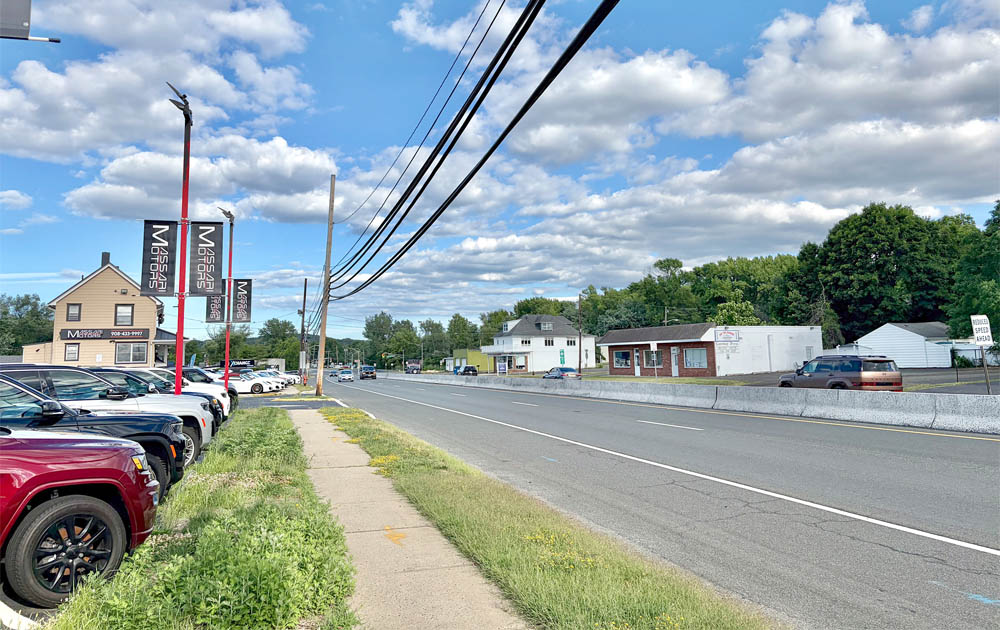
The locations for the billboards are 981 Highway 36, Middletown (bordering Atlantic Highlands) outside Massari Motors; 220 Highway 36, behind the Eastpointe Shopping Plaza; and 329 Newman Springs Road (CR 520) in the Lincroft section of Middletown, according to the planning board agenda.
The applications followed the April 8 adoption of Ordinance 2026-3502 by Middletown Township, which amended the township code governing billboards. The ordinance states that, since the last amendment in 2011, “there have been multiple developments in the law and changes in technology that make the current Township code provisions governing billboards outdated and insufficient.”
The project will not move forward until all three billboard applications for conditional use permits are heard at the July 1 Middletown Planning Board meeting, which is open to the public.
In 2025, IAAT Services LLC submitted an application for a 60-foot billboard in Raritan Borough, which was rejected. The company subsequently appealed the decision in a lawsuit that is ongoing.
Some Two River-area residents seemingly share the same concerns about the billboard as those in Raritan. Tom Stark, an Atlantic Highlands resident, is concerned the billboards could shine and flash in residents’ windows 24/7. If approved, the billboard located at 220 Highway 36 would be directly across the highway from his home. Stark is currently president of the association for his home at Buttermilk Ridge, a residential townhome community in Atlantic Highlands.
The Atlantic Highlands Planning Board did not respond to requests for comment about whether the borough was informed of the potential project.
Middletown Township administrator Tony Mercantante said the planning board “cannot have an opinion or position on the applications. It would be improper to form an opinion until all testimony and evidence has been heard and submitted,” he said.
But Stark said the billboards are “not appropriate for the area,” adding that he heard at the June 3 meeting that the signs would be visible from Highlands and Sandy Hook. “If you’re on the beach at Sandy Hook and you look up and see a sign flashing every 8 seconds, that’s not appropriate,” he said.
Potential Traffic Hazard
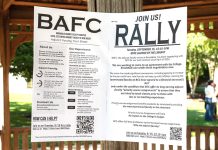
Melanie Elmiger, a Lincroft resident and member of the Lincroft Village Green Association (LVGA), feels these billboards are not just inappropriate, they’re dangerous.
“Our research has shown such a huge number of crashes in that area,” Elmiger said, referring to the 329 Newman Springs Road location.
During the June 3 meeting, Elmiger noted that civil engineer William Vogt Jr. said a driver could see these billboards from as far away as 250 to 750 feet.
At the next board meeting, when all three billboard applications will be on the agenda, Elmiger and the LVGA hope to raise concerns about car accidents on Route 520. This “high crash corridor” is already full of distracted driving, according to Elmiger, and yet the town may be adding something that is “deliberately trying to get your gaze to go up.”
She noted the proximity of the Newman Springs Road location to Garden State Parkway exit 109. “People are still hurting from 109 redevelopment,” Elmiger said.
“The public is getting disenfranchised, powerless,” and adding a billboard nearby will “add insult to injury.”
In May 2025, accidents along Route 520 became so frequent that Middletown Township intervened. After a string of accidents that included vehicle collisions, driver deaths, and pedestrian injuries, Middletown Township announced it would be converting the access road behind Acme into a two-way street, according to a May 2025 Two River Times article. At the time of the article, Middletown reported 66 motor vehicle crashes along Newman Springs Road in 2025 and 406 motor vehicle summonses in just a five-month period.
Even with this two-way street, the area is still a hot spot for accidents. This past March, 20-year-old Scott Sanczyk passed away from a fatal car accident near Exit 109.
On June 15, a 15-year-old boy riding an e-bike passed away from injuries sustained during a June 10 collision with a vehicle on Route 520.
Impact on Migrating Birds
The projects could also have impacts beyond potential light pollution and distracted driving. One possible environmental impact of the LED billboards could be on migrating birds.
“Bright light attracts birds, and that’s something we don’t fully understand,” said Brett Ewald, director of Cape May Bird Observatory, part of the New Jersey Audubon Society. Ewald said New Jersey has an “incredible amount” of nighttime migratory bird species.
New Jersey sits right in the middle of the Atlantic Flyway, a major north-south migration route, according to Ewald. “Sandy Hook has a funneling effect in the spring,” he said. “We’re talking millions and millions of birds, right in a major pathway.”
“Building lights, streetlights, billboards like this” can all pose a problem for these birds, Ewald said, since many species use cues from the night sky and stars as navigation tools.
First, the light usually emanates from man-made structures that birds can fly into, often resulting in their deaths from impact. Second, the light pulls birds off their natural migration course, disorienting them until they end up circling the area and burning through the fat storage they built up for migration.
The Lights Out Program, a natural initiative designed to minimize light pollution during spring and fall migrations, collaborates with building owners and managers and municipalities to turn off excess lighting during peak migration times.
Efforts like this are “at least something to help protect those birds,” Ewald said, adding that, while “migration is an ebb and flow,” there is “no day that there isn’t migration happening throughout the year.”
The only environmental report submitted with the proposal is a topographic survey that reviews the elevations and dimensions of the project area’s natural features and man-made structures, conducted in April 2025 by Lakeland Surveying.
The article originally appeared in the June 11 – 17, 2026 print edition of The Two River Times.