By Sunayana Prabhu
Parking woes in the Two River area are not new. But as New Jersey Transit (NJT) continues to monetize its train station parking lots, many customers are concerned about whether parking spots will remain affordable or even available at stations in the future.
Of the three train stations in the Two River area on the North Jersey Coast Line, Red Bank is one of the busiest and currently under NJT’s active redevelopment plan with developer Denholtz. Little Silver managed to dodge one redevelopment proposal for its train station parking lot a year ago, while Middletown stays largely untouched – for now.
The agency’s push to develop the land around its stations once reserved for commuter parking is part of its Transit-Oriented Development (TOD) strategy to generate non-fare revenue – as an economic boost and to alleviate the state’s affordable housing crisis. Several examples of this planned transformation are already visible at stations in Rahway, Matawan and Metropark, where mixed-use projects dominate the landscape.
Red Bank:
Parking Details Uncertain
In Red Bank, Denholtz has already presented site plans for part of the redevelopment of 6 acres of NJT property around the train station.
The first phase of the project, known as The Rail at Red Bank North, is a five-story, 175-unit, mixed-use building with 20% of the units set aside as affordable housing.
The project calls for structured parking decks with public parking in the basement and on the first floor and privately accessed parking for building residents on upper levels. Plans also include a kiosk at the parking garage entrance, along with retail space and other amenities, with additional parking planned throughout the site.
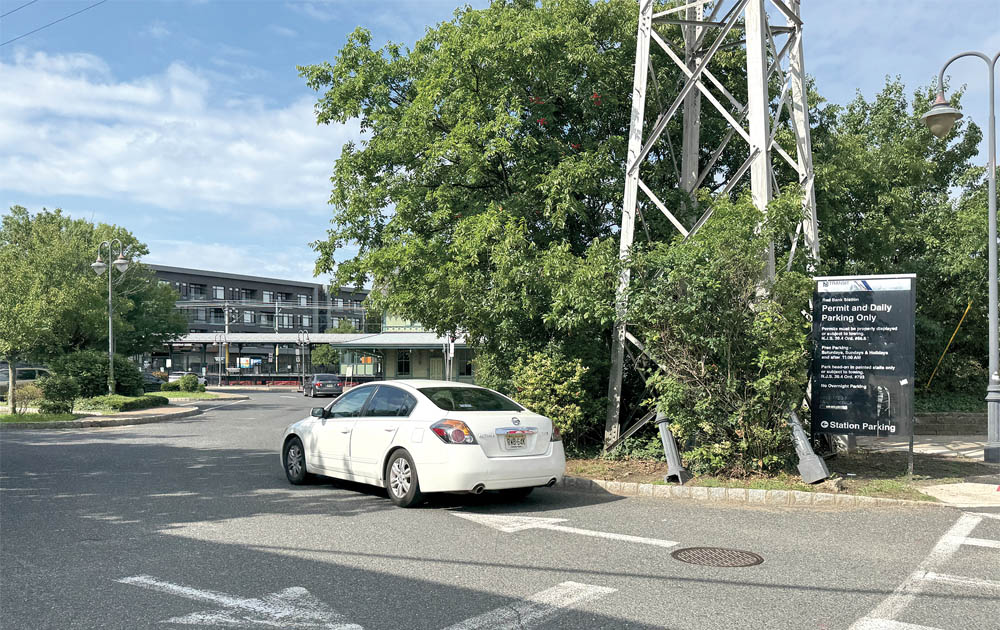
What remains unclear, though, is whether commuters will have enough or any free public parking once the project is complete. The lots currently require a permit or daily payment to park before 11 a.m. After 11 a.m., parking is free. Permit fees run to $1,000 annually; daily parking is available for $6, payable at a parking kiosk or by mobile phone app. Overnight parking is prohibited.
“We are still in the process of finalizing several details of the redevelopment, including revenue arrangements with NJ Transit and parking allocation,” Denholtz executive Steven Denholtz said in an emailed statement. “It is premature to speak to specifics at this stage, but we look forward to sharing more as those details are finalized.”
Red Bank borough administrator Jim Gant said the borough has no authority over the outcome. “We do not control the transit lots and do not receive revenue from them,” Gant said. “The parking garage proposed in the project would be owned by the property owner. Public parking has also been proposed in the plan.”
That is evident in Denholtz’s first phase site plans – but will it be free? That is “yet to be determined,” an NJT spokesperson said when asked how parking would function after the project’s completion.
The agency ensured “safe and convenient parking” remains a goal at all its facilities.
The Red Bank lot generated $128,750 in parking revenue in 2025, according to NJ Transit, which uses a third-party company to manage it.
Little Silver, Middletown:
No Guarantees
NJT confirmed there are currently no redevelopment plans for the parking lots at the Little Silver or Middletown stations. But recent history suggests those plans can shift quickly.
In Little Silver, Mayor Bob Neff said developer interest in the borough’s train station lot came up about a year ago, driven by joint interest from NJT and the state Economic Development Authority, which were exploring the sale of certain NJT properties for redevelopment, he said. At the time, borough officials pushed back.
Neff said they made clear the borough was not enthusiastic about “dozens of housing units on that property for a whole host of reasons.” He said the borough has since been told “the focus is no longer on Little Silver,” and has received no further proposals.
For now, the lot remains commuter parking. Little Silver manages it under a lease with NJT. NJT confirmed that “100% of the revenue goes to NJ Transit after expenses.” Daily parking costs $4, with six-month ($200) and annual permits ($360) also available.
Neff said ridership is rising, though it has not fully returned to pre-pandemic levels. To help cover costs, the borough leases some spaces to the nearby Mercedes-Benz dealership for vehicle storage.
In Middletown, there are two train station commuter lots – a large lot to the southwest of the tracks and a small one across from the Middletown Arts Center (MAC).
NJT owns roughly 4 acres of the station’s large parking lot, while the township owns about 6.8 acres of that lot. The smaller lot is entirely owned by the municipality, according to township administrator Tony Mercantante. Because most commuters park in the township-owned section closest to the station, NJT collects no revenue from the site, Mercantante said.
But parking there isn’t free. Commuters can buy an annual permit ($315) or pay a daily meter rate ($5); parking is free on weekends and township holidays. The township said it earns no profit from this arrangement; fees only offset maintenance and administration costs.
NJ Transit’s
Statewide Strategy
“The concept of using TOD to generate non-fare box revenue is not new to NJ Transit,” said Megan Massey, NJT’s director of Transit Friendly Planning, at the New Jersey Transit Planning Authority’s July 13 board of trustees meeting. “What is new is the broader acknowledgment of how we use our land has profound impacts on ridership, community vitality, access to housing, and economic opportunity.”
NJT established its TOD policy in 2023 to guide the development of walkable mixed-use communities around transit facilities. TOD is part of NJT’s L.A.N.D plan (Leveraging Assets for Non-farebox Dollars).
According to Massey, NJT’s projected revenue over a 30-year period from the L.A.N.D plan could rise to $1.9 billion in incremental agency revenue, up to $14 billion in statewide economic impact, and up to $1.6 billion in increased municipal revenues. The agency also estimates the plan could produce up to 20,000 new housing units, including 2,600 to 4,000 affordable units and create up to 50,000 jobs along with solar power and wetland restoration projects.
The article originally appeared in the August 6 – 12, 2026 print edition of The Two River Times.