Local and state initiatives emphasize the importance of mental health outreach for the upcoming school year
By Gianna Puglisi
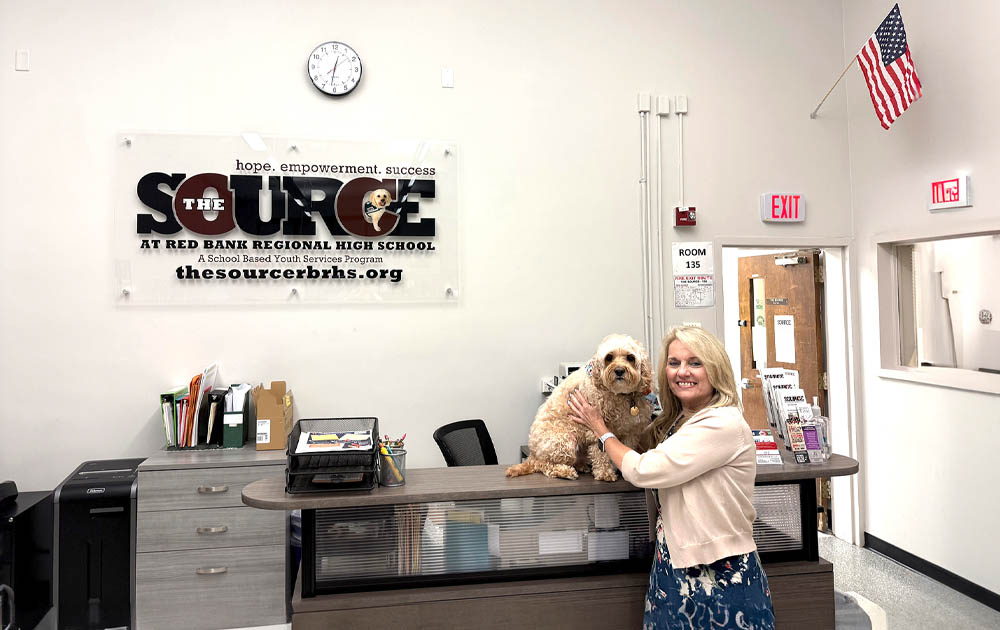
NEW JERSEY – Tucked among the classrooms and hallways of Red Bank Regional High School (RBR), an unassuming door waits to be opened. Behind it sits The Source, a free youth services program dedicated to the mental health and emotional well-being of RBR students.
Inside The Source’s space, which feels more like a community center and less like a school counseling office, there are motivational mantras, comfortable couches, a warm staff and Riley, the school’s service dog. In the program’s 27th year, it has established a trustworthy bond with students and RBR administrators for a paramount issue of adolescence: student mental health.
The program’s supervisor, Suzanne Keller, said a reward of working with students has been witnessing their growth.
“I’ve seen the evolution. It makes you so proud to see your students’ success,” she said. “So that’s what’s so rewarding for me, just to know that it made a difference in someone’s life, that our program has made a difference.”
The Source’s founder, Risa Clay, who worked as RBR’s student assistance counselor at the time (Clay is currently the mayor of Tinton Falls), had a “revolving door” of students in 1999 before she created the program, according to Keller. Soon after, Clay found a recurring statewide grant that could provide funding for a new staff and program. She also established The Source as a nonprofit organization that could raise its own funds. Keller credits that decision as the one that sets the program apart from others.
“That’s what makes my program so not just popular, but… rich,” Keller said. “We’re able to meet the needs of the staff, school and community, which is really our mission.”
Keller’s involvement with The Source dates back to 2004, when she interned with the program while completing her master’s degree in social work at Monmouth University. She had previously worked in sales and marketing and found that she could combine her skill sets at RBR. She interned again in 2005, before receiving a full-time offer in 2006 and rising to the role of supervisor in 2010.
Local partnerships with businesses, community programs and educational institutions help The Source thrive: Keller and the on-site clinicians often refer students struggling with food insecurity to Lunch Break, a social service organization based in Red Bank; after college financial aid paperwork became more complicated, Keller collaborated with a team from Brookdale Community College to ensure students stayed on track.
As part of their new partnership, Keller said Brookdale staff visit “four times a year now to work with the students to make sure they have all the paperwork that they need, and this year every single student got some form of financial aid.”
But Keller said the range of mental health issues present in the student body has shifted over time, and some triggers have to do with the expansion of the digital landscape. “Harassment, intimidation and bullying moved to an online presence,” she said. “I feel like kids can never retreat because, before all of this technology… maybe you were stressed out in school and you had so many things coming at you… but you could still go home and feel like you were safe.”
“Today, it never stops,” she said.
The Role of Technology
Going back to school in 2026 means something entirely different from what it did just three decades ago. Today, school-issued laptops are as prevalent as textbooks, and digital platforms dish out what used to be paper assignments.
The prevalence of social media can also promote harmful habits and encourage unhealthy behaviors. According to the National Library of Medicine, while social media can aid with socialization and human connection, “adolescents who spend excessive time on social media (more than three hours per day) are significantly more likely to experience mental health issues, particularly increased symptoms of anxiety and depression.” The article states that “the overuse of platforms like TikTok and Instagram has been linked to lower life satisfaction, compulsive behavior, and an increased risk of developing psychiatric symptoms.”
In a December 2025 ruling, Australian officials banned social media for children under 16. Most recently, the French government announced a similar mandate for children under 15, starting in September.
But, “You can find the positive in the negative in everything,” Keller said. “Students have support systems now. They can call 988 and chat with someone on the phone, which is a wonderful thing. They never had that in the past. They can also get online. They can meet people from all over the world.”
Keller said she thinks technology is a “good thing. I think we just need to establish good boundaries with it.”
New Jersey Solutions
While the negative offshoots of technology can certainly harm students, its positive advancements can also be the outreach needed to save them.
Take New Jersey’s first-of-its-kind partnership with Uwill, a digital platform offering mental health and wellness services. Forty-five institutions of higher education participate in the collaboration, providing college students with free, unlimited mental health support in conjunction with their existing school counseling centers.
Amaura Kemmerer, Uwill’s vice president for clinical success, said the idea for Uwill stemmed from trends observed in the early 2010s, when the demand for college counseling overwhelmed the offices that offered it. Uwill wanted to help.
“(Uwill’s) signature component is the teletherapy component,” Kemmerer said. “But we also have access to 24/7 crisis care, psychiatry, urgent medical care, basic needs support. So there’s a whole kind of complementary ecosystem, all on one platform for students.”
Kemmerer said that technological advancement has solved the issue of “immediacy of care” in many ways. Students on campus often have to wait to receive basic mental health services. Additionally, language barriers or poor patient-provider connection can cause even longer delays. Kemmerer said Uwill and its software “pulls away a lot of these existing barriers.”
Statewide, 25,000 students have received care and engaged in 114,000 therapy sessions with the help of Uwill. According to data provided by Kemmerer, 31% of sessions occurred outside a traditional treatment window (weekdays between 9 a.m. and 5 p.m.), and students utilized Uwill from 10 states and 20 countries during travel, study abroad and other international experiences.
This back-to-school season, it is important for students seeking help to recognize which habits may be harming them, but more importantly, the resources available to them that can help.
If you or someone you know needs support, call or text 988 to speak to a counselor. Visit 988lifeline.org for more information.
The article originally appeared in the August 13 – 19, 2026 print edition of The Two River Times.