By Jamie Jablonowski, MPH, BSN, RN, CPH
Monmouth County may have no shortage of beaches and boardwalks, but some of its communities lack a tool commonly used to prevent tooth decay: fluoridated drinking water. Across New Jersey, only 16.2% of residents receive fluoridated water from their tap. According to the New Jersey Dental Association (NJDA), as of 2022, New Jersey ranked 49th among the 50 states in the percentage of residents receiving fluoridated public water. In Monmouth County, access to fluoridated drinking water varies by community and water system: some areas receive it year-round, some seasonally and others not at all.
Cavities are among the most common chronic dental conditions, yet they often go untreated. According to the Centers for Disease Control and Prevention (CDC), half of children ages 6 to 9 have had cavities in their baby or adult teeth. Among adolescents ages 12 to 19, 10% have at least one untreated cavity, while 21% of adults ages 20 to 64 have untreated cavities.
The American Dental Association (ADA) states that fluoridation of community water is the single most effective public health measure to prevent tooth decay and recent studies have shown that water fluoridation is effective in preventing at least 25% of tooth decay in children and adults.
So what does that mean if you have access to fluoridated water – and what does it mean if you don’t?
How Cavities Happen
Bacteria love cookies and cake as much as we do. When you eat sugary or starchy food and it remains on your teeth, bacteria begin feeding off it, forming a sticky film called plaque. Plaque that stays on your teeth and hardens becomes tartar. The acids from the bacteria remove minerals in your tooth’s enamel and these erosions are the first stages of cavities and can eventually progress into tooth decay.
The Role of Fluoride
“Fluoride has been proven to protect against cavities and when we remove that layer of protection, we increase that risk of decay,” Kristianne Macaraeg, D.M.D., a board-certified pediatric dentist and owner of Surfside Smile Co. Pediatric Dentistry & Orthodontics in Middletown, explained. She described how fluoride works topically through dental products containing fluoride, like toothpaste, and systemically through consumption in food and water. “Fluoride in over-the-counter products such as toothpaste and mouthwashes you can think about as fluoride-in-action as soon as it touches the tooth,” she said. “Fluoride in drinking water coats the teeth as soon as we sip, but when it gets incorporated into our system, we release fluoride through our saliva to constantly protect the teeth as well.”
Fluoride in the Water
According to the CDC, water fluoridation plays a pivotal role in cavity prevention in the U.S. It’s considered a cost-effective, practical way to reach communities, regardless of socioeconomic status. The CDC named community water fluoridation one of the 10 great public health achievements of the 20th century, citing the dramatic decline in cavities since community water fluoridation began in 1945.
Fluoride is a naturally occurring mineral found in soil, plants and water. The recommended fluoride concentration in community drinking water is 0.7 milligrams per liter (mg/L), often higher than naturally occurring fluoride concentrations. In New Jersey, local governments decide whether to add fluoride to the water on a community-by-community basis.
How to Prevent Cavities Without
Fluoridated Water
For people whose water isn’t fluoridated, other preventive measures become especially important. For adults, the CDC recommends visiting the dentist at least once a year, brushing twice a day with fluoride toothpaste and flossing daily. According to the ADA, individuals should generally brush their teeth for two minutes twice a day with a toothbrush that has soft bristles. Replace toothbrushes every three to four months or sooner if the bristles are visibly matted or frayed. Both manual and electric toothbrushes work well.
Special Considerations for
Children and Babies
Because babies and children are still developing their adult teeth, fluoride exposure requires special attention. “At least 40% of kids will have their first cavity by kindergarten,” Macaraeg said. “Kids love to snack, they are not always the easiest to brush, and the enamel of baby teeth is much thinner than that of an adult. This is where fluoride comes into play.”
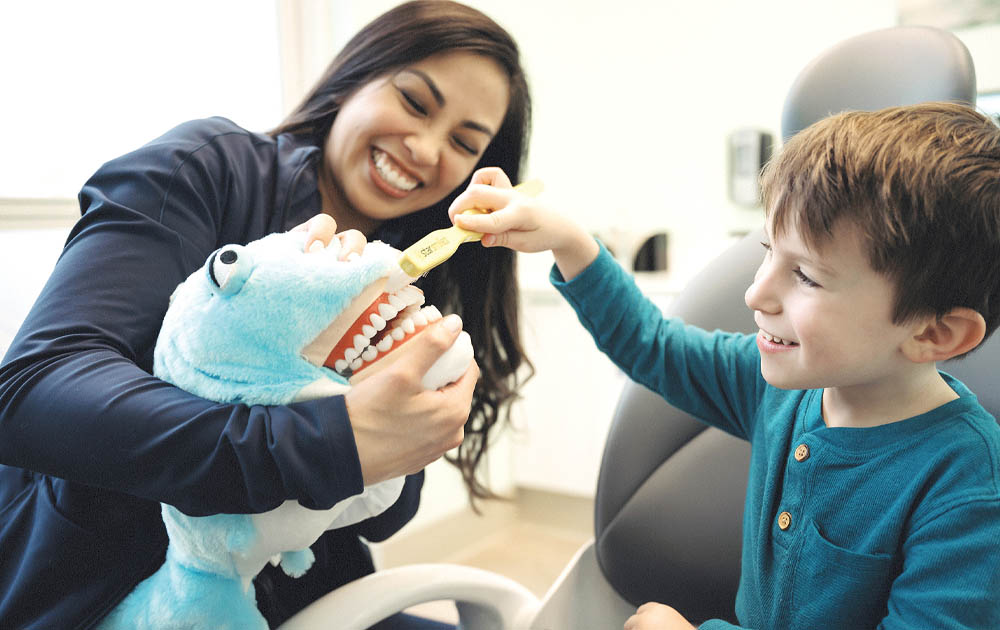
Macaraeg advises parents to start brushing their kids’ teeth with fluoride toothpaste as soon as the first tooth appears. “For children under three, we recommend a tiny smear or rice-grained-sized amount of fluoride toothpaste, and for those over 3 years old who are able to spit, we recommend the use of a pea-sized amount of fluoride toothpaste.”
For babies, the CDC recommends the following:
• Wipe gums twice a day with a soft, clean cloth in the morning after the first feeding and right before bed to wipe away bacteria and sugars that can cause cavities.
• When teeth come in, start brushing twice a day with a soft, small-bristled toothbrush and plain water.
• Take your baby to the dentist by their first birthday to catch problems early.
• Talk to your dentist or doctor about putting fluoride varnish on your child’s teeth as soon as the first tooth appears.
• For children under 2, consult a doctor or dentist about fluoride toothpaste.
For children, the CDC recommends brushing their teeth twice a day with fluoride toothpaste. Help your child brush their teeth until they have good brushing skills. If your child is younger than 6, watch them brush. Make sure they use a pea-sized amount of toothpaste and always spit it out instead of swallowing it. Ask your child’s dentist to apply dental sealants or fluoride varnish when appropriate.
Too Much Fluoride
Fluorosis is a cosmetic condition that occurs due to excessive fluoride consumption during early childhood tooth development. “When a child is exposed to too much fluoride, the concern is fluorosis and these can be seen as white spots on the teeth,” Macaraeg said. “Mild to moderate fluorosis is mainly an aesthetic concern and is the most common when it comes to excessive fluoride exposure.”
Regarding extremely high levels of fluoride exposure, Macaraeg said, “the levels of fluoride at which we recommend usage and ingestion are far below the levels of toxicity.”
Are There Fluoride-Free
Alternatives?
The ADA recognizes several non-fluoride approaches that may help reduce the risk of tooth decay, including sugar-free chewing gum and certain professionally applied treatments. However, these strategies are meant to complement, not replace, established cavity-prevention measures.
Macaraeg has noticed increased fluoride hesitancy. “When families come to my office for visits, what I find is that families are getting confused about the information they are seeing and genuinely just need more education on it,” she said. “Fluoride use is a personal choice, and of course as a pediatric dentist, I recommend using it, but for families who choose to stay fluoride-free, we discuss and stress other factors, such as diet and hygiene, that may need to be stricter to accommodate staying fluoride-free.”
How to Check if Your Town has
Fluoridated Water
To see whether your municipality’s water is fluoridated, identify the public water supplier serving your home. Visit the New Jersey Department of Environmental Protection website at dep.nj.gov and access the DataMiner page by clicking on the Information Tools tab. Once there, select Search by Category and enter “fluoride” in the Keyword search. Follow the prompts to select your county and municipality. Note that because fluoride is naturally occurring, it is likely to be present in most water sources. If fluoride is added to water, it will be close to the recommended 0.7 mg/L. You can also contact your water supplier directly to ask whether fluoride is added to your drinking water.
For further questions regarding fluoride, visit your favorite local dentist.
The article originally appeared in the October 1 – 7, 2026 print edition of The Two River Times.