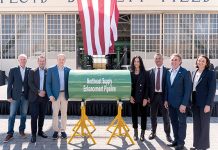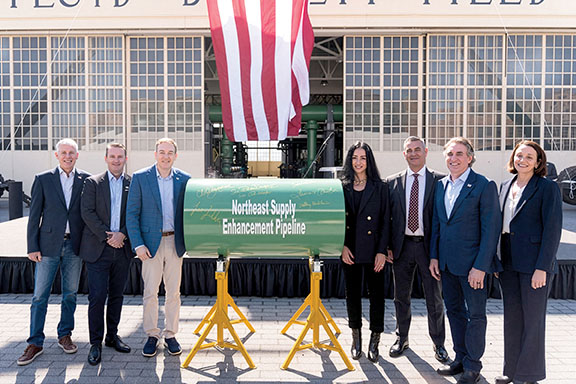
Williams/Transco held a ceremonial groundbreaking for the Northeast Supply Enhancement (NESE) pipeline April 14 in Brooklyn. Now, five months later, the U.S. Court of Appeals for the Third Circuit has revoked a vital New Jersey water quality permit the pipeline needs to continue. COURTESY WILLIAMS COMPANIES
By Emily Schopfer
NEW JERSEY – The infamous “zombie pipeline” is back in its grave – at least for now. The U.S. Court of Appeals for the Third Circuit vacated the Williams/ Transco Northeast Supply Enhancement (NESE) pipeline’s water quality certification in a Sept. 8 ruling. The New Jersey Department of Environmental Protection (NJDEP) issued the permit to Transco in November 2025. The same month, six organizations filed a lawsuit challenging the decision – a lawsuit that brought the pipeline in front of the appeals court.
The NESE project is an over-$1 billion, 23.4-mile fracked natural gas pipeline that expands an existing pipeline system owned by Transco (Transcontinental Gas Pipeline Company) and Williams Companies Inc. The expanded pipeline would stretch from Lancaster County, Pennsylvania, through New Jersey’s Middlesex and Monmouth counties, up to New York City. More than nine miles of the pipeline would run under the Raritan Bay, the New York Harbor and Cheesequake Creek tributary tidelands. A compressor station is also planned for Franklin Township in Somerset County.
“Under federal law, agency action is arbitrary and capricious when it fails to examine the relevant data and articulate a satisfactory explanation for its action, including a rational connection between the facts found and the choice made,” Judge Jane Roth said in the unanimous court decision finalized Sept. 8.
The ruling said NJDEP documents “do not adequately explain its conclusion that Transco’s dredging will comply with New Jersey’s water quality standards.”
“Technical expertise does not relieve an agency of its obligation to articulate the basis for its decision,” the ruling said.
“NJDEP’s explanation falls short.”
This ruling resolved the Nov. 18, 2025, lawsuit against the NJ-DEP and Transco challenging the water quality permits. Petitioners included NY/NJ Baykeeper, Princeton Manor Homeowners Association, Central Jersey Safe Energy Coalition, Food & Water Watch, New Jersey League of Conservation Voters Education Fund, and the Sierra Club. The Eastern Environmental Law Center (EELC) represented all petitioners.
Christopher Miller, EELC’s executive director, said the EELC was “very pleased” with the ruling. While the decision puts a red light on all construction within Raritan Bay, the question remains what this means for construction on land.
In an April 14, 2026, news release, Williams said it held a ceremonial groundbreaking for the project that day at Floyd Bennett Field in Brooklyn. Miller said he is “not aware of any actual in-the-ground activity advancing NESE.”
The question of what the ruling means for construction outside of the bay is one “we’re all trying to find the answers to,” Cindy Zipf, executive director of Clean Ocean Action, said.
But to proceed with work in Raritan Bay, Transco would need to reapply and undergo a new review process with the NJDEP – for the seventh time. The NJDEP has denied six applications since 2017, earning NESE the “zombie pipeline” nickname.
Despite repeated rejections, active lawsuits and public protest, the Sierra Club noted that the NJ-DEP granted water quality permits for NESE Nov. 7, 2025. “On the same day last year, the NY State Department of Environmental Conservation (NYSDEC) also granted the project their permits,” the club said.
Several months later, the Tide- lands Resource Council (NJTRC), a division of the NJDEP, granted the pipeline a utility license. Three days after the July 17 license signing, the Long-Branch-based non-profit Clean Ocean Action (COA) filed a lawsuit in New Jersey, seeking to appeal that approval. According to Zipf, the reversal of the water quality permit poses an interesting development for COA’s active lawsuit, as the utility license was granted to NESE on the basis that the project had necessary water quality permits.
While there are no updates to COA’s lawsuit, the organization is pleased with the “great” news regarding the water quality permit. Zipf said she and COA are “so thrilled that finally judges looked at the facts and saw them for what they were.” Zipf is “deeply grateful to the lawyers that defended the environment.”
“The legal system prevailed,” Kin Gee, President of CHARGE (Consumers Helping Affect Regulation of Gas & Electric, said. “Arguments we’ve been making have been heard; it’s amazing.”
“We applauded the decision.”
Like COA, CHARGE was not one of the petitioners in the November 2025 lawsuit. However, CHARGE is part of a coalition of nonprofits, along with COA, that has been opposed to NESE from the start. The coalition most recently organized a March 25 press conference in Atlantic Highlands.
Gee was “pleasantly surprised” at the Sept. 8 ruling, adding that the courts “should be commended.” But Gee said he and his organization believe the utility license was “still incorrectly approved.” NESE, or the “pipeline to nowhere” as Gee called it, serves no public interest or need for New Jersey, and is a “private venture by a for-profit energy company,” he said.
“There are two fronts,” Gee said.
“One is the court of public opinion, and two is the legal basis.” In the court of public opinion, the pipeline has faced controversy since its beginning. Local officials, nonprofit organizations and members of the public have expressed concerns regarding both environmental repercussions and public health impacts. Another argument is that the pipeline only benefits New York, while New Jersey gains nothing and is left with all the downsides.
“The NESE pipeline project is a danger to our waterways and our communities and will lead to massive amounts of new fracking and climate pollution,” Matt Smith, New Jersey state director at Food & Water Watch, said. “We are pleased to see the Third Circuit Court of Appeals has reversed the unjustifiable approval of the water quality certification. We’ll keep fighting for clean water, clean air, and a livable climate and will continue to oppose this dirty gas pipeline until we win once and for all.”
“They’re going to be back,” Zipf said of Transco, but “the public will certainly be ready.” In May 2024, the project was “literally dead in the water,” Zipf said, when a key Federal Energy Regulatory Commission (FERC) construction application extension expired. But the project resurfaced and has had “more chances at life than a cat,” she said. “That’s the problem with the environment,” Zipf said, “It’s never really over.”
“I think a lot of us would be very surprised if they did not come back,” Greg Remaud, deputy director of NY/NJ Baykeeper, a petitioner in the case, said. “This process has been so jaded,” and has been “transparently politically fixed,” with the politics in Williams/Transco’s favor, he said.
Remaud has mixed feelings over the ruling. “Normally you have a sense” about the court’s decision, he said. “This was a flip of the coin.”
While happy with the Sept. 8 outcome, Remaud said the ruling is a delay, not a complete win over NESE. The delay, however, “gives the chance for folks to put pressure on Gov. Sherrill,” Remaud said. This is a “great chance for her to step up” and “stand up here for what’s right for New Jersey.”
This article originally appeared in the October 1-7, 2026 print edition of The Two River Times.