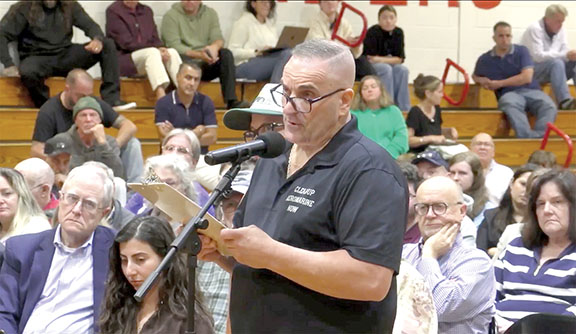
At a Sept. 22 meeting at Keyport High School, residents questioned officials from the New Jersey Department of Environmental Protection over past oversight of the Aeromarine site. COURTESY KEYPORT BOROUGH VIA FACEBOOK
By Sunayana Prabhu
KEYPORT – Residents near the Aeromarine industrial site and adjacent landfill were furious after state officials said at a recent meeting that the contaminants found at the sites were not impacting the health of neighboring communities.
“We’re nearing 500 reported cancer cases within our community. This unmonitored site is marked for redevelopment. This isn’t a mistake. It’s a pattern the DEP repeated in 1990, ’97, 2004, 2010 and now,” Tiffany Busby, one of the many enraged Keyport residents, said at a Sept. 22 public meeting at Keyport High School.
After nearly five months of environmental investigation, the New Jersey Department of Environmental Protection (NJDEP) presented its findings at the meeting, along with the federal Environmental Protection Agency (EPA), the state Department of Health and two environmental consulting firms.
Investigators examined samples from 13 sites in Keyport and three in Union Beach, as well as the Aeromarine industrial site and the former landfill. The NJDEP’s goal was to determine what contaminants exist, at what concentrations, and whether people could be exposed to them at levels that would affect their health.
Three parties conducted these investigations: SESI Consulting Engineers, hired by the prospective buyer Pacer Realty, examined the landfill and portions of the industrial property; Excel Environmental, hired by the township, investigated the industrial property; and the NJDEP sampled the landfill, residential areas, the nearby Raritan Bay and Chingarora Creek and reviewed existing records.
NJDEP Commissioner Ed Potosnak said the combined testing examined three sources – drinking water, vapor intrusion and surface water – that could carry contaminants into nearby homes and businesses. He said their investigation had “not found any indication that contamination from the Aeromarine site, which includes the landfill, is impacting the surrounding neighborhoods.”
DRINKING WATER
“People are not being exposed through drinking water,” Potosnak said. Although he reported contamination in shallow groundwater at the landfill, including some results above standards, he said that water is not used for drinking. “Residents and businesses are using municipal water supply that comes from a confined aquifer,” he said. “That means it’s under a layer of silt where the contaminants can’t be transferred, and that water is regularly monitored to meet strict state and federal standards.”
VAPOR INTRUSION
Next, experts wanted to see if soil gas levels from the landfill were high enough to cause vapor intrusion. Vapor intrusion occurs when gases from contaminated soil or groundwater seep through cracks and holes in the foundation and accumulate in basements, crawl spaces and living spaces.
In sampled Keyport residential areas, Potosnak said test results did not exceed vapor intrusion screening levels. Results from three Union Beach locations were “inconclusive,” Potosnak said. Experts said benzene was detected in all three soil-gas samples, with two above screening levels. The NJDEP will be conducting additional sampling in October.
At the Aeromarine industrial park, which is currently being rented out to small businesses, groundwater occurs about 4 to 7 feet below grade, Laura Dodge, president of Excel Environmental, said. She reported no volatile organic compounds in groundwater at levels exceeding vapor intrusion screening thresholds.
Excel detected several PFOS compounds in groundwater at the site but said higher concentrations were found on the “upgradient” or higher side of the property, adding that the results did not indicate the compounds originated there.
SESI and DEP also reported contaminants in the landfill groundwater but said the results did not show a vapor intrusion pathway to nearby homes.
SURFACE WATER
In water samples from Raritan Bay, Chingarora Creek and other rivers in the area, the NJDEP found contaminants such as manganese, lead, copper, arsenic, pesticides and compounds associated with combustion and runoff. But Potosnak said, “They were likely being carried by storm water runoff from diffused sources, not particularly attributable to the Aeromarine site or the Keyport Sanitary Landfill.”
Arsenic exceeded standards in both stream and harbor sites but, according to the NJDEP, those results aren’t inconsistent with values in other parts of the surrounding watersheds and Raritan Bay. “Arsenic is naturally formed in the grounds here,” Potosnak noted.
While the focus of the testing has been the Aeromarine site and the landfill, he said “there could be other places where contamination is coming from.” He added that the owner, Bay Ridge Realty, is responsible for properly closing the sites. According to the NJDEP, four enforcement orders involving the site are pending before an administrative law judge.
Justin Protasiewicz, from SESI, identified ammonia, metals, benzene, PFOS (forever chemicals) and dioxane, among others, in the landfill groundwater but said they “did not find anything that was out of the ordinary.”
While they “didn’t find any direct exposure pathways to adjacent residences,” Protasiewicz said the areas “are going to need to remediate as part of future remediation at the site.”
PUBLIC COMMENTS
Tension in the room only grew after the conclusions were delivered. Residents questioned the agencies’ past oversight and challenged the sampling methods. Sever- al said they had lost relatives to cancer or were living with serious illnesses.
Resident Nicole Hen, whose child survived cancer, also asked why earlier soil gas findings had not required the NJDEP to test vapor intrusion in nearby homes. She particularly noted a 2010 investigation by Excel Environmental for the borough that found known carcinogens benzene and vinyl chloride on site up to 120 times the state’s acceptable levels.
Dodge, of Excel Environmental, said the 2010 readings were from inside the landfill and did not show a pathway to residences. She explained that the current data showed groundwater flowing in patterns that did not indicate contamination was migrating from the landfill toward homes.
The investigation results covered exposure pathways but still do not explain the reported cancer cases, one area congressman said. “I still don’t have answers from the state health department as to whether or not the level of cancer, in other words, the number of people that have cancer, is out of the ordinary,” said U.S. Rep. Frank Pallone Jr. (D-6).
The health assessment, additional Union Beach sampling, and an EPA review are expected in the next few months.
“People are dying. We’re waiting too long for the board of health to come help us,” resident Salvatore Ligouri Jr. said. Ligouri lives next to the Aeromarine industrial site. He lost one of his sons to cancer and was recently diagnosed with leukemia.
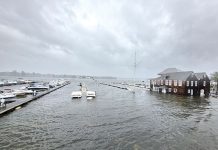
The nearly 60-acre property, owned by Bay Ridge Realty Co. since 1966, was once home to Aeromarine, a seaplane builder and airline operating to the Caribbean. The plant closed in 1937. About two-thirds of the site is a defunct landfill with a half-mile of Raritan Bay shoreline, while the remaining third houses a small industrial park. The NJDEP ordered the landfill closed in 1979, but the state has acknowledged it was not properly capped or remediated. The site has been through decades of environmental testing from state, municipal and private agencies as part of potential redevelopment but no projects have come to fruition. The owner has not yet paid fines of over $1 million issued by the NJDEP. Since August 2025, Pacer Realty, a prospective buyer of the site, has been looking to redevelop it and has said it will fund a full closure and long-term environmental controls there.
This article originally appeared in the October 1-7, 2026 print edition of The Two River Times.