By Alli Tretina
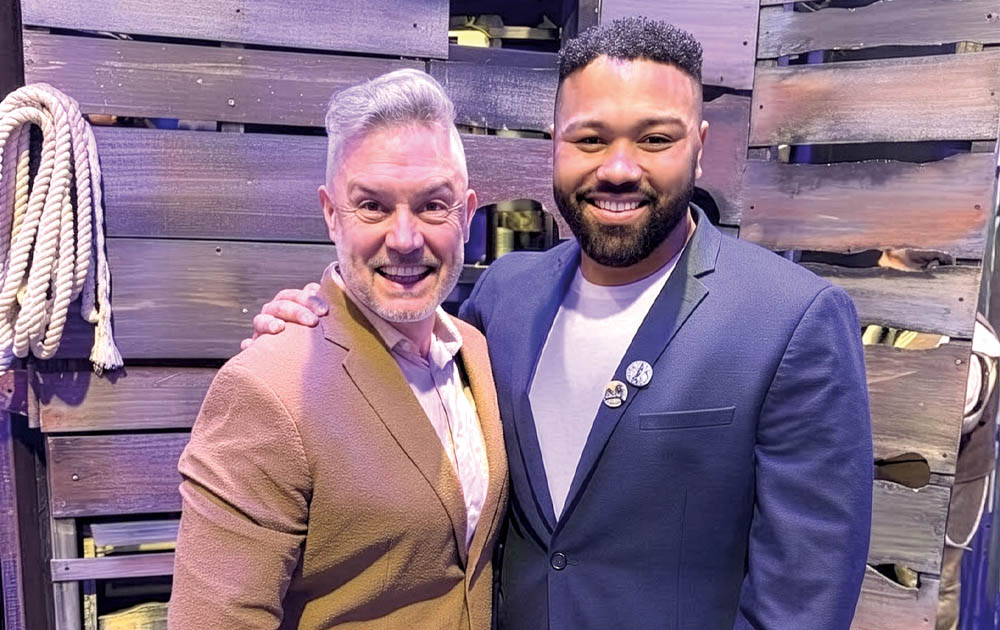
RED BANK – Twenty years after a shy 15-year-old walked into a Phoenix Productions rehearsal feeling out of place, that now 35-year-old directed the community theater company’s mainstage production of “Pirates! The Penzance Musical,” working alongside the man who first cast him.
Last weekend Anthony Viera and James Grausam, now managing artistic director of Phoenix Productions, the Count Basie Center for the Arts’ community theater company, were back on the same team – Viera as director, Grausam as choreographer – for a jazz-infused reimagining of Gilbert and Sullivan’s “The Pirates of Penzance,” reset in 19th-century New Orleans, at the Basie’s Hackensack Meridian Health Theatre.
Their first show together was “Fiddler on the Roof” in 2007.
“Coming here, I was super nervous. I felt kind of out of place,” Viera said of joining Phoenix as a high school freshman. “But that quickly changed because of the community Phoenix created even then, and even more so now.”
He estimates he has appeared in or worked on about 20 Phoenix productions since then. What began as a hobby became a second career. Viera works in business-to-business marketing for cybersecurity companies.
At Phoenix, he has served as a performer, assistant director, production manager and director. Last season he was assistant director for the company’s production of “Fiddler on the Roof.” In the spring, he directed the musical “Ain’t Misbehavin’ ” at The Vogel, which was nominated for an NJACT Perry Award for outstanding production of a musical. This is Viera’s second nomination in that category; he was a producer of “The Color Purple” in 2025.
“Theater has a special way of creating a world for you,” he said. “It’s a place where people can be expressive and feel like they belong despite their differences. I considered it a home even at that age.”
Diversity Making Art Better
Grausam recalled the teenager who arrived eager, quiet and determined.
“I remember a kid who was really, really eager to get it right. Quiet, shy, but had just the biggest heart,” Grausam said. “Every time he would come back for another show, I was delighted to see him.”
Grausam said he cast Viera in that first “Fiddler” because he worked hard and danced well enough to balance bottles on his head. After strike (removing a stage set after a production has ended), Viera asked why he had been cast; he did not look like the other villagers of Anatevka.
“I don’t even remember what I said,” Grausam said. “But I was so taken aback. That permanently imprinted in my brain and has guided me the rest of my career. My job is to make opportunities for everybody.”
Grausam said he didn’t initially see a future for Viera in professional theater. That changed after Viera returned from college.
“He spent a lot of his youth looking for approval, and that’s not the sign of a future theater professional,” Grausam said. “Theater professionals have that internal confidence. When he came back after college, I said, OK. That’s when I started seeing how he could stick around.”
A Confidence for Comedy
The turning point, Grausam said, came after COVID-19, when the company was rebuilding its season. Viera arrived with a notebook proposing a Christmas show: director’s notes, set and costume ideas, a sample of how he would talk to an actor.
“A lot of people say they want to direct,” Grausam said. “It’s not just telling people where to stand. There’s a teaching component. There’s a psychologist. In that moment I went, he’s ready.”
Viera said nearly everything he knows about theater comes from Grausam.
“I still very much lean on him,” Viera said. “He knows everything about theater. Him being able to push me and challenge me has been a great gift.”
The lesson that stuck, Viera said, is to trust the process.
“I struggle with rushing to the finish line,” he said. “We’re a band of people that have lives outside of here. You have to allow people to arrive at your vision at different points. For some people, that might be opening night, and you have to be OK with that.”
Grausam chose “Pirates” as Viera’s first mainstage musical because he had already succeeded as a leading performer, assistant director and director of a play. Comedy, Grausam said, would stretch him.
“Everyone thinks they can do the drama. Drama’s easy,” Grausam said. “This is a show I’m very passionate about. It’s not the old-school version. It’s a modernized retelling set in New Orleans with some jazz. It’s purposefully multiethnic. It’s about inclusivity, which is something we’re both very passionate about. What better way to say, you tackled the small space, let’s go to the big space, and I’m going to be right there with you.”
Grausam downplayed the dancing in rehearsal. Viera said Grausam would not even call it choreography. The production, they agreed, was built for singers.
“If they’re a singer, we’re happy to have them on stage,” Grausam said. “We’re happy to move them around.”
Asked what Viera brought to the production that was uniquely his, Grausam returned to the 15-year-old’s heart.
“He genuinely cares – not just about the production, but the entire production team, all of the actors, the quality and the Phoenix name,” Grausam said. “He knows he’s part of the legacy of Phoenix.”
Becoming a Director
What makes him proudest, Grausam said, is Viera’s ability to see what actors are capable of, not only what they are doing. “That’s the hardest thing for a director,” he said. “It’s a really advanced skill, and he has that because of how much he cares.”
Viera said Phoenix gave him more than stage time. The work, he said, also changed how he shows up at his day job.
“Doing art, you’re super vulnerable,” he said. “For me, it’s only helped grow my confidence. The way I show up as an employee has been affected because of my time here, being able to lead a room and see a project all the way through.”
If he could speak to that 15-year-old before the first rehearsal, Viera said, he would tell him to calm down and be a sponge.
“I spent a lot of my youth and even my 20s worrying about what people think,” he said.
“Live your life the way you want and everything else will fall into place.”
Viera and Grausam still talk about “Fiddler.” They still dissect obscure off-Broadway plays while everyone else in the room changes the subject. In rehearsal they could stand at opposite ends of the house, watch the same beat and know what the other was thinking with a look.
“That’s 20 years,” Grausam said.
Belonging, Viera said, means safety: room to be who you are, to make mistakes and to be bold. He sees the cycle starting again in a 16-year-old lead in the company, Sean Sciarillo, who played Frederic.
“I said, you remind me of myself,” Viera said. “That’s the goal, to create a place where people can be crazy and fun and enjoy themselves and learn something.”
Grausam added one word to that goal: empowerment.
“Feeling safe, but also feeling the conditions are right that I’m allowed to do it,” he said. “Trusted enough to step up and put a bottle on my head and not let it fall off.”
The article originally appeared in the October 8 – 14, 2026 print edition of The Two River Times.