By Sunayana Prabhu
FORT MONMOUTH – Switching from Fort Monmouth’s existing electrical power grid to Jersey Central Power & Light’s (JCP&L) grid may cost East Gate homeowners up to $20,000 per unit, they say. The Borough of Oceanport also faces nearly $350,000 in transition costs to connect borough offices to JCP&L’s new distribution system.
“I don’t just have $20,000 sitting on my kitchen counter to pay for this stuff,” a resident of East Gate, who asked not to be named, told The Two River Times.
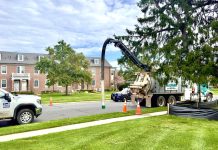
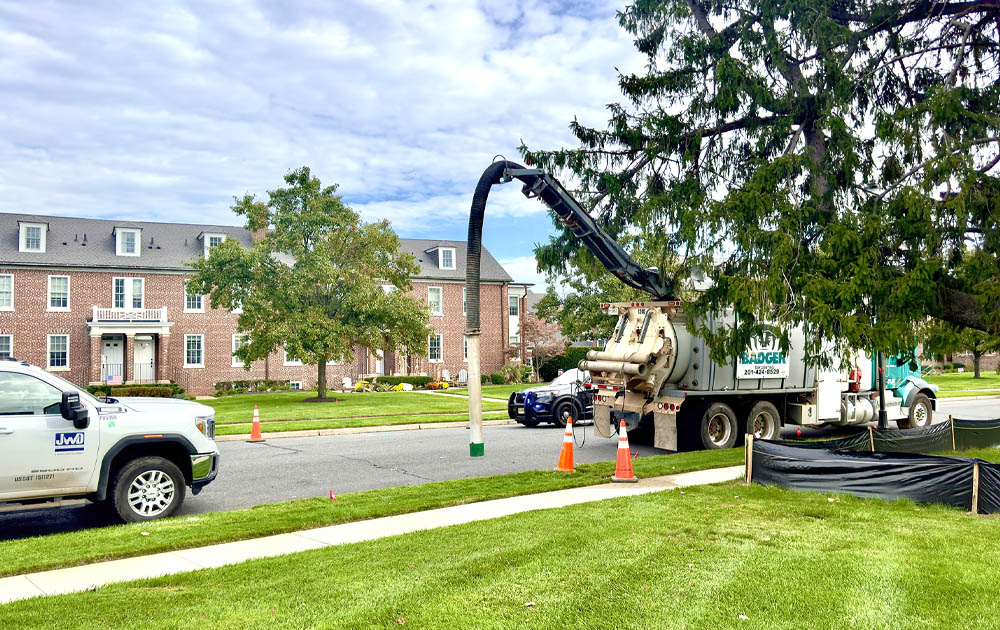
JCP&L is replacing the transformers that serve the East Gate community to match the voltage at which its system operates. The company is also requiring new service lines be installed from these transformers to each unit’s meter.
According to the resident, East Gate’s homeowners’ association (HOA) has received contract bids from two private electricians to connect underground power cables from the units to the JCP&L’s new system. HOA meeting documents from Oct. 6 show current bids range from about $700,000 to $830,000, which means each homeowner could be on the hook for $15,000 to $20,000.
“The grid on the fort property was owned by the military. It operated at a very different voltage than most traditional distribution grids and was not compatible with JCP&L’s services in the area,” Chris Hoenig, JCP&L’s senior communications representative, said. According to a JCP&L status meeting report shared during the community meeting, the “Army grid is 50 to 60 years old, runs on 4160 V, and is incompatible with new JCP&L 12,500 V grid.”
“As part of the redevelopment of the fort, JCP&L is updating the grid and replacing the antiquated infrastructure with new equipment that ties into the (region’s) existing JCP&L grid,” Hoenig said.
Fort Monmouth was established in the early 1900s by the U.S. Army and used for military purposes until its closure in 2011. The transition of the historic power grid to JCP&L is part of the broader redevelopment of the nearly 1,126-acre site undertaken by the Fort Monmouth Economic Revitalization Authority (FMERA). Redevelopment of the fort now includes nearly 300 acres of a planned Netflix production campus, in addition to several new housing and commercial developments.
According to FMERA officials, the decommissioning of the former Army electrical system and transition to JCP&L was long planned to integrate new developments on the fort with JCP&L’s electrical distribution in the region. The contract with JCP&L covers the Oceanport and Eatontown sections of the fort.
JCP&L’s contract for the buildout of a new substation was executed in February 2022, before Netflix was under contract at the fort, according to FMERA officials. FMERA also told East Gate residents in a written response to their questions that “Netflix is working separately with JCP&L for additional power at their own cost and expense due to their electrical demand.”
All properties on the fort served by the old electrical grid must now connect to JCP&L’s new transformers. “FMERA is paying approximately $9.2 million for the installation of a new distribution grid and substation,” Sarah Giberson, director of Real Estate Development & Marketing for FMERA, said, adding that any associated costs for on-site connections are negotiated between the property owner and JCP&L. “Each developer was made aware of these planned utility transitions at the time of sale,” Giberson said.
In 2017, Montclair-based developer RPM Development Group purchased the fort’s former 100-year-old Officers’ Row houses from FMERA and renovated them into the 68-unit East Gate community. The for-sale units, including townhouses, duplexes and single-family homes, went on the market in 2018.
When residents purchased their homes in East Gate, they knew they’d have to pay for future power grid upgrades. RPM’s sale agreement and disclosures for East Gate state: “Purchaser is responsible for replacement, repair, maintenance and/or relocation of all roads and utilities within the Property.” The document also includes a portion of RPM’s redevelopment agreement with FMERA that states “RPM would contribute an estimated $1,000,000.00 to FMERA in lieu of RPM’s performance of certain utility obligations.”
Residents are now holding the developer accountable for the promised funds, which may help reduce some of their costs. “It is RPM’s responsibility,” the resident said. A few months ago, “the (homeowner’s) association did send a letter to RPM, and I don’t believe they responded,” they added.
Many residents have now reached out to the New Jersey Board of Public Utilities and elected town and county officials for assistance.
“The borough does not believe it has the authority or a basis to pay the costs associated with the utility transition for these privately owned properties,” Oceanport Mayor Thomas Tvirdik said, confirming that East Gate’s HOA requested financial assistance from the borough at a meeting he attended. “I recommended that the HOA also reach out to Congressman (Frank) Pallone’s office, given that the property was originally federal land. I also offered to assist in advocating on behalf of the HOA,” he said. The borough offices and the adjacent police department will also have to pay to transition to the new grid.
Developer Pulte ran the new power lines while building the Parkers Creek development, so those residents will not have to pay for utility transition. RPM also developed and owns all rental properties at Liberty Walk across the parade grounds from East Point. Because those are all rental units, RPM paid to connect them to JCP&L. The developer is still actively developing the fort’s former Nurses Quarters along Main Street. The 3.75-acre site, first offered for sale by FMERA in 2015, was purchased by RPM in 2019.
RPM did not respond to requests for comment by press time.
The article originally appeared in the October 15 – 21, 2026 print edition of The Two River Times.