By Emily Schopfer
RUMSON – Although Rumson wasn’t officially incorporated as a borough until 1907, it has a rich history dating back to the 1600s, when the Lenni Lenape lived on the Navarumsunk Peninsula. With a past filled with maritime history, the Revolutionary War, and Prohibition-era bootlegging, could a few former residents be reluctant to leave?
To answer this question, the RumsonAmerica250 committee invited historian Greg Caggiano to the borough. Caggiano is co-founder and host of the popular paranormal research and historic investigation group Ghosts on the Coast, based in Monmouth County. For the past three months, Caggiano and the Ghosts on the Coast team explored Rumson’s history through three separate investigations at the Quaker Cemetery, Bingham Hall and the J.P. (Jonathan) Cooper House on Hance Road.
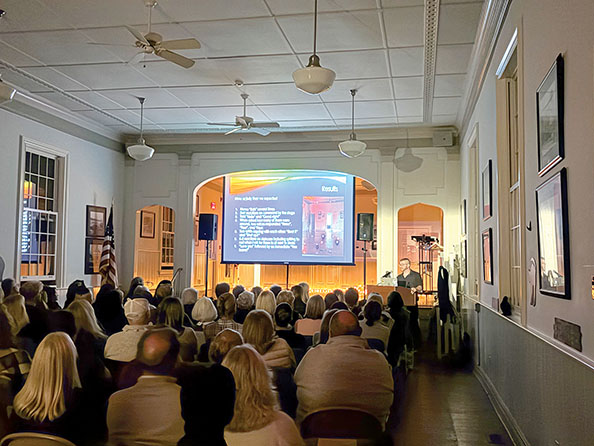
On the evening of Oct. 7, Ghosts on the Coast and the RumsonAmerica250 committee gathered the community at Bingham Hall to review the findings at its Haunted Rumson event. This was the first time, Caggiano said, that he had ever investigated in Rumson.
Investigations
“There aren’t too many ghosts,” Caggiano told The Two River Times, but there is a lot of “creepy stuff… burial grounds, shipwrecks, cemeteries, so a lot of stuff that can cause a haunting.” More so than actively haunted, Rumson is filled with “creepy history,” he said.
While one may assume cemeteries are brimming with ghosts, Caggiano said that is not the case in his experience. Rumson’s Quaker Cemetery, also known as the Rumson Burying Ground, at the corner of Conover Lane and Rumson Road, was pretty quiet, Caggiano said in his lecture. The biggest takeaway from this site concerned Thomas Letson. Letson served in the Revolutionary War, passed away at age 93 in December 1849, and now rests at Quaker Cemetery. At his grave, Caggiano asked, “What war did you fight in?” After listening to his recording post-investigation, Caggiano said he heard “someone” say the word “Revolutionary.”
“We didn’t come into this investigation with high hopes, because it was a church,” Caggiano said. Still, he reported that right at the start of the investigation, the EMF (electromagnetic field) tripwire lit up when the team asked, “Can you give us a sign that you’re here?” An EMF tripwire is a long cable with several sensors that light up or make noise when detecting changes in motion or energy.
At the end, when Caggiano asked if the spirits would like them to leave, he reported a voice saying very clearly, “You leave.”
Out of the three investigations, Caggiano said without hesitation that the most active was the J.P. (Jonathan) Cooper House. At this location, the team got a “lot of good spirit box responses” that were “spot on, intelligent responses.”
“Within 10 years of this house being built (in 1877), every single person associated with it was dead,” Caggiano said.
Caggiano explained that Randall Borden largely caused the Cooper family’s demise by marrying Emma, the Coopers’ adopted daughter. For paranormal or true crime enthusiasts, the name Borden may ring a bell. Caggiano confirmed that, yes, the Rumson Bordens were in fact related to the infamous Massachusetts Bordens, from the 1892 Lizzie Borden axe murder.
After the Cooper family deaths, Charles Doelger, of Manhattan’s Peter Doelger Brewing Company, bought the home and turned it into a Prohibition-era bootlegging masterpiece, complete with tunnels and a speakeasy.
The most “direct confirmation for something we were looking for,” Caggiano said, were recordings picked up in the bedroom where death-by-poisoning occurred. When asked about Emma and Randall Borden, Caggiano said Randall was an alcoholic and abusive toward Emma, and voices were recorded saying things like “crash,” “blood,” and “broke.” Randall Borden died in a carriage crash, according to Caggiano.
The current residents of the house have reported occurrences of shadowy figures and footsteps that cannot be explained, he added.
‘Creepy’ History
Rumson’s “creepy” history extends further than any ghost story. As early as 1879, Caggiano said he found reports chronicling sightings of Navesink River’s very own Loch Ness monster. The modern conclusion is that what people saw was not a monster or squid, but an oarfish. Oarfish can grow up to 35 feet long, according to National Geographic, and resemble eels.
Over 700 shipwrecks also lie within 5 miles of Sandy Hook, including the Aurora, which wrecked in 1827 where the Navesink meets Sandy Hook Bay, Caggiano said.
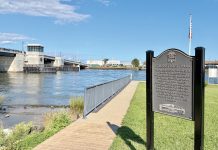
Rumson’s Oceanic Bridge even made a cameo appearance in the 1979 horror movie “Don’t Go in the House,” he said.
Before he revealed his investigation’s findings, Caggiano said Rumson’s paranormal scene is pretty on par with surrounding towns. Its uniqueness comes from “how much wealth there has been here throughout history.”
“Most prominent residents that lived here who could possibly still be haunting all started out as just summer residents. As far back as the 1800s, people were coming here for the summer,” he said. “Personally, I think they probably enjoyed it. Maybe they’re hanging around in death.”
This article originally appeared in the October 8-14, 2026 print edition of The Two River Times.