America’s oldest distiller, producing applejack in Colts Neck
since the 1600s, has plans for a cultural center in the township
By Laura D.C. Kolnoski
COLTS NECK – Few American companies are older than the nation itself, much less owned and operated by the same family for 10 generations. The Lairds, makers of America’s first blended applejack and the country’s oldest family of distillers, are committed to preserving their legacy while adapting to the times.
Arriving from Scotland in 1678 with his ancestors’ apple brandy recipe, William Laird opened an inn, distillery and stagecoach stop where the Colts Neck Inn now sits on Route 537, known then as the Burlington Path, traversed by indigenous peoples and colonists. George Washington, believed to be the only person outside the family to obtain the recipe, frequently visited for the “cyder spirits” he praised in his diary.
Robert Laird joined Washington’s forces during the Revolutionary War, supplying troops with his family’s spirits. In 1778, Moses Laird rode with Washington as a guide before the Battle of Monmouth. Afterward, the general rested at the tavern. In 1780, Laird’s received the nation’s first distillery license.
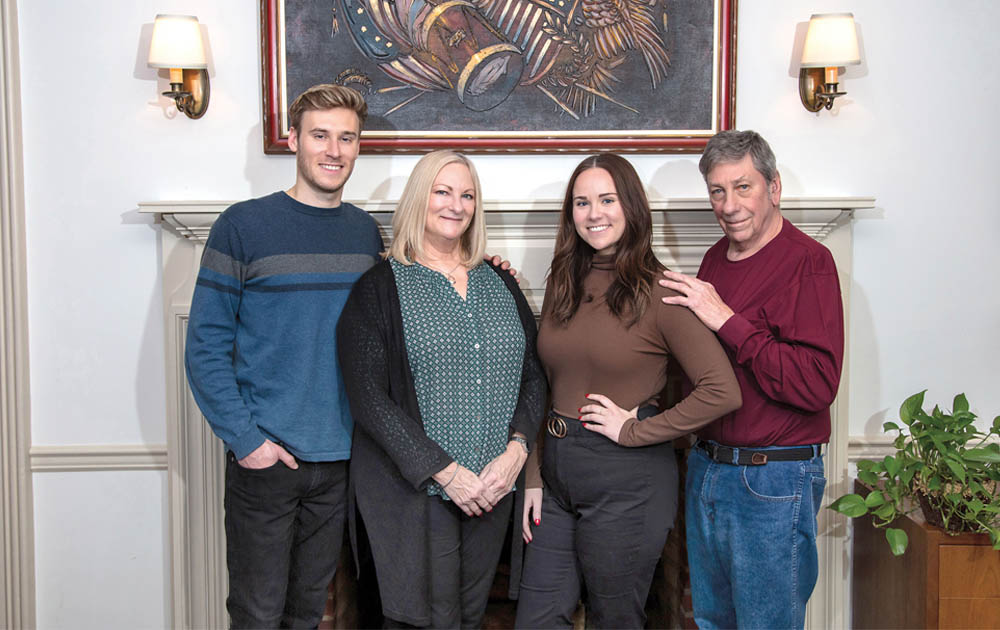
“Not many people have a history like ours,” said ninth-generation steward, president and CEO Lisa Laird Dunn, the second woman to lead Laird & Company Distillers after her grandmother, who took over after her grandfather died.
“I like to believe Laird’s Applejack got George Washington and his troops across the Delaware that cold Christmas Eve night.”
Following an 1849 fire, a fifth-generation Laird rebuilt the distillery a few miles east in its present location in the township’s historic Scobeyville section. The distillery sourced apples from the Barclay farm across the street, now Eastmont Orchards. (In 1911, the Barclays founded Delicious Orchards nearby on Route 34.) Today, the site is headquarters for aging, processing, and bottling, while apple harvesting and distillation happen in Virginia.
Dunn and her parents were the last family members to live in the familiar white house with the yellow shutters on the 22-acre property at the corner of Route 537 and Laird Road. The complex includes a 155,000-square-foot bottling facility and a barrel warehouse built in 1933, the same year Prohibition ended and Laird & Company was granted United States Federal Liquor License No. 1, which it still operates under today.
The property was listed on the Registry of Historic Places in September 2024 by the New Jersey Historic Preservation Office, and the National Register of Historic Places in October 2024 by the National Park Service.
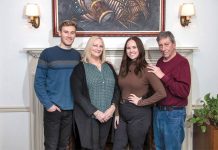
Dunn’s father, Larrie Laird, remains active with no plans to retire. “I enjoy what I do, making sure the company keeps going and helping out where I can,” he told his grandson Gerard Laird Dunn, now executive vice president, in a recent video. The 10th generation to join the firm, along with his sister Laird Emilie Dunn, Gerard uses his business and marketing degree from the University of South Carolina to expand the firm’s social media presence.
Beginning at 14, Gerard worked various Laird positions from cleaning to production, accounting and sales. He was elevated to operations manager in 2018 and vice president of operations in 2023 before becoming executive vice president last December. Laird Emilie, who has a degree in marketing and business administration from Appalachian State University in North Carolina, serves as mid-Atlantic sales manager.
“Our family has been part of America’s story and social media gives us a way to keep telling it,” Gerard said. “Across Instagram, Facebook, LinkedIn and YouTube, we share our family’s connection to the nation’s history, along with our products and ways to enjoy them. Telling our story has helped us stay connected with lifelong fans, introduce our brand to new consumers, and build awareness.”
Cultural Center
Lisa Laird Dunn’s long-held goal of creating a cultural center in an old barn on the property is nearing fruition. Work began over a decade ago when the structure’s foundation was painstakingly rebuilt with mortar comparable to that of the 1700s to maintain its historical integrity. The pandemic and lengthy approval processes at the local, county and state level stymied progress.
Simultaneously, the family has been working to sell directly to the public.
New Jersey’s Historic Distillery License, sponsored by Assembly members Margie Donlon and Luanne Peterpaul (D-11) and state Sens. Vin Gopal (D-11) and Declan O’Scanlon (R-13), was signed into law in July 2025 by former Gov. Phil Murphy. Dunn said the state Division of Alcoholic Beverage Control is currently developing its parameters.
“Once this is established, we are requesting the state issue a temporary license so we can open a bottle shop on our premises,” she said. “When the cultural center is built, we will receive the full license. It will have a museum dedicated to New Jersey’s history of applejack distillation that will explain and demonstrate Laird’s process.”
The Colts Neck Planning Board conditionally approved the center’s site plan in May 2025. Dunn said all outstanding issues have been addressed except for escrow funds for needed permits, which will be finalized once tax credits are approved and construction can move forward. The family applied for two tax credits to offset their “very large investment” through the New Jersey Economic Development Authority.
Inside, the family will display artifacts, photos and memorabilia, including heirlooms depicting famous devotees. Abraham Lincoln served applejack in his Illinois tavern. President Lyndon Johnson presented a case to Soviet Premier Alexei Kosygin at their 1967 Glassboro summit, and President Bill Clinton served it at his first Inaugural Ball. President Barack Obama’s 2009 holiday party featured the colonial drink “Stone Fence” made with applejack, bitters and mint.
America’s 250th
This year, the family introduced a rare apple brandy to honor the nation’s 250th anniversary, producing 1,300 bottles (100 for each of the 13 original colonies), with an ABV (alcohol by volume) of 56%, symbolizing the 56 signers of the Declaration of Independence. Laid down in 2013, it spent 13 years in oak.
The company created new – and reintroduced classic – cocktails to mark October as National Applejack Month and posted them on its platforms.
Laird’s products are served nationwide, including at the historic Congress Hall in Cape May and Smithville Inn in Galloway, and at celebrity chef and Monmouth County native David Burke’s restaurants. The new Hurly Burley lounge at Walt Disney World’s Boardwalk (formerly Jelly Rolls) has the “Road to Fame” cocktail on its menu, “an Atlantic Coast-inspired Whiskey Sour made with rye whiskey, Laird’s Straight Applejack Brandy, and lemon juice.”
“Fall through the holidays is traditionally Applejack season with hot cider drinks and eggnog,” said Lisa Laird Dunn. The family’s eggnog recipe appears in their cookbook, “Applejack: The Spirit of America,” compiled by Lisa and her mother, Rose Marie. The 146-page paperback includes family history, sketches, vintage photographs and the recipe for Martha Washington’s Applejack Walnut Cake.
“I could not be prouder or more humbled that my children have joined Laird & Company to carry forward and advance our family’s heritage,” Dunn said. “Their involvement represents continuity and the opportunity for renewal. Each generation brings fresh perspectives and new ideas while building on the foundation laid by those who came before them. It is incredibly meaningful to know that the passion and dedication I have for our family’s legacy have been passed to my children, and that they share the same desire to preserve it, grow the business, and ensure it thrives for generations to come.”
The article originally appeared in the November 5 – 11, 2026 print edition of The Two River Times.