By Sophia Wiener
LINCROFT – Over the past decade, mental health has become an increasingly hot-topic issue in colleges, schools and anywhere else young people can be found.
But what do health services look like when students range in age from 18 to 80? At Brookdale Community College, the Caroline Huber Holistic Wellness Center is trying to answer the same questions that private colleges do, tailored to its own community.
The center, which opened its doors less than two years ago and had over 20,000 visitors in 2024 alone, has been improving student life in many ways. Mental health plays a large role in that, but as center director Summer Deaver explained, there’s far more to discuss when trying to keep a student healthy at school and later in life.
Deaver pointed to the eight basic needs outlined by New Jersey’s Office of the Secretary of Higher Education, including food security, mental health and physical health, as well as access to transportation, technology, housing and childcare. What someone needs to be healthy, she explained, “is defined differently by different organizations. So for education, technology is definitely a need. A student needs a computer.”
A mental health grant provides Brookdale with third-party counselors to help meet the needs of its thousands of students. The Wellness Center even runs a campus Alcoholics Anonymous group.
But that’s just where health begins. “Nothing stands on its own. We can give all the mental health services that we want, but if students don’t know how to talk to each other, or if they don’t have their basic needs met, it’ll only do so much,” Deaver said.
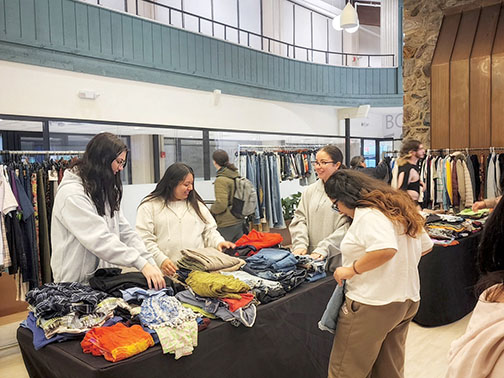
To lower food insecurity among students, the center partnered with Brookdale’s food pantry, relocating it to the Huber building and expanding its hours for easier access. In 2024, it gave out 375 weekly grocery bags. It also dispenses meal vouchers and meal tickets. Meanwhile, grab-and-go snacks offer healthy, high-protein options to keep stomachs full throughout the day; the center gave out 7,069 in 2024 at Brookdale’s main campus alone.
A thornier issue, however, involves housing, transportation and technology. The college does not have dormitories, and while it can help its students work with social workers and apply for aid, it can only do so much. “Some students are sharing a phone with their younger sibling and trying to do their schoolwork on a phone. And you would be surprised how many people live in their car or are just on the edge of being unhoused, and we don’t have a really good solution for that in Monmouth County,” Deaver said. She lamented that so-called “affordable housing” isn’t actually affordable for a young person trying to go to school and work.
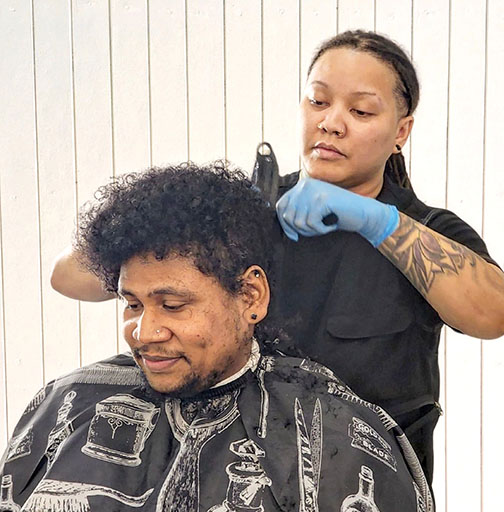
The Wellness Center’s latest project is a program that would allow in-need students to rapidly apply for and receive assistance with basic needs emergencies. “Something like $200 could be the reason why a student doesn’t show up and continue their degree,” Deaver said. “When we talk about an emergency around basic needs, it usually is under $500. Someone might say, ‘That’s not a big deal, put it on a credit card and pay it off.’ But that’s not a reality for a lot of our students. If they were able to get a car repair that would allow them to make it to class, that is huge.”
The speed of that aid is especially key. “That’s the other thing with basic needs. Someone in an emergency situation needs the money immediately. They don’t want to wait two months for a mini-grant from somewhere.”
The center’s offerings don’t end there. One of its most popular programs is high tea, where the staff provides tea, cookies and a selection of board and card games, encouraging students to take time to meet friends and practice their social skills.
In its occupational health programs, Brookdale’s younger students can acquire life skills and enhance resume-building abilities, such as programming, with a focus on life after graduation.
With such a diverse range of offerings, Christopher Jeude, the director of Student Services, believes Brookdale’s student support is largely similar to what a four-year college provides. He sees a greater difference in how Brookdale communicates with its students. “When you’re a traditional college-age student living on campus, that stuff is in your face a lot more. We recognize that our students are coming from a diverse range of age groups, all sorts of different backgrounds, and so we need to work a little more creatively to make sure students are aware of our resources.”
Brookdale student Ailton Alanya, who hopes to transfer to a four-year school and become an obstetrician after obtaining her associate degree, learned about the center during her first psychology class when her professor took the students to tour the Wellness Center. She commented on its spaciousness and the “soft and calm music” that’s always playing. “It’s just a nice environment to sort of focus and relax and study in,” she said. Eventually, she arranged for the Nectar Club, a club she founded that celebrates flowers and uses them to relax, to meet there and enjoy the “unconditional kindness” that suffuses the space.
Brookdale has been quick to embrace the idea of supporting the whole student. The issue of basic needs in higher education first came to national prominence only in 2017, when the Hope Center for Community, College, and Justice released influential research on the topic. When Caroline Huber died in 2021, she bequeathed a substantial amount toward the health of Brookdale students, and the center was born.
“I’m really very proud of the work we do to support our students at Brookdale,” Jeude said. “We recognize that students are coming to us from all different backgrounds, and sometimes support can make all the difference in making sure that they’re successful in their classes and that they can graduate and transfer or get a job one day. This is stuff that can really make the difference for them in making sure they can stay in school and focus on their work.”
The article originally appeared in the February 27 – March 5, 2025 print edition of The Two River Times.