By Stephen Appezzato
MIDDLETOWN – An important and innovative oyster research effort just got a little bigger with the addition of 80 more oyster castles in Sandy Hook Bay.
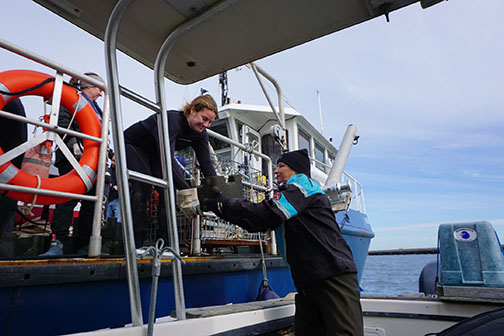
Last month, another wave of oyster castles was installed at Naval Weapons Station Earle (NWSE), the location of an important Monmouth University aquaculture facility. The castles, seeded with oyster larvae, will remain on the bay bottom and be studied for oyster growth, survivability, biodiversity and coastal resilience.
The project not only provides important insights into oyster survivability in the area but also serves as a living shoreline, helping boost coastal resilience to flooding.
“We’re really working on expanding our operation exponentially,” said Amanda Boddy, a marine biology technician with the university’s Urban Coast Institute (UCI). In the leadup to the new castles, new tanks and enhanced heating systems were also installed at the aquaculture facility.
“Instead of just focusing on restoring oysters to the harbor, we started looking at ways to expand this work and really focus on shoreline protection and erosion prevention,” Boddy explained.
Oysters are ecosystem engineers – organisms that modify, destroy or create habitat, altering the landscape and impacting other species.
When reefs are created, “they protect the shoreline by dampening wave energy. It encourages accretion and reduces erosion,” all while providing new habitat, Boddy said. In the New Jersey and New York Harbor, which is primarily flat, barren sand, reefs are particularly important.
Since native oyster populations are functionally extinct, “we’re trying to mimic those reefs with the castles, which provide the same things as habitats,” Boddy said.
Currently, the program has about 1,300 castles. The office of U.S. Rep. Frank Pallone (D-6), who secured federal funding for the program, said more seeded castles are coming next year, too.
According to Boddy, the oyster castles are in a safe zone and under 24-hour security, meaning “there are no poaching concerns.”
So far, the project has been a success, providing important information on natural coastal defenses while using nature-based solutions to address climate change impacts and also increasing biodiversity around the site.
To the surprise of some, oysters are native to local waterways. They once played a key role in filtering pollutants and promoting biodiversity in the Two River area.
“New Jersey waters used to be filled with oysters,” said Tim Dillingham, director of the American Littoral Society. However, through misuse and pollution, oyster populations were drastically reduced.
Before 2010, environmental groups were permitted to keep man-made oyster beds in local waters to act as a natural means of cleaning and filtering the water. However, due to concerns over poachers consuming or selling these oysters, which could be unsafe, the state Department of Environmental Protection ordered the removal of the oyster beds.
“They’re trying to make sure that bad oysters or oysters that have been in polluted waters don’t make their way into the market,” Dillingham explained.
While these concerns are valid, local environmental groups also recognize the beneficial role the native mollusks play in nearby waterways and support reintroducing oysters in the area.
“It’s a piece that’s missing and it pays to get it back in place,” said Rik van Hemmen, president and trustee of the Navesink Maritime Heritage Association. “Oyster reefs provide ecosystem and shelter for different animals and they also clean the river itself by filter feeding,” he said.
“We have always supported the various efforts by the various organizations that are trying to restore it.”
The American Littoral Society shares a similar belief. “We’re very supportive and very active in both restoring oysters and connecting the community to doing that,” said Dillingham, noting the “tremendous” ecological value in restoring oyster populations and “putting a piece of the coastal ecosystem back where it’s been destroyed over history.”
In recent years, the Littoral Society has operated science-based projects investigating oyster viability and benefits in New Jersey waters. In Barnegat Bay, a joint reef project between the society and the DEP is underway, studying the benefits of oysters in a monitored environment to deter poaching. The group also collects spent oyster shells from local restaurants, using the waste to build reef projects for living shorelines.
“We’d love to re-oyster New Jersey. We’d love to see oysters in places they were historically,” Dillingham said. “This type of work brings these added benefits, combining ecological restoration with adaptation to climate change.”
As the UCI’s project continues to gain momentum, it serves as an important case study on the viability and important roles oysters play in area waterways, promoting biodiversity and furthering coastal resiliency.
The article originally appeared in the December 5 – 11, 2024 print edition of The Two River Times.