By Sunayana Prabhu
FORT HANCOCK – The Fort Hancock 21st Century Federal Advisory Committee, which advised the National Park Service (NPS) on ways to revitalize historic buildings on the Sandy Hook peninsula, has been disbanded. The termination followed President Donald Trump’s executive order to reduce government spending, although, according to NPS, there was no funding associated with this advisory committee.
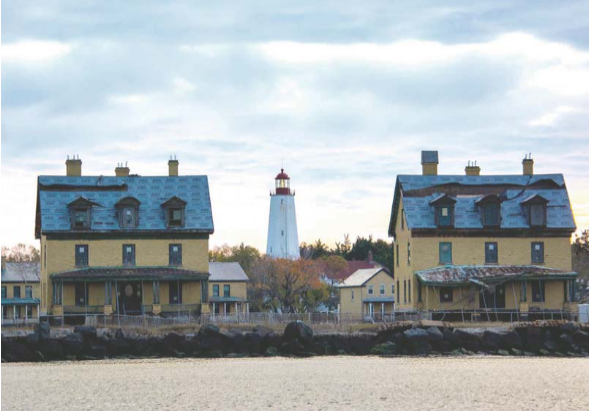
The volunteer-driven committee, appointed in 2012 by the U.S. Secretary of the Interior, was tasked with making recommendations to the NPS on the adaptive reuse of nearly 30 dilapidated structures, including the 21 Officers Row houses. The structures are on the former U.S. Army base that includes Fort Hancock and Sandy Hook Proving Ground National Historic Landmark, located almost entirely in the Gateway National Recreation Area’s Sandy Hook unit.
“Consistent with Executive Order 14217 Commencing the Reduction of the Federal Bureaucracy, the Fort Hancock 21st Century Federal Advisory Committee was terminated by Secretary (Doug) Burgum on Feb. 27, 2025,” officials confirmed in a statement on the NPS website.
The administration deemed several advisory committees “unnecessary,” the executive order reads. The disbanded Fort Hancock advisory committee is part of a list of committees that cover a range of topics, including foreign aid, consumer finance and long COVID. The order also eliminates agencies such as the Presidio Trust and the U.S. Institute of Peace. “Reducing the size of the Federal Government will minimize Government waste and abuse, reduce inflation, and promote American freedom and innovation,” the order states.
“There was no funding associated with this group,” Daphne Yun, public affairs officer for the Gateway National Recreation Area, clarified in an emailed response March 17.
The advisory committee drew experts from several disciplines and occupations, mostly from the communities surrounding Sandy Hook, to study the historic district and make recommendations for its possible reuse. Members included professionals from the scientific, education, recreational, business, real estate and hospitality communities, as well as local elected officials. They served three-year terms. When terms expired, a call for nominations was placed in the Federal Register and announced by the park service via press release.
“The Fort Hancock leasing program will continue even without the advisory committee, and Gateway will continue to work toward preserving these historic structures,” Yun said.
According to Yun, seven buildings have been leased so far and are being used as restaurants, event venues and academic institutions.
NPS had been working with the committee for more than a decade to find financially viable solutions to preserve the buildings, many in structurally dangerous conditions from years of disuse. The park service worked to stabilize the structures as funding became available while exploring opportunities to collaborate with public and private business entities to find long-term solutions to save the buildings.
However, NPS’s goal to completely transform the area into a vital community has been challenging. In 2020, the NPS entered into a general agreement with the New York-based Stillman Development Group to identify adaptive reuses of the properties. In 2023, Stillman presented an estimate of $100 million to rehabilitate the 21 Officers Row buildings for long-term residential use.
Of the $100 million, the Stillman Group was willing to invest $50 million, but that left the NPS with a “big, daunting financial gap,” Jennifer Nersesian, Gateway National Recreation Area’s former superintendent and designated federal officer, said during the advisory committee’s Nov. 6 virtual public meeting.
During the advisory committee’s October 2024 meeting, Nersesian, who had served as the park’s superintendent for 11 years, announced she was departing for a new role as regional director of the National Park Service’s National Capital Region in Washington, D.C.
“This is a new chapter in trying to find the solutions for these buildings to activate them and make them usable for the public and the parks,” said Pete Izzo, chairman of the Sandy Hook Foundation, NPS’s official nonprofit.
The foundation aims to preserve the buildings’ cultural and historical significance while making them accessible and useful to the public. “The park has that core as mission, and we as the foundation are working as a partner alongside the park to achieve that,” Izzo said.
No immediate information was provided from NPS about a potential replacement for the advisory group.
The article originally appeared in the April 3 – April 9, 2025 print edition of The Two River Times.