By Sunayana Prabhu
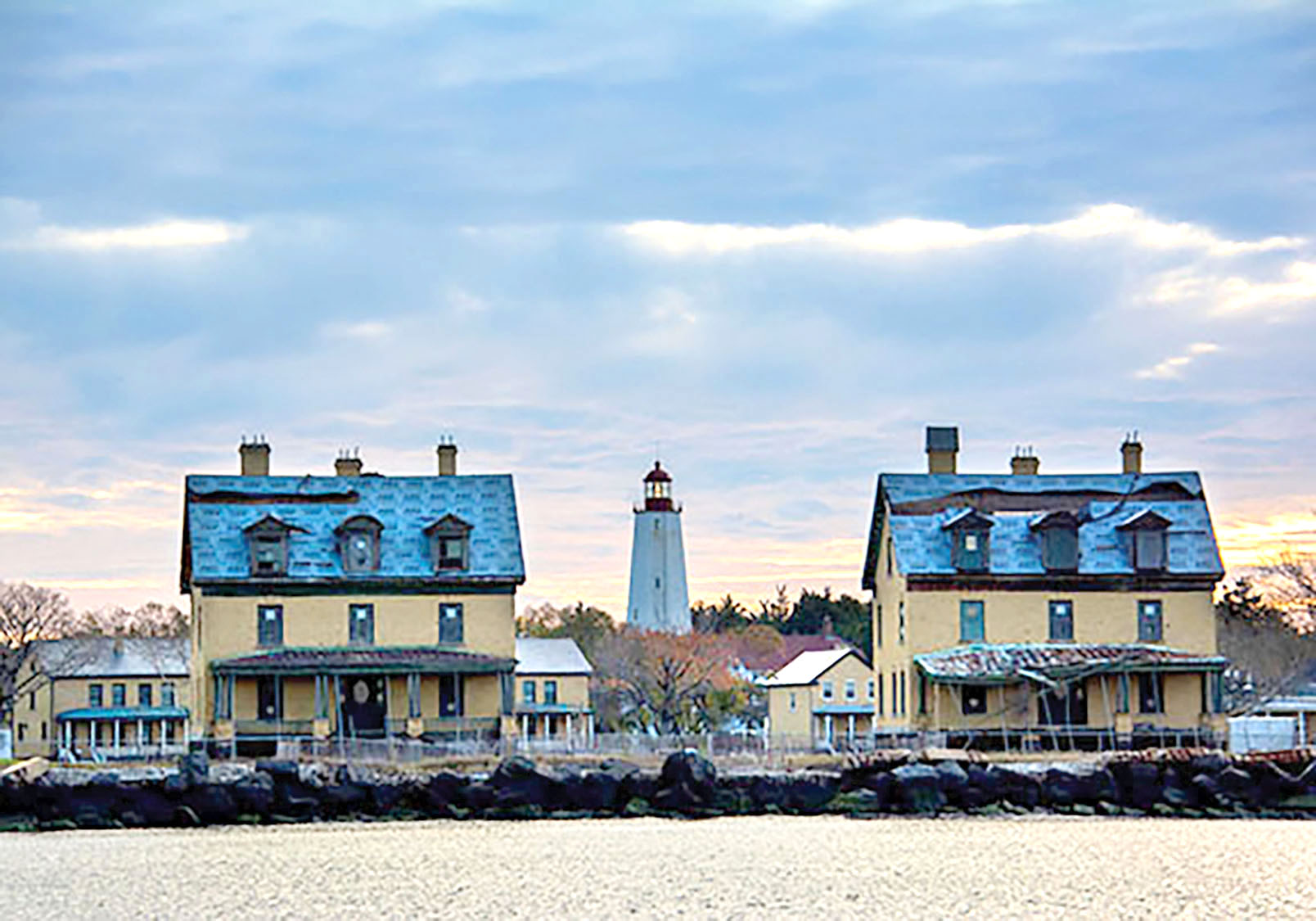
FORT HANCOCK – Preserving Fort Hancock’s historic character while finding financially sustainable uses for its landmark Officers Row buildings through leasing has been an ongoing challenge for the Gateway National Recreation Area, one that continues to drive efforts toward repurposing the property.
The Fort Hancock 21st Century Federal Advisory Committee, a committee of residents and community leaders set up by Gateway to engage with the ongoing development process, met virtually May 20 to continue leasing program discussions.
For over a decade, the advisory committee has grappled with how to fund the rehabilitation of 21 rapidly deteriorating vacant historic buildings at the Sandy Hook Unit of Gateway.
During the committee’s November 2023 meeting, Jennifer Nersesian, superintendent of Gateway National Recreation Area, part of the National Park Service, spoke about the “daunting” financial gap to rehabilitate the buildings on the peninsula to the state’s historic restoration standards for long-term residential use, estimating the cost at $100 million. Of the $100 million, the New York-based Stillman Development Group is willing to invest $50 million. However, despite several efforts, the National Park Service is still on the hook for the remaining amount.
At its Monday meeting, the advisory committee continued wrestling with this complex issue, as the future of Stillman’s proposed rehabilitation remains uncertain after four years of negotiations.
“I don’t see what the light is at the end of the tunnel yet,” said Nersesian.
Stillman is still “a potential private sector partner,” willing to invest in the project, Nersesian noted, but “we don’t have that financing plan yet. And we may wind up with the conclusion that there is not a viable pathway forward at the scale of investment that’s needed to cover that financing gap.”
She said she has continued to “have conversations with colleagues in Washington and, not surprisingly, there is no major funding source out there that is going to cover this kind of gap from the federal government end.”
Stillman suggested incremental investments toward the restoration of a group of buildings. Still, Nersesian said, “to move forward on an incremental basis, we need a financial plan and we need to know what financing would be available when.”
Meanwhile, the NPS has been working on stabilizing existing structures to buy more time until funding is available for the restoration. “Our goal is to keep them standing,” Nersesian said. “The goal is stabilization to buy ourselves time for more incremental investments.”
She updated the committee on interim stabilization work funded by the agency and sought guidance on the next steps.
The NPS recently successfully funded and completed roof replacements on Officers Row. The $3 million project repaired 15 roofs and bought time for further investment. “Masonry repairs will be prioritized next using additional park funding,” Nersesian said.
While supportive of ongoing stabilization, members debated how long to pursue Stillman’s proposal given the uncertainty around financing. Committee members Bill Kastning and Michael Walsh suggested considering a “Plan B” if Stillman’s proposal proves unworkable.
Ideas proposed included re-opening buildings to individual bids, as was originally planned, and exploring alternative funding streams like the American Rescue Plan Act.
Committee member Brian Samuelson urged the committee to give interested individuals an opportunity. As a past bidder with experience renovating buildings at Sandy Hook, Samuelson pledged his construction expertise and offered to coordinate volunteers.
“The winning formula is local people,” Samuelson said, noting that local developers are “enthusiastic,” have access to financing, and could succeed where larger developers have faced challenges navigating the complex approval process over many years.
Pete Izzo, chairman of the board of trustees of the Sandy Hook Foundation, a philanthropic partner at Sandy Hook, proposed hosting a full-day Fort Hancock symposium in August or September to brainstorm solutions with stakeholders from various sectors. The foundation’s website describes its association with the NPS as “the official nonprofit friends group to the National Park Service at Sandy Hook.”
Izzo hopes this forum will bring together federal and state government leaders, nonprofits, educational institutions and professionals to discuss rehabilitation pathways.
The nonprofit also aims to play a larger role going forward in building preservation efforts at Fort Hancock in collaboration with the NPS, and that role can take a wide variety of forms, including “planning, strategy, fundraising, building important relationships, and more, that can all assist the park,” Izzo said, as well as the advisory committee as it works to find the best solutions for the historic buildings.
Other members also questioned relying solely on Stillman’s proposal indefinitely. “I’m having trouble following the logic around the Stillman project,” said advisory committee member Patrick Collum during the meeting. “I don’t know if it’s a wise business decision to tie up a large parcel of assets that we can’t put out on the market for him (Stillman) to do a couple of buildings.”
Others questioned the wisdom of relying solely on one large private developer and suggested a hybrid approach incorporating interested individuals alongside a nonprofit or public partner.
“I don’t know that putting these (buildings) all back on the market is going to yield a different result. I mean, it’s going to cost this much for anybody to come in and rehab these buildings at this point,” Nersesian pointed out, noting that Stillman is still looking at the potential revenue generation of the buildings, which is going to be “a similar calculation to anybody coming into it.”
“It took us years, with these buildings out on an RFP (request for proposal), to get anybody with that level of interest. So, I don’t want to turn away from that prematurely.”
Stillman’s $100 million proposal remains the only option under consideration four years after signing an agreement.
According to updates provided at the Monday meeting, the NPS has had a few successes in restoring and leasing seven buildings. Buildings 56 and 23, part of a $12 million project funded by Monmouth County, are being leased by the Marine Academy of Science and Technology (MAST). Building 36 is now the Mule Barn Tavern, an upscale pub and event space. Building 53 is being used as a café. Buildings 52 and 21 are used for lodging, and Building 104 is being used as an office. Lease negotiations are nearly completed for Buildings 24 and 25, authorized for residential use; Building 40, a former YMCA, will soon be a restaurant, and Building 114, the Officers’ Club, will be used for events, lodging and outdoor dining.
This was the advisory committee’s 43rd meeting; rehabilitating Fort Hancock properties has been on their agenda for over a decade. The committee will continue weighing rehabilitation pathways as the future of the historic structures remains unsettled.
The article originally appeared in the May 30 – June 5, 2024 print edition of The Two River Times.