By Stephen Appezzato
MIDDLETOWN – As the United States approaches its 250th anniversary next year, communities across the country are gearing up to celebrate the nation’s rich history through various projects. One such effort – aimed at showcasing the historical depth of Eastern Monmouth County – is the Navesink Maritime Heritage Association’s (NMHA) book, “NAVESINK – A Historical Novel.” The project, a James Michener-style historical narrative, delves into the development of the region through the Grover family.
“We figured it would be fun to run through it so people get a feeling about the history of this area, especially leading up to America 250,” explained Rik van Hemmen, president and trustee of the NMHA.
The novel is being released in a serialized format on the organization’s website, with the book’s second chapter, titled “1524, An Italian Visitor,” now available. The chapter, centered around the arrival of Giovanni Verrazzano to the region, offers a glimpse into the 1500s landscape and sets the stage for the area’s historical evolution. Subsequent chapters will be released one by one, maintaining an old-fashioned serial release style that encourages readers to follow along as the story unfolds.
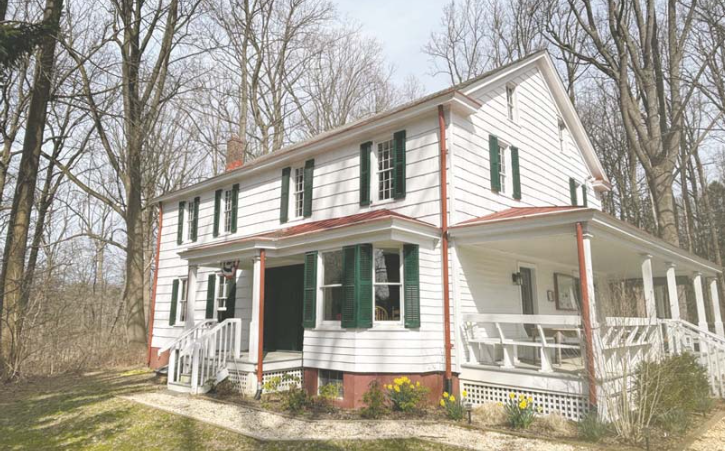
The project began in 2021 when NMHA hired historian Rick Geffken to research the Grover family, a historically significant family in the region. The Grover family’s ancestral home, located on West Front Street, still stands today and became the headquarters of NMHA in 2015.
“The reason the project was so interesting is because they (the Grovers) were sort of like the upper-middle class. In other words, they were very involved through the entire period,” said van Hemmen.
The Grovers settled in Monmouth County in 1665 and built their home around 1730. Generations of Grovers lived in the Grover House until 1982, when the last family member, Anna Lum Grover, was murdered during a home invasion.
“The Grovers were never the first people in the row, but they were always in the game,” van Hemmen said, underscoring their involvement in key historical events over the centuries.
Connections to Historical Events
As Geffken’s research on the family deepened, it became clear the Grover family’s story was not only one of individual significance but also tied to the broader events unfolding around them.
“While the central characters in Michener’s novels are imaginary, in this story,” the Grovers are real people, van Hemmen said. While historical events are factual, van Hemmen, who wrote much of the book’s narrative, took some liberties with details of characters’ personal lives and personas when records were sparse.
The novel covers an extensive time span, beginning in 17,000 B.C.E., and touches on several pivotal events in Monmouth County, including the arrival of Henry Hudson and the first European settlers. Van Hemmen also notes that even before the 1600s, the region was a site of significant activity.
“Even before Monmouth County was settled in the late 1600s, there was a lot of activity here,” he said.
“When you start writing, you realize there was so much trade amongst the lineup, and this was sophisticated trade” between the native Leni Lenape, Dutch settlers, Manhattan and more.
He adds that many of these figures are far more developed and complicated than we give them credit for. “When you actually start to write about it, you come to realize that you’re dealing with humans, and you’re dealing with much more sophisticated stuff than we think about. We tend to think about the past as unsophisticated, but when you start to write within the characters in the past, you realize that they were just as sophisticated as we were, just they had different tools.” The research process was rigorous and often took the authors to unexpected places. In one instance, Geffken even traveled to England and the Netherlands to search for correspondence between one of the original Grovers and England’s Oliver Cromwell, a statesman, politician and soldier. “Once you go down the rabbit hole, it becomes very interesting,” van Hemmen said.
Currently, the second chapter, “1524, An Italian Visitor,” can be found on the NMHA website at navesinkmaritime.org/Navesink-Novel.
The article originally appeared in the March 13 – March 19, 2025 print edition of The Two River Times.