By Sunayana Prabhu
MIDDLETOWN – The district’s board of education voted 5-4 last week to close three schools under mounting financial pressures. The highly emotional and often turbulent meeting ended past midnight Feb. 27, with parents threatening litigation over a school closure plan that was revived this year despite a 10.1% tax hike last year to prevent the closures.
Under the plan, Leonardo Elementary and Navesink Elementary schools would close, and those students would attend the new Bayshore Elementary School in the current Bayshore Middle School building. Bayshore Middle School students would be relocated to the two other middle schools in the district, Thorne and Thompson.
A nine-page “Restructuring Proposal” recommending school closures was released to the community by the district Feb. 21. District officials have used the ongoing financial challenges to justify the closures. “If we only anticipate tax levy increases 2% each year and receive minimal – if any – increases in state aid, we’ll still face budget deficits of $6.6 million in 2027-28, $10.2 million in 2028-29, and $13.9 million in 2029-30.” board president Chris Aveta said, summarizing a recent finance committee report. The district has reported a budget deficit of over $3 million for 2026-2027.
District business administrator Amy Doherty also noted that health insurance costs were underbudgeted last year, forcing the district to tap into its reserves.
In the restructuring proposal, district officials said last year’s tax increase was a “temporary bridge to allow for further investigation of alternative options.” The tax hike provided breathing room but did not resolve mounting budget deficits.
According to the proposal, the school closures could mean between $3.7 million and $4 million in ongoing annual savings, primarily through workforce reductions.
According to its website, the Middletown Township School District serves more than 9,000 students in pre-K through 12th grade throughout 16 schools, and employs 1,600 staff members.
Voting Amid Pushback
School board members Mark Soporowski, Erin Torres, Joan Minnuies and Deborah Wright voted “no” on school closures. Minnuies twice introduced a motion to table the closure resolution, hoping to substitute it with an alternative budget without closures, but the motion failed both times.
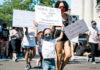
The five votes for school closures came from BOE members Jacqueline Tobacco, Frank Capone, Sara Weinstein, Caterina Skalaski and Aveta. An outraged crowd tried to shout them down with “put children first” slogans. Many also openly warned the board to anticipate lawsuits.
“When you’re sued over this decision you’re about to make, what are your emails going to show? What are your text messages going to show?” Lincroft resident Roshan Shah asked.
Torres urged the board to reconsider their decision in light of potential legal costs from lawsuits.
“If we are sued, we have insurance,” Tobacco said, triggering an enraged crowd, many of whom screamed expletives.
Skalaski, who voted against a closure plan last year, was the only board member who responded when the public implored the board to justify its position. “Continuing to delay difficult decisions only increases uncertainty and can create even greater challenges for our students, family and community in the long run, and with full understanding of the weight of my decision, I voted ‘yes,’ ” Skalaski said in an emotional statement, fighting back tears. “I am sorry.”
An extended debate, which repeatedly brought the shouting crowd to its feet, continued among board members and the public, with the meeting, which began Feb. 26, lasting until 1 a.m.
Torres said there is “absolutely no way” these school closures won’t have “a domino effect,” predicting more closures in the future. Soporowski said years of “financial mismanagement” and a lack of a long-term strategy had backed the district into a corner. “This is not strategic leadership. This is reactive,” he said.
Soporowski asked the board to call upon the town to share some of the PILOT (Payments in Lieu of Taxes) money the borough receives. A town is not required to share PILOT money with its school district.
“Don’t be scared to go talk to the town; they helped you guys get elected,” Soporowski told the newest members of the board. His comments were often met with applause from the crowd.
The plan for school closures also comes amid a leadership change in the district, with Superintendent Jessica Alfone’s retirement effective July 1, 2026. Soporowski further noted that it was “irresponsible” to implement a plan of this magnitude with a departing superintendent and “nobody driving the ship.”
How Did This Happen?
Last year, citing a $10 million budget gap, the BOE proposed closing three schools. After widespread public opposition, residents formed the grassroots coalition, Save Middletown Schools, and pushed back with financial data and enrollment projections. Ultimately, the board voted to raise the school tax levy to close the budget gap and engage in proper strategic planning over multiple years.
At a Jan. 27 public meeting, the educational consultant Ross Haber, hired by the district to complete a boundary study, recommended redistricting 119 students to avoid overcrowding. That plan was called the path of “least resistance” by Alfone, who at the time reported that the district is in a significantly improved financial position this year compared to the previous year.
Just weeks later, Alfone announced her retirement. Two days after the announcement, during the Feb. 19 BOE meeting, Haber appeared virtually and said his earlier “minor redistricting” plan was not accepted by district officials and he was instead asked to explore school closures. He described the proposal to merge Leonardo Elementary and Navesink Elementary and repurpose Bayshore Middle School as advantageous for the district, adding that it might eventually make sense to close other schools, such as River Plaza Elementary. On Feb. 21, the school released the restructuring proposal to the community, reviving the plan for school closures. The resolution authorizing that proposal was passed Feb. 26.
Lingering Questions
At the meeting, residents repeatedly alleged that the plan to close the schools rests on insufficient data and incomplete financial analysis.
Resident Bernie Daus presented a rough construction estimate, arguing that converting Bayshore Middle School into an elementary school could cost $5 million to $7 million once fixtures, furniture and equipment are included.
“I spent the afternoon working on school construction estimators,” Daus told the board, noting squarefootage calculations at Bayshore Middle School and a district-commissioned report that projected $2.6 million just for bathroom upgrades at the school. “I’ll submit that as your draft budget and let you come back to me and tell me where I’m wrong.”
Critics also argued that the district had not fully accounted for transportation costs, summer overtime for teachers to pack and move classrooms, and long-term operational costs, adding that the projected savings figure in the district’s restructuring proposal was misleading without those elements.
Several speakers said the board had rushed the process and relied on “flawed data” and “questionable finances,” accusing members of making decisions behind closed doors. “We as the parents got to be the town’s punching bag for raising taxes last year to save schools. I can’t imagine the pain you will feel for failing us and costing taxpayers more for closing them and not closing this budget,” resident Kate Raftery said.
Community Vows to Fight
As the meeting neared its end, community members made clear that the board’s vote would not end the dispute.
“This is not over,” resident Emilie Donohue told the crowded room, urging parents and staff to email the county superintendent, submit formal opposition to the closures and include what they believed was a lack of facts, data and evidence in the board’s decision.
Resident Eric Dowell warned that the closures would “open a Pandora’s box,” deepening long-standing divides between the township’s northern and southern areas.
“You can’t break the rules and get away with it,” said Donohue, a member of Save Middletown Schools, alleging the board’s plan to close the schools was already decided behind closed doors. “Don’t go home and tell your kids that their schools are closing. Tell them that people that have the wrong intentions voted to close their schools, and that people that are not afraid to do the right thing will save them.”
Middletown resident Bernard Dawson expressed his concern at the March 2 township committee meeting workshop, where he asked the committee to “please come to the rescue.” Dawson said there is an “imminent threat hanging over Middletown right now” and that the closure of the schools “will fracture Middletown communities, hurt our students and put our tax dollars in peril.”
“With your leadership, I hope you can guide the BOE back to a cooperative, compliant, transparent, options-based process,” Dawson told the committee.
Mayor Tony Perry said the “governing body has not received any type of briefing,” but Colleen Lapp, the township’s chief financial officer, is planning to meet with Alfone, board of education members and Amy Doherty, the board’s business administrator and secretary, later this week to discuss matters.
The district must submit required assurances and documentation to the New Jersey Division of Administration and Finance and to the Monmouth County executive superintendent. Until authorities review and act on the district’s submission, residents said they will continue to organize, file complaints and push for the plan to be reversed.
The article originally appeared in the March 5 – 11, 2026 print edition of The Two River Times.