By Sophia Wiener
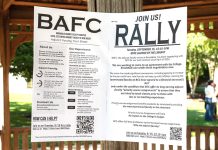
WEST LONG BRANCH – More than 200 Monmouth University (MU) students and faculty members gathered on the steps of the Great Hall April 2 to push for improved electronic grading transparency. But the rally ended as a celebration of progress, achieving most of the students’ goals.
The rally took place at the same time a Faculty Association of Monmouth University (FAMCO) meeting was to happen, the culmination of months of pressure on the professor’s union to make the changes.
“We got grades electronically throughout middle school and high school. We’re used to it. For us, that’s a transparent grading process,” explained Tanner Purdy, MU’s Student Government Association (SGA) president.
But posting grades onto the university portal, eCampus, isn’t written into professors’ contracts. Until now, 30% of courses have been taught by professors who opted not to post, leaving students adrift – especially when they needed to return graded assignments or when professors changed the syllabus partway through the semester.
When the current SGA took office, it decided to revitalize council resolutions as a means of governing. According to both Purdy and SGA Director of Public Relations Brendan Sheehan, the SGA started with electronic grading because they viewed it as “low-hanging fruit” – a wide- spread issue that would be simple to fix but drastically improve students’ quality of life. SGA Resolution S25-01, calling for professors to be required to post syllabi, assignment information and grades on eCampus, passed unanimously in a Feb. 5 SGA vote.
But the matter turned out to be not so “simple.” FAMCO refused to change.
Its official position was that requiring the use of eCampus beyond “the posting of a syllabi infringed upon ‘faculty’s academic freedom and professional autonomy,’” according to an open letter the SGA posted in the student newspaper The Outlook.
Not all faculty felt the same way, however. Professors Joseph Patten and Robert H. Scott also penned an open letter, stating that studies correlate low grading transparency with increased student anxiety. The letter also called FAMCO’s argument that its policy protects faculty members’ ability to “decide the best method to evaluate students” “nonsensical.”
“The SGA initiative does not… impact the method by which faculty evaluate students’ work – it only requires the faculty to be transparent about their grading process.”
FAMCO had only recently finished its latest contract negotiations, a grueling months-long process, and wanted to wait until the next round began in June 2027 to make any more changes. The SGA viewed this as too late to benefit the thousands of stu dents who would graduate before then. SGA circulated a petition that gained over 1,500 signatures and continued to push the conversation, posting information on social media and spending almost two months speaking with faculty and administration.
The rally was planned as another step of escalation – one that turned out to be unnecessary.
The Monday before the rally, MU President Patrick F. Leahy released an internal statement to the university committee explaining that the university has set a goal of 90% of courses being graded electronically by Fall 2025. This initiative aims to satisfy students without requiring reopening contract negotiations. Training will be provided to help professors less familiar with eCampus learn the program, and part-time faculty will be heavily encouraged to do the same. FAMCO did not respond by press time for comment.
The rally ended up being a celebration of what the student body and their supporters had accomplished. FAMCO postponed their meeting until the rally ended, and some members came outside and listened to student speakers. Candidates for next year’s SGA president also attended. Both promised that whoever won would continue to ensure electronic grade transparency stayed on the docket.
The current SGA views this year’s initiative as a success. Purdy highlighted it as a victory for shared governance, where collaboration led to an outcome that everybody is happy with.
“It’s not 110% of what we wanted, but it’s 90% of the way there. And I think there’s one thing that we’ve learned as student politicians, is that you get 90%, you take 90%.”
The article originally appeared in the April 10 – 16, 2025 print edition of The Two River Times.