By Jody Sackett
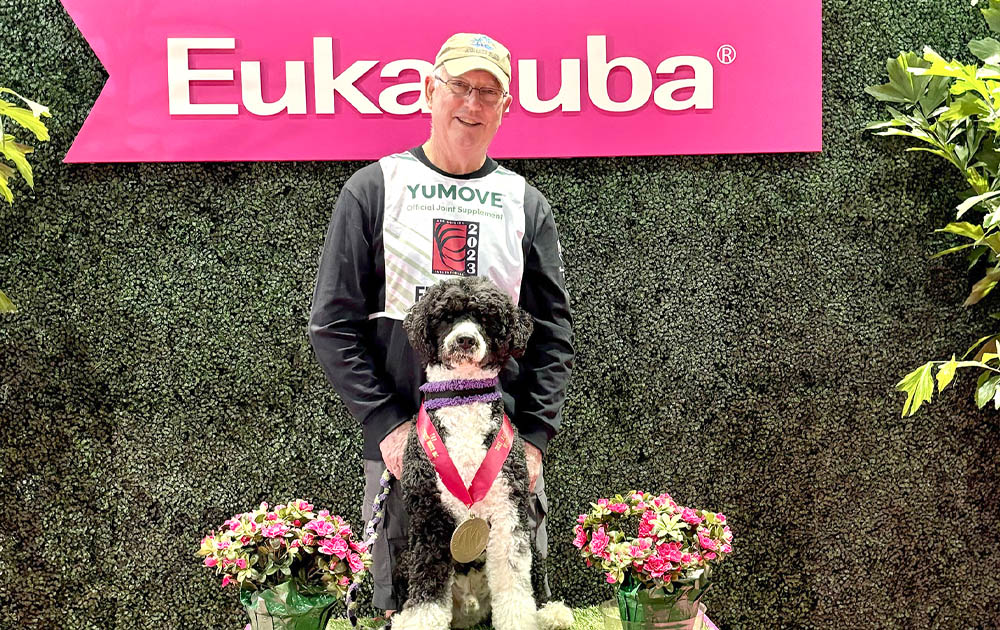
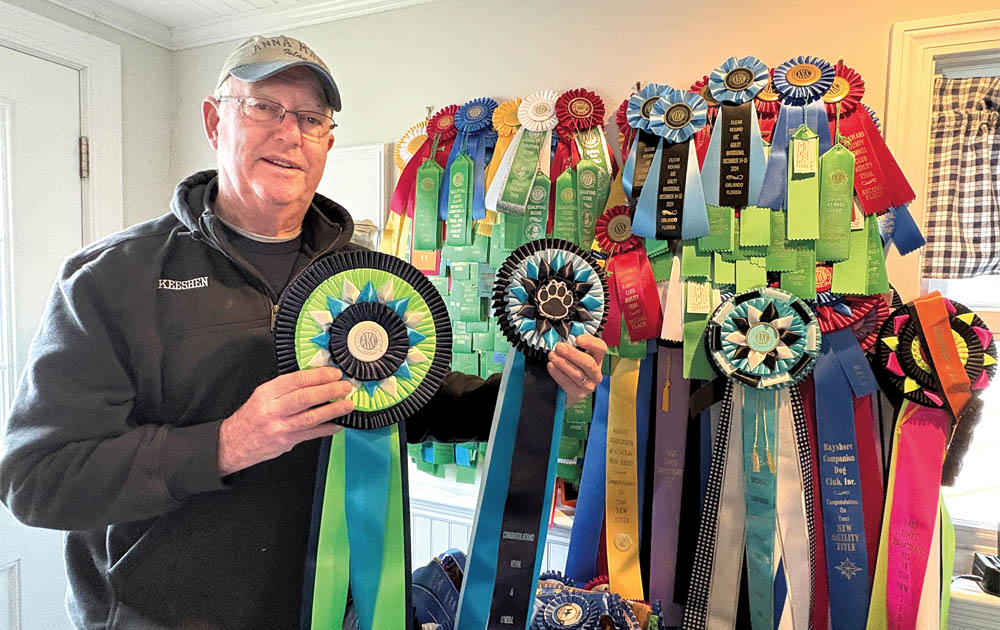
MONMOUTH BEACH – Local Portuguese water dog O’Neill is a rock star of the canine world. He was on ESPN Christmas Day, leaping over high bars, racing up and down seesaws, and running through tunnels. He’s won competitions all over the Eastern Seaboard by completing agility obstacle courses faster and more accurately than other dogs in his class, earning over 500 ribbons and the national Portuguese water dog Agility Grand Champion title. He even made the cover of a national dog magazine.
And perhaps more importantly, much to the envy of some dog owners, O’Neill responds swiftly to commands from his beloved owner and handler Kevin Keeshen, a Monmouth Beach resident.
Teamwork is key, Keeshen notes, and success didn’t happen overnight.
O’Neill is a special type of show dog. While he has competed in four Westminster competitions, he doesn’t win by posing; he wins by performing. Agility competitions blend training, teamwork and athleticism with effective communication between dogs and handlers. Groups like the American Kennel Club organize official agility competitions for each breed, and pet companies often sponsor them. Even mixed-breed dogs can compete. These are often big events with hundreds of dogs running multiple trials. Every course is different, created by a certified course designer with several difficulty levels, but all use obstacles to test the dog’s accuracy, speed and coordination with its handler. Ranking depends upon cumulative points earned throughout a competition career. O’Neill is currently ranked an impressive Master Agility Champion Level 6, meaning he now only competes at the highest level.
There are various classes of agility courses, including two universal ones that require speed, jumping ability, and tunnel navigation. Standard Class uses obstacles like seesaws, balance beams and steep A-frames to test a wide range of skills, including tight turning and control, requiring dogs to physically touch “contact zones” on the course.
Jumpers Class courses are shorter, faster and more intense. They don’t have contact zones; instead, they emphasize precision with weave poles, where dogs move between close-set poles like a slalom skier. In both courses, dogs qualify as contenders if they meet or beat the standard course time while avoiding faults for knocked bars or navigating obstacles out of sequence.
Handlers run around the course with their dogs, calling out commands. The dog that runs the course in the fastest time with the least number of faults is the winner. Prizes can include ribbons, trophies and even dog food or money.
Unlike horse racing, these competitions are not the purview of the wealthy, but can be enjoyed by anyone with a dog and the dedication to train and compete.
A Team is Born
Keeshen, now 71, got hooked on the sport after watching a Rhode Island agility competition. He entered the canine competition world with his first dog Bensen, also a Portuguese water dog. An easygoing fellow, Keeshen loved being a handler right from the start, he said, learning the ropes from local organizations like the Bayshore Companion Dog Club.
Competition dog owners are a diverse group, and female owner/handlers outnumber men by about 10 to 1. Keeshen’s comrades include lawyers, teachers, CFOs, cops and even a Top Gun pilot. Experienced judges, who have themselves competed for years, are in demand to oversee weekend trials.
Keeshen adopted O’Neill nearly 10 years ago from a Cape Cod breeder who raised grand champions. The energetic puppy with the cute name caught Keeshen’s eye right away, and he started training him several months later with basic backyard agility equipment on the family’s quarter-acre lot in Monmouth Beach.
Agility trials start with three obstacles at the novice level and progress to 18-21 obstacles on an advanced 180-yard course. But dogs, like toddlers, have short attention spans, so effective training can’t be too long or monotonous. Handlers and dogs often train in private or group classes; Keeshen and O’Neill take local weekly classes with five other teams, working under the watchful eye of an instructor. And there are plenty of everyday training opportunities around the house or in the neighborhood. Food is a much-relished reward; dogs can learn to “stay” or “come” using treats or even just regular meals as inducements, Keeshen notes. Persistence and consistency are key.
Since O’Neill is so well-behaved, Keeshen takes him everywhere to strengthen their teamwork relationship. You might have seen them working on the Long Branch boardwalk, 60 feet apart, with O’Neill happily lying down and intently waiting for commands. “The dogs want to please you,” said Keeshen.
Sometimes they attend local events together, and O’Neill’s exemplary conduct impresses onlookers. “I first saw him in Monmouth Beach Borough Hall with a loud crowd around him and the dog was just lying down, so quiet and relaxed despite the noise,” said Mike Canavan, a borough resident.
Barbara Keeshen, Kevin’s wife, wasn’t surprised. “Nothing bothers O’Neill,” she said.
It takes time to develop the essential teamwork, which is easier now for Keeshen since he’s semi-retired as vice president of Shorelands Construction, a company he founded and runs with sons Bryan and Peter.
It’s clear both Kevin and Barbara adore O’Neill. They emphasize that he is their cherished pet first, and a competitor second. “He’s family,” Kevin said.
“His agility ability is all just gravy to us,” added Barbara, explaining why they’re not interested in breeding.
O’Neill recently underwent surgery for a soft tissue sarcoma, and will soon begin post-op treatment with targeted radiation and physical therapy. The human family is there to help, as is Mittens the rescue cat, who regards O’Neill as “Papa.”
O’Neill’s diet is almost as special as he is. Hard-working dogs need a high-protein diet, and O’Neill eats a particular brand made in Lakewood and Barbara cooks her own homemade dog food in a crockpot. The recipe includes beef and chicken, brown rice, kidney beans, carrots, apples, pumpkin, coconut oil, and peas – healthy stuff – and O’Neill loves it, although he’s not a picky eater, she said.
“He counter-surfs,” laughed Barbara. “We can’t have any food on our kitchen counter.”
But that’s okay, since even champions are allowed a bit of mischief now and then.
The article originally appeared in the January 8 – 14, 2026 print edition of The Two River Times.