By Sunayana Prabhu
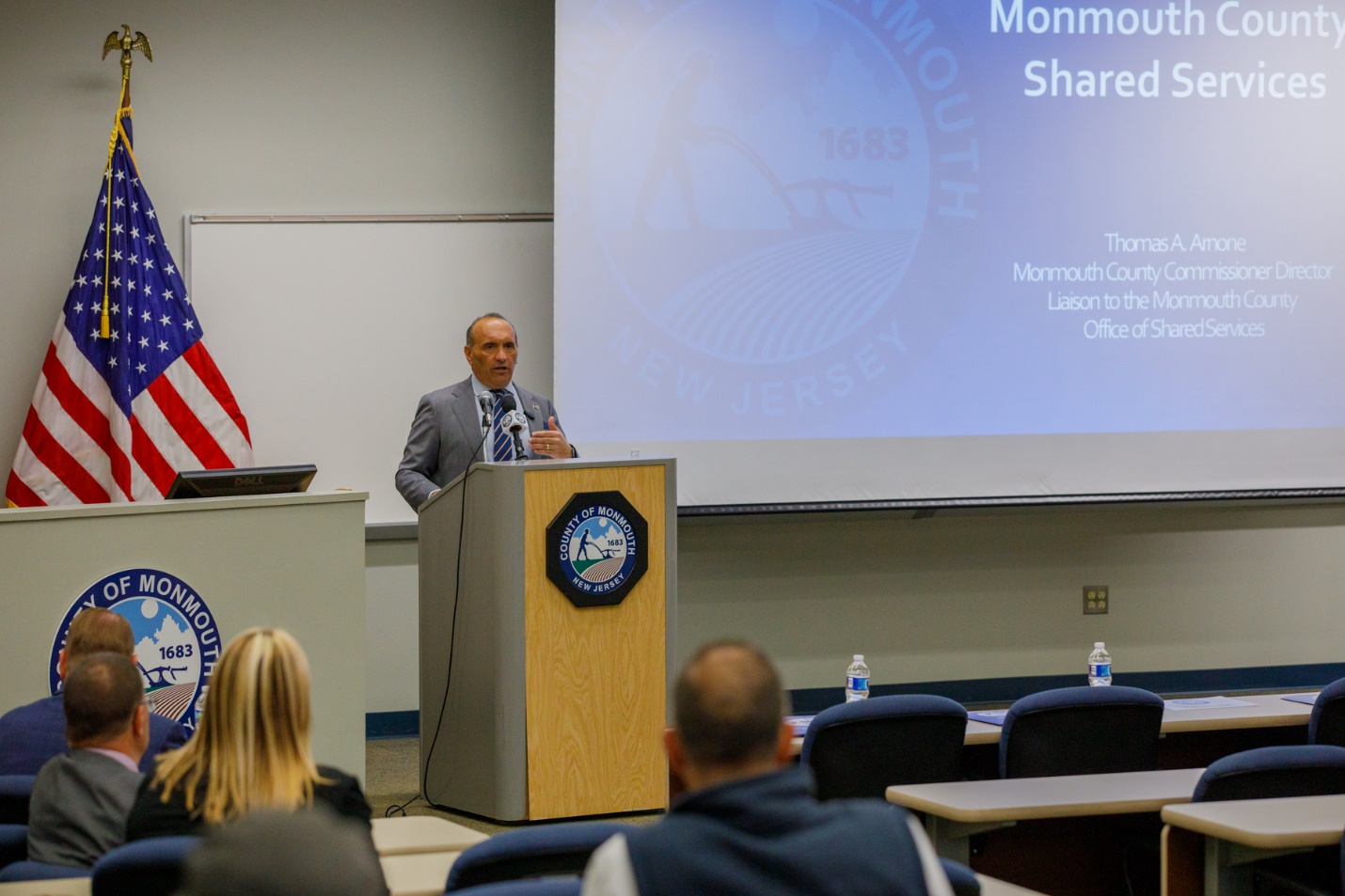
FREEHOLD – The Monmouth County Board of County Commissioners hosted its annual Shared Services Summit Nov. 13, urging elected and appointed officials to set their priorities for growth before the municipalities reorganize next year.
Often, municipalities have limited budgets that can delay or limit projects that offer residents the best quality of life. The Monmouth County Office of Shared Services facilitates partnerships with and between local government entities – the county provides services, equipment and resources to them, which helps reduce costs and increase efficiencies.
“We know how challenging it is to maintain an annual budget without raising taxes, but together we can continue to help reduce the heavy tax burden on our residents and preserve the high quality of life we all have come to enjoy in Monmouth County,” said Commissioner Director Thomas A. Arnone, liaison to the Office of Shared Services.
The objective of the county’s annual summit, besides discussing collaborative programs, was also to gain input from municipal officials on how to most efficiently implement the programs. Held at the Monmouth County Fire Academy, the summit featured presentations from various county officials, including Monmouth County Sheriff Shaun Golden, Monmouth County Clerk Christine Giordano Hanlon, officials from the Monmouth County Department of Public Works and Engineering, the Monmouth County Tax Board and the Monmouth County Division of Planning. Each speaker provided background on services offered through shared services agreements.
“One thing that is unique about our county compared to other counties is we have a designated program of shared services that truly” means just that, Arnone said. The point of the program is “to be partners to see joint savings,” said Arnone, noting that the initiative was launched to benefit all 53 municipalities nearly 15 years ago and it has evolved and expanded ever since.
The summit covered several county collaborations with municipalities, including centralized 911 dispatching, emergency medical services and public works assistance, among others.
One of the most notable programs is the county’s centralized 911 communications system, which now serves 139 law enforcement agencies throughout Monmouth. “The phone calls never stopped. They did over 785,000 calls for service last year,” with an average response time of six minutes for emergency medical calls, said Golden, noting how the system’s advanced technology, including real-time crime center feeds and drone integration, has increased efficiency. “To try to do that on a local level, or replicate any of that on a local level, is very difficult, very costly,” Golden said.
In February, the county commissioners approved and authorized funding for MedStar, the Monmouth County Emergency Medical Services program. Designed to assist volunteer squads facing staffing shortages, the program has responded to over 3,800 calls and transported 2,500 patients, all at no cost to participating municipalities. The program now has 10 ambulances, with an additional eight acquired recently.
Currently, MedStar serves Asbury Park, Eatontown, Freehold Borough, Howell and Long Branch. The program is set to expand to additional areas by the end of 2025.
The Monmouth County Department of Public Works also plays a key role in shared services, providing assistance with snow removal, vehicle maintenance, flood mitigation and historic preservation. Several municipalities, including Colts Neck and Neptune City, have already benefited from these services.
John Tobia, Monmouth County Director of Public Works and Engineering, said the public works department is not just focused on plowing roads but is a true partner in helping municipalities operate more efficiently.
Tobia provided several examples of the significant cost savings municipalities have achieved through the county’s public works shared services. Colts Neck saved over 33% on police vehicle maintenance by using the county’s services; Asbury Park saved 40% on its public works costs by utilizing the county’s resources.
The county can leverage its buying power to provide materials like salt and other supplies at discounted rates to municipalities, Tobia explained. “The county has a very big buying capability. We’re buying a lot of material, a lot of supplies, a lot of parts. We can avail that to you at our savings,” he told the municipality representatives in attendance. Whether salt, vehicle parts, signposts, iron for catch basins or manhole covers or stone used in public works, the county can offer that in a resale program which Tobia called “a tremendous, tremendous savings, where you don’t have to do the bidding process, you don’t have to wait for somebody to deliver, because most of that material, is already in our facilities.”
He also noted the county can perform services like street sweeping for towns at a fraction of what it would cost them to do it themselves.
In addition to cost savings, Tobia discussed the county’s investment in equipment and truck training simulators that are available for municipal public works staff. This training program helps improve safety and efficiency for municipal public works departments. During the summit, Arnone also pointed to a collaborative project with Red Bank as an example of the county working closely with a municipality to implement infrastructure upgrades in a cost-effective, shared service model. The county is partnering with Red Bank on improvements to Shrewsbury Avenue, including the installation of beacon lights.
Red Bank is to design and install the beacon lights – a minimal cost. After the initial installation, the county will take over the maintenance and repairs, a more significant ongoing cost. This approach allows the town to benefit from the improvements, while the county handles the long-term maintenance responsibilities.
As the county’s records keeper, Hanlon said the clerk’s office understands the challenges municipalities face in managing their documents and archives.
The shared service programs the clerk’s office offers aim to leverage the county’s resources and expertise to provide cost-effective solutions for local governments, such as allowing municipalities to safely store historical and important paper records that they may not have space for.
The county clerk’s office also offers an e-recording system for property transactions which Hanlon noted saves municipalities time and paper compared to submitting physical documents. Hanlon encouraged municipalities to sign up for the e-recording system, as it is a free service provided by the county.
Additionally, the county’s digital records management system – the RIM (Records Information Management) – program digitizes municipal records, allowing for easier access and reduced storage costs. Hanlon noted this state-certified program has been adopted by 21 of the 53 municipalities, with plans to expand further.
Arnone said the county has dropped some shared services programs that weren’t financially viable, including “care center businesses,” a move that saved the county roughly $8 million.
The county also stopped operating the Tinton Falls landfill, putting it in a private company’s hands instead, saving the county around $6 million.
The article originally appeared in the November 28 – December 4, 2024 print edition of The Two River Times.