By Ryan Gallagher
If your tap water tastes a little different for a while, don’t panic.
On Feb. 12 New Jersey American Water switched its water treatment process from the usual “total chlorine” approach; two treatment plants will use “free chlorine” to disinfect tap water until mid-April. As a result, there is a chance customers may notice a smell or taste of chlorine in their tap water, according to company officials.
“The treatment change is temporary and is an annual proactive maintenance activity,” explained Brian Jacobus, the senior manager of production for NJ American Water’s Swimming River water treatment plant in Colts Neck. Jacobus has been in this position since 2018; he is a hydrogeologist by trade and has also been an environmental consultant.
The Jumping Brook treatment plant in Neptune will also undergo the same switch in water treatment.
“It is a regulatory requirement to have disinfectant in water,” explained Jacobus. “This area has a total chlorine system where we add chloramines. The benefit of switching the treatment process is proactive and beneficial to our plants and distribution system. This switch allows us to take systems offline to perform maintenance on pumps and motors.”
For more than nine months of the year, the water at these plants is treated with chlorine and ammonia for disinfectant, Jacobus explained. However, over the next eight to nine weeks the treatment plants will rely solely on free chlorine to disinfect the tap water. This is why it is possible customers may smell or taste chlorine in their tap water at some point between now and mid-April.
“If customers experience this, they can fill a glass or container with water, put it in the fridge, and wait for the smell or taste of chlorine to dissipate,” said Jacobus. “But we do not anticipate any taste or smell difference in the water.”
Customers are not advised to take any other measures, said Jacobus and Chelsea Kulp, senior manager of Government & External Affairs, when asked if customers should buy purified water in jugs or utilize personal water filters.
“Customers might notice a slight difference, but it will quickly dissipate,” said Kulp, who handles public relations for NJ American Water and who also said she is a tap water drinker.
“I don’t want to speak for Brian, too, but he also lives and is a customer of these treatment plants. If anything, let the water sit in the fridge so the smell or taste of chlorine dissipates,” she suggested.
Jacobus and his family are also “tap water drinkers, through and through,” he said.
“The water that leaves treatment plants during this time and during normal operations will continue to meet or exceed federal or state regulations,” he said. “And no one particular region should experience different water quality than other service areas.”
The change in water treatment is done during this time because the total demand for water is less in the winter months, compared to the summertime. The Swimming River plant in Colts Neck can treat 40 million gallons per day at peak demand times. While the Jumping Brook plant can treat 30 million gallons per day at peak demand times.
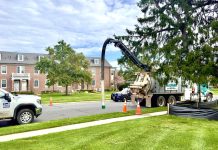
“During this time we also go through fire hydrant flushing as long as we don’t have freezing conditions,” said Jacobus. “We are typically flushing, if weather allows, in mid-March. That coincides with treatment as we pull free chlorine disinfectant through the entire system.”
After the free chlorine treatment is finished sometime in April, the NJ American Water plants in Neptune and Colts Neck will go back to treating tap water by adding chloramines (or using the total chlorine treatment method).
Chloramines are a group of chemical compounds that contain both chlorine and ammonia, according to the Centers for Disease Control and Prevention. Specifically, for these treatment centers, a type of monochloramine has been mixed into water since 2012. The process was implemented to kill germs while also offering water which is safe to drink.
The temporary treatment change applies to New Jersey American Water customers in all 14 Two River-area communities: Atlantic Highlands, Colts Neck, Fair Haven, Highlands, Holmdel, Little Silver, Middletown, Monmouth Beach, Oceanport, Red Bank, Rumson, Sea Bright, Shrewsbury and Tinton Falls.
The article originally appeared in the February 15 –21, 2024 print edition of The Two River Times.