By Sunayana Prabhu
RED BANK – The competition for real estate in a saturated downtown area is fierce.
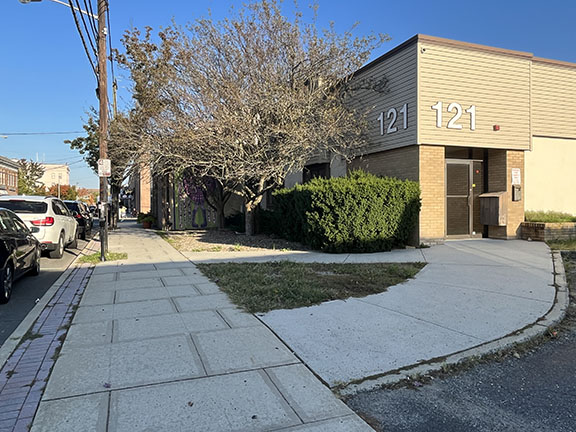
And density comparisons were the crux of an argument at the Red Bank Zoning Board meeting, Oct. 6, where developer Michael Salerno’s 121 Monmouth St. application to construct a 46-unit apartment building faced objections from owners of the newly constructed 45-unit Station Place apartments, located few doors west at 145 Monmouth St.
Salerno’s application to construct a mixed-use building at 121 Monmouth St. was back on the agenda at a regularly scheduled meeting that turned dramatic as professional planner Joe Burgis was the focus of an angry rebuttal from former mayor and attorney for Salerno, Ed McKenna.
Burgis and attorney Kevin Asadi presented objections to the proposed building on behalf of their client, Station Place. Burgis refuted testimony presented by Salerno’s project engineer James Kennedy and professional planner Keenan Hughes.
Hughes indicated to the board that transit-oriented developments should typically fall within a quarter-mile radius of a transit hub like a train station. However, Burgis noted that Red Bank chose to adopt a transit-oriented overlay instead, which coverage area ends about 400 feet to the west of 121 Monmouth. “So, all those comments about how this application furthers the Master Plan, transit-oriented overlays… It really doesn’t apply here,” said Burgis.
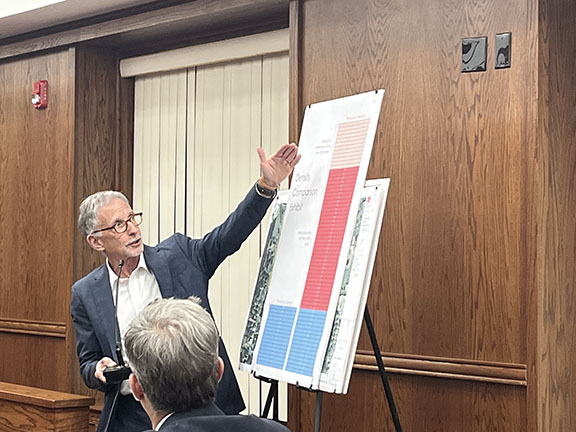
He concluded that “there is no real justification” for the applicant’s request for certain variances. He also presented a density comparison exhibit, a poster that illustrated what 16 units to the acre looked like in relation to Salerno’s proposed 46 units, noting that is “a substantial deviation” from zoning code.
At that point, McKenna walked over to the density comparison poster and dropped it to the ground, redirecting the board’s attention to the fact that Station Place apartments has “50 units per acre.”
“Burgis testified on how this board should be enforcing 16 units per acre but the person that’s writing his check has 50 units per acre,” McKenna said. He also noted, “They have 1.2 parking spaces. And they built their affordable housing in a separate building, that they didn’t even preserve within their structure.”
Burgis said he had only evaluated whether the current application met the statutory criteria and made conclusions to the board. “You can cross-examine me on that, but I did not study that other building in terms of whatever rationale was presented, how it’s designed, or anything else. I focused on the application before the board.”
McKenna asked Burgis to list the densities that have been approved in the last three years in the area. “They are all in excess of code,” Burgis said.
McKenna explained that densities of “69, 64 and 72 units per acre have all been approved, built and highly successful. So, what you’re doing is coming to this town and saying, ‘You should have always stuck to 16 units per acre.’ ”
Asadi, Station Place’s attorney, intervened and clarified the board has approved variances on other properties, but he said, “variances are to be considered on a property-by-property basis.”
“I think you showed disrespect for this governing body, disrespect for this town,” McKenna said. “We have tremendous people that serve here, they put in their time, their effort, they spend incredible number of hours concentrating on each application.”
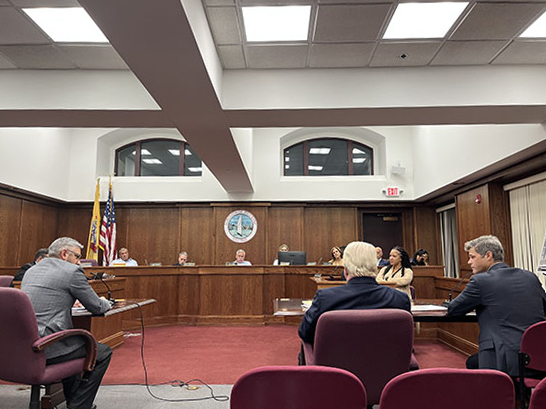
“I live in this town. You don’t,” McKenna told Burgis.
McKenna’s cross-examination turned into a “rant against my planner’s character,” said Asadi, calling McKenna’s comments “preposterous” and disrespectful of the board and governing body. “I want it to stop, right now,” said Asadi.
Since Feb.17, 2020, Salerno has been seeking approval from the zoning board to construct the mixed-used building at 121 Monmouth St., on the southwest corner of Pearl and Monmouth streets. With subsequent reviews and rejections from the zoning board, the original proposal for a 5-story building with 59 units was scaled down to a 4-story, mixed-use building with 46 units, meant for residential and retail use.
The proposed building would envelope the existing Pearl Street Consignment and Custom Clothes thrift store within its structure and save the single-family home at the rear of the property on Oakland Street, which would become a three-bedroom, deed-restricted affordable housing unit.
The proposed apartment would abut Red Bank Charter School property. McKenna ensured the board their team had resolved all issues concerning proximity to a school, like traffic and trash removal, among others. The only public comment at the meeting came from Carl DeAngelis who owns 117 Monmouth St., a building that shares a common wall with 121 Monmouth St. He said he was “strongly in favor of this application,” but was concerned about the impact of the demolition on his building. Salerno’s engineer Kennedy assured DeAngelis the developer has agreed to take on any reasonable costs to protect his building.
At the meeting, the board granted Asadi the opportunity to present the testimony from his traffic engineer and decided to carry forward their vote on Salerno’s application to the next board meeting Nov. 3.
The article originally appeared in the October 13 – 19, 2022 print edition of The Two River Times.