By Sunayana Prabhu
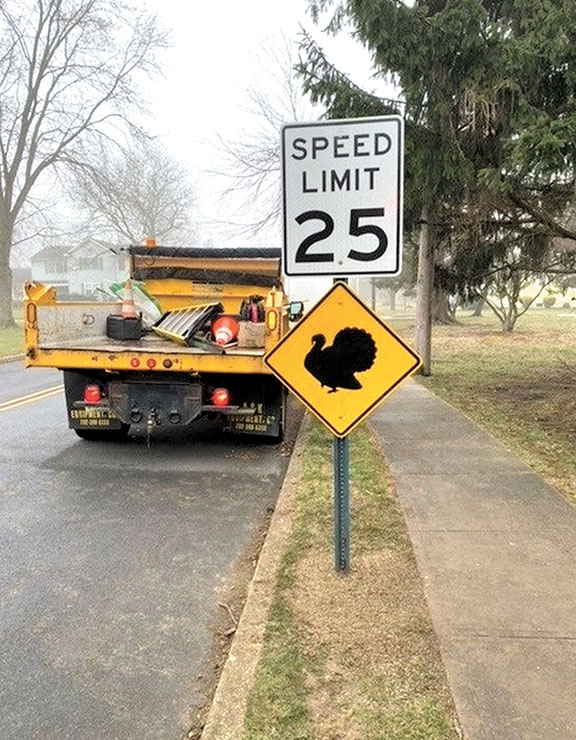
OCEANPORT – Wild turkeys have sent some residents on a wild goose chase. To help the birds pecking around Port-Au-Peck, borough officials recently installed two wild turkey signs, notifying residents about the free birds that are causing quite a stir in the neighborhood.
Mayor John “Jay” Coffey Jr. made residents aware of the birds’ presence in a social media post May 11. “Wild turkeys taking up residence in Oceanport,” he wrote. “There are about five of them.”
Unlike the “Five Little Turkeys” waddling away one by one in William Boniface’s read-aloud book, the five wild turkeys of Oceanport have been charging at humans lately and they appear to be “here to stay,” Coffey said, noting that the birds had been “peacefully meandering throughout Oceanport for several months, but recently began taking a bit more of an aggressive stance with our human residents, especially those humans driving slowly in motor vehicles.”
Shannon Ivins said she was in her car at the traffic light at Port-Au-Peck Avenue and Monmouth Boulevard when “all of a sudden this wild turkey came charging at my car from the lawn of the neighbor and came out into the road and started aggressively going around my car. I had to throw the car into park.”
Ivins said a cop who saw the incident turned on his sirens. “Whoop-whoop-whoop and the turkey ran away.”
“I’ve lived here for 37 years and I’ve never seen turkeys until this year,” Tom Murphy said. This year he’s seen them in “packs” of “at least five to 10.”
The aggressive behavior of the wild turkeys is now being viewed as gender specific by some residents. “I think there’s a male that keeps attacking everybody’s vehicle at the end of Comanche (Drive),” said Miguel Toro. He has found the birds on his front yard the last few nights on Wardell Circle. According to Toro, “Only the male does this,” noting the turkey “would stand in front of cars and you have to get out, shoo it away, and get back in the car and take off. But yeah, he’ll block your car.”
Coffey said several videos and photos of cars being pecked at or charged by the birds can be found on social media. The wild birds have apparently been attacking their own reflection on the side of a car. Coffey believes the turkeys “think it is another turkey,” because wild turkeys don’t seem to have “much experience with how mirrors or reflections work,” he said. “They are, after all, wild turkeys.”
With “little experience or no experience with marauding wild turkeys,” Coffey said, he contacted the NJDEP’s Division of Wildlife Management and Wildlife Control and learned more about their “history, habits and habitats.”
The centerpiece of dinner tables once a year, the ubiquity of these birds during holidays is indisputable: magazine covers, newspapers articles, television shows, fundraisers, cooking contests. But the wild version of these birds does co-exist with humans all year-round.
Coffey also reached out to the representatives at USDA’s Wildlife Services Department which assessed the borough’s wild turkey situation to determine whether the birds should be relocated.
“The long and the short of it,” Coffey said, is that “we are going to have to adapt to their presence.”
Wildlife experts reported that turkeys were being fed by residents which they and the mayor urge against. Coffey encouraged residents to put away bird feeders or any accessible source of food for a few weeks.
Wild turkeys were nearly endangered in the 1800s “due to habitat changes and killing for food,” according to the New Jersey Fish and Wildlife (NJFW) website. In 1977, NJFW biologists collaborated with the New Jersey chapter of the National Wild Turkey Federation to “reintroduce wild turkeys with the release of 22 birds in the state. In 1979 biologists and technicians began to live-trap and re-locate birds to establish populations throughout the state. By 1981 the population was able to support a spring hunting season, and in December 1997, a limited fall season was initiated.”
Wild turkeys are now abundant throughout the state – not just in Oceanport – wherever there is suitable habitat. The turkey population is now continually monitored by the state. The NJFW estimates the statewide population is now at 20,000 to 23,000 with around 3,000 turkeys “harvested” annually.
“The females are sitting on the eggs now,” resident Jackie Smith noted. “They should be hatching soon.” Meanwhile, she quipped, the males disrupting traffic are “just bored. The harem is full.”
“Wild turkeys are beautiful albeit somewhat foul-mannered birds but to see them running on our streets and through our yards is,” Coffey said, quoting Port-Au-Peck’s oldest fireman Buddy Brocklebank, “poultry in motion.”
The article originally appeared in the May 25 – 31, 2023 print edition of The Two River Times.