By Sunayana Prabhu
MONMOUTH COUNTY – Many families are preparing for Thanksgiving, but not all with the same spirit this year.
The federal government shutdown that started Oct. 1 has now caused the suspension of the country’s largest anti-hunger program, the Supplemental Nutrition Assistance Program (SNAP), previously known as the Food Stamp Program. The shutdown is leaving nearly 42 million low-income households – including almost 90,000 across Monmouth and Ocean counties – without their November food assistance.
Federal judges in Massachusetts and Rhode Island ruled separately but similarly Oct. 31, ordering the Trump administration to use emergency funding to temporarily fund SNAP and continue benefits. On Monday, the administration OK’d partial funding for the month, but those benefits may take weeks or even months to be restored, according to federal officials.
“The complexity of what is going to be required to get those partial payments out could create additional delay,” said Triada Stampas, president and CEO of Fulfill NJ, the state-supported food bank serving nearly 300 food pantries, meal providers and shelters in Monmouth and Ocean counties.
Stampas explained that state officials need to recalculate the partial benefit amount for recipients and transmit that information to the company that processes transactions and loads SNAP recipients’ debit cards with their benefits.
“The stakes are really high for the state to get the benefit amounts exactly right,” said Stampas. Food banks, already stretched thin since the pandemic, are now bracing for even more demand for food assistance.
Meanwhile, neither state officials nor area food banks are banking on the avail- ability of those funds and have activated emergency response actions to protect vulnerable populations that rely on SNAP cards for their daily nutritional needs.
Gov. Phil Murphy declared a state of emergency Oct. 31, a day before SNAP expired, and allocated $42.5 million in relief measures, along with increased support for food banks, which were already reporting an “unprecedented” number of new people seeking food assistance.
“This is the very first interruption of benefits in the entire history of the program that started in the 1960s,” Stampas said.
Food Banks See ‘Crisis’
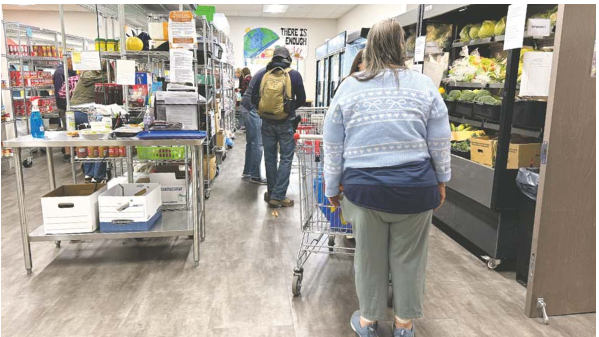
At Lunch Break’s food pantry in Red Bank – a free resource – 61-year-old Paula Merz sat waiting her turn among many other adults and children in an unusually crowded lobby. Disabled and unemployed, she is among those who did not receive her monthly SNAP payment Nov. 1.
“Everybody is worried right now without the food stamps,” Merz said. “I’ll try to take whatever I can with what I get.” She said she plans to stretch her pantry supplies to host 10 family members, including five grandchildren, for Thanksgiving. But for Merz and other SNAP recipients across Monmouth and Ocean counties – 60% of whom are children or seniors – this holiday season has become uncertain.
Local food banks have activated disaster response protocols, calling it a “crisis” situation. Most pantries are reporting a nearly 50% surge in people seeking help since the federal freeze began.
“Before this issue came up with SNAP, people were already struggling,” said Gwendolyn Love, executive director of Lunch Break.
“This just exacerbates the whole situation.” Love said more pantries are opening in response – the YMCA is running food drives, colleges and schools now have pantries. “More and more people need access to food,” Love said, and “with the holidays coming, with people being laid off… it’s just going to get worse.”
The Lunch Break pantry has witnessed a 51% surge in new families seeking assistance between September and October. A similar uptick was also observed in the adjoining soup kitchen. Beth Sherrard, Lunch Break’s pantry supervisor, said there were 180 families in September that had never been to the pantry before; in October that number rose to 271.
Sherrard noted that the suspension of benefits isn’t the only worry. There are changes coming to the SNAP program, too, including a new work requirement when the program resumes. “People up to age 65 need to work a certain number of hours to be able to get more than three months’ worth of SNAP benefits,” Sherrard said. “That’s going to be a hardship on a lot of our clients as well.”
For Merz, survival means creativity. “I make magic with the cans,” she said. “Hey, listen. You have a fire to put a pot to boil water, you can make something.”
Yet her resilience cannot fully bridge the widening economic gap that is at the center of burgeoning food insecurity. Particularly in Monmouth County, “rent is prohibitive,” Sherrard said. In addition, high “property taxes, medical expenses, inflation, tariffs” and limited state support drive people to seek assistance.
Many people who receive SNAP benefits are employed but can’t make ends meet, Sherrard explained, so they turn to food pantries like Lunch Break for additional food assistance.
The amount of SNAP benefits a person receives varies based on household size and circumstances. New Jersey’s mini- mum monthly SNAP payment for an individual is $95.
“You can’t buy anything for $95,” Sherrard said.
From July through September, Fulfill has seen almost “50% more visitors than the same period the year before, and that’s before these cuts went into effect,” Stampas said. “We are collectively serving at a level that we never have before, and many of our pantries are really at capacity.”
According to Stampas, in a typical month, SNAP delivers about $17 million worth of grocery money to low-income households in the area. Without SNAP, that’s a loss of 4.3 million meals. “We would have to more than triple our distribution to cover that loss,” Stampas said.
State Leaders Scramble to Provide Relief
In addition to the $42.5 million in food and hunger grants to help fund New Jersey food assistance programs, Murphy allocated another $900,000 through the New Jersey Economic Development Authority (NJEDA) Nov. 3, to support the state’s six Emergency Feeding Organizations (EFO) that include Fulfill NJ. Fulfill will receive $6.375 million as part of the state’s food and hunger grants and $135,000 from the NJEDA.
According to state officials, this aid comes at a critical time, as approximately 813,000 New Jerseyans, including 340,000 children, rely on SNAP benefits.
A bipartisan coalition of nearly 26 states, including New Jersey, filed lawsuits Oct. 28 in the U.S. District Court in Massachusetts against the U.S. Department of Agriculture (USDA) and Secretary of Agriculture Brooke Rollins for “unlawful” suspension of SNAP during the government shutdown.
“New Jersey families are being used as political pawns by the Trump Administration, which is illegally suspending SNAP and the critical assistance it provides to residents who are struggling with food insecurity,” said Attorney General Matthew J. Platkin in a statement announcing the lawsuit. “This is especially devastating in the month of November, when families are gathering and demands on food banks and pantries are heaviest. We are standing up for families across our state and fighting to ensure that they continue to have access to food for their households.”
A federal judge in Rhode Island ordered the U.S. Department of Agriculture to fund SNAP in November, in whole or in part. In court filings, the USDA agreed to use $4.65 billion from the program’s contingency fund to continue partial SNAP benefits.
Snap Pause Impacts School Food Assistance
More than 500,000 students are enrolled in free or reduced-price school meal programs, according to the state. Suspended SNAP benefits coinciding with statewide school closures in November for the New Jersey Education Association conference and other holidays could limit food access for school-age children and further exacerbate food insecurity.
Fulfill launched targeted food distribution efforts for school districts with high SNAP enrollment during this week’s extended school closures.
“Because we’re dealing with school closures that may impact meal access, we are prioritizing getting immediate relief to school communities that have high numbers of SNAP enrollees,” Stampas said.
Last Wednesday, Fulfill conducted a special food distribution at the Long Branch school district, identified as having the largest concentration of SNAP recipients in the region.
Several schools have notified parents and posted details on their websites about how students can still get access to food assistance during the shutdown. According to an official post on the Red Bank School District’s website, “All children in families receiving benefits from NJ SNAP are automatically eligible to receive free school meals – they do not need to fill out an application. They simply need to go to the school cafeteria for lunch as usual. If your school also serves breakfast, that is another free school meal for your student.” Those students who aren’t currently receiving free school meals can complete an application with the district.
Meanwhile, SNAP recipients can still access any funds carried over from October or earlier months, and those who receive a state supplement will continue getting that limited amount, officials said.
How to Help
The Monmouth County Board of County Commissioners has launched a countywide food drive to support local food banks and residents affected by the suspension of full SNAP benefits. “Many families in our community are facing increased challenges putting food on the table,” commissioner director Thomas A. Arnone said. “By coming together, we can make a real difference for those in need.”
Nonperishable food items can be dropped off at the Monmouth County Library Headquarters in Manalapan or the Eastern Branch in Shrewsbury. The state encourages residents to locate nearby food pantries and community kitchens through NJ 211 (nj211.org). Many pantries offer fresh produce, shelf-stable foods and additional support services. Fulfill and Lunch Break continue to seek donations and volunteers. SNAP recipients can find updated benefit information at fns.usda.gov/snap. Visit lunchbreak.org for more information about its offerings or how to donate.
The article originally appeared in the November 6 – November 12, 2025 print edition of The Two River Times.