By Sunayana Prabhu
RED BANK – As the national debate intensifies over a federal budget eyeing Medicaid cuts, millions face the threat of losing essential health care coverage, a concern already evident at nonprofit care centers in Monmouth County, including the Red Bank-based Parker Family Health Center and The Arc of Monmouth in Tinton Falls.
On Feb. 25, the U.S. House of Representatives passed a budget resolution calling for $2 trillion in spending cuts. The resolution, which passed along party lines, instructs the Energy and Commerce Committee, of which U.S. Rep. Frank Pallone Jr. (D-6) is the ranking member, to find $880 billion in cost cuts over the next decade, “with Medicaid squarely in the crosshairs,” Pallone said, criticizing the plan in a March 3 statement. He warned that Medicaid cuts would threaten home and community-based care, health care and employment programs for individuals with disabilities.
Medicaid funds more than half of all services for people with disabilities, covers nearly half of all births in the U.S. and provides essential long-term care for more than 61% of seniors in nursing homes.
“The impact of the loss of Medicaid is going to be felt tremendously in the population that we serve,” said Suzanne Dyer, executive director of Parker Family Health Center. For patients on Medicaid who lose their benefits, a free clinic would be the next option for health care.
The center on Shrewsbury Avenue is one of only five free clinics in the state of New Jersey. It serves Monmouth County by offering free health care to low-income families who don’t have access to other medical care. The center offers vaccines and health care screenings, in addition to other medical services, and utilizes federal funding like Medicaid to help their patients.
“Access to care is a fundamental right and so we will work tirelessly to try and meet what we’re anticipating will be numbers like we’ve never seen,” Dyer said.
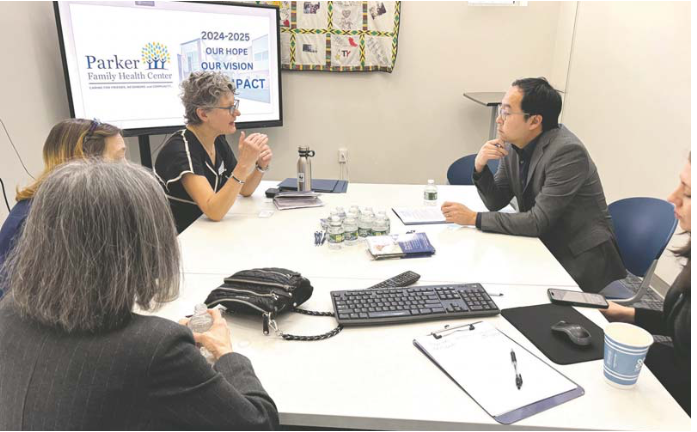
U.S. Sen. Andy Kim (D- NJ) visited the Parker Family Health Center March 1 and heard from volunteer physicians and clinic team members. The potential impact of Medicaid cuts “would be catastrophic,” Kim said during his visit.
According to the March 2024 enrollment summary of NJ FamilyCare, the state’s Medicaid program, gutting Medicaid could impact nearly 1.8 million recipients in the state and about 14,291 recipients in Monmouth County, including seniors, individuals with disabilities, low-income adults and children.
According to the state’s budget recommendations for fiscal year 2026, nearly $6.3 billion has been allocated for NJ FamilyCare. Possible federal cuts to Medicaid pose a substantial risk to the state’s budget plan.
The Parker Family Health Center is anticipating a 15% cut, Dyer said, “I will not cut clinical staff. We may have to cut in other places… It’s going to be at least $200,000 out of a $1.6 million budget this year,” Dyer warned. “If Medicaid is cut and subsidies are lost, we are going to see a tremendous influx of patients in New Jersey and Monmouth County,”“If Medicaid is cut and subsidies are lost, we are going to see a tremendous influx of patients in New Jersey and Monmouth County,” she told Kim during his meeting at the center.
The center faces tough decisions ahead. “We’re anticipating having to expand our hours, potentially opening every Saturday and extending evening hours,” Dyer said, as staff would try to meet increasing demand for care.
Since the center is prohibited from charging patients, grant funding is its primary lifeline, along with other funding avenues. But “private foundations and donors cannot make up the funding gap in the loss of the federal funding. The gap is too great,” Dyer said. “The real question is: Who is going to provide these services if nonprofits start to go out?” The center accommodated over 18,000 medical visits last year.
The potential funding loss also threatens the clinic’s ability to serve approximately 1,300 patients annually.
“Our patient population is made up of those who can’t afford to pay, whether through the ACA (Affordable Care Act, also known as Obamacare), or Medicaid, for a host of reasons – financial, documentation, or otherwise,” Dyer explained.
The fight for health care equity goes beyond funding. Dyer is also concerned about the potential loss of the Federal Tort Claims Act (FTCA), which offers liability protection to certain volunteer health care professionals working in federal programs at community health centers such as the Parker Center. FTCA coverage serves as malpractice insurance and its removal would make it more difficult to attract volunteers to community clinics.
“A lot of us are retired and we don’t have our own malpractice insurance anymore. Even when I was working part-time, the malpractice insurance was ridiculously expensive, and there’s no way I could work here unless I am provided malpractice (insurance coverage).” Vivian Kominos, a volunteer cardiologist at Parker Family Health Center, said during the Saturday discussion with Kim.
“Losing our FTCA coverage would not be a game changer. It would be a game over,” Dyer said.
Essential services, including programs such as Vaccines for Children, are also at risk, she added. “If these programs go away, we cannot make up for that.”
Pallone announced March 3 that Lauren Zalepka, a disability advocate and former president of Tinton Falls-based The Arc of Monmouth, was to be his guest at President Donald Trump’s 2025 Joint Session of Congress address March 4.
Zalepka, whose daughter has an intellectual developmental disability (IDD), has fought to protect Medicaid, an important resource for people with disabilities. Without it, organizations like The Arc of Monmouth could be forced to cut back or shut down entirely.
“As a mother, I know exactly how much Medicaid means to families like mine,” Zalepka said in a statement March 3. “The Arc of Monmouth serves more than 1,600 individuals in our community, and nearly all of them depend on Medicaid. These cuts aren’t just numbers on a page – they are real people losing the care they need to survive and thrive.”
Pallone condemned the cuts, which he argued take “health care away from people with disabilities and seniors so the ultra-wealthy can get another payday.”
Zalepka, alongside Pallone, said she would send a message at the Tuesday presidential address that these cuts will not go uncontested.
The article originally appeared in the March 6 – March 12, 2025 print edition of The Two River Times.