Agreement Would Allow 450 Residential Units
By Emily Schopfer
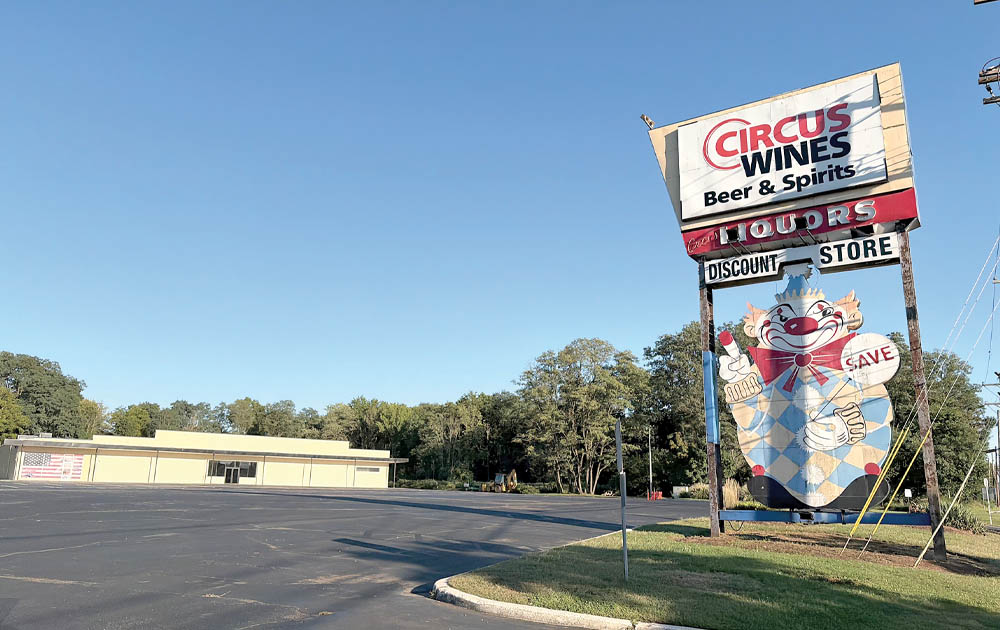
MIDDLETOWN – The township has released a settlement agreement that could end a three-year affordable housing lawsuit around the development of the 52-acre former Circus Liquors property on Route 35.
AAMHMT Property LLC filed the builder’s remedy lawsuit in 2023. A fairness hearing is scheduled for Oct. 2 before New Jersey Supreme Court Judge Gregory L. Acquaviva, according to a notice posted Sept. 1 by the township. The Aug. 6 settlement would allow 450 residential units, with 15% (68) set aside as affordable housing. AAMHMT originally proposed 937 units in 2023.
Mount Laurel Doctrine
The developer’s central claim against the township is that, under the Mount Laurel Doctrine, the township violated its third round of New Jersey’s Affordable Housing Obligation. It called for rezoning the former Circus Liquors property to allow development.
When the third round ended in 2025, Middletown still had an affordable housing obligation of 602 units, down from an original 1,026. The fourth round, from 2025 to 2035, added 346 units to this obligation.
A builder’s remedy lawsuit lets a real estate developer sue a municipality for failing to meet fair share housing obligations, using it to bypass municipal zoning and make way for affordable housing construction. According to the nonprofit advocacy organization Fair Share Housing Center (FSHC), a builder’s remedy is an enforcement tool under the Mount Laurel Doctrine.
The Mount Laurel Doctrine was a landmark 1975 civil rights case in which the New Jersey Supreme Court outlawed exclusionary zoning. The case also required the state’s municipalities to provide their “fair share” of affordable housing.
These state-mandated requirements have become a source of contention in Middletown. “The problem that we have is that because Middletown is so large, our obligations are higher than – far higher than – anybody’s,” Middletown Township attorney Brian M. Nelson said. He also said the “ball,” or rules, are constantly changing.
Middletown Mayor Tony Perry took a similar stance on state-mandated affordable housing requirements during a Jan. 20 township committee meeting about the West Nutswamp Road development. Perry said he is “sick and tired” of those who don’t know the town dictating what should be done within the town. “Every 10 years, the goal post is going to be moved and moved and moved and, despite what varsity kicker you have on your team, you are never going to get that extra point because you are never going to satisfy them,” he said at the time. The West Nutswamp Road development has since been settled, allowing for up to 136 townhomes with 20% set aside as affordable.
Nelson confirmed that, in addition to the West Nutswamp Road development, Middletown has at least a dozen sites throughout the township that will help satisfy the remaining affordable housing obligation.
Property History
The builder’s remedy lawsuit between Middletown and the Wall-based real estate developer AAMHMT Property LLC began Aug. 17, 2023, when the developer sued the township. Nelson explained that the Circus Liquors site has decades of litigation history. “I’ve been township attorney since 2009 and it precedes me,” Nelson said.
“This did not start in 2023.”
The Circus Liquors property is one of many parcels along Route 35 owned by the Azzolina and Scaduto families that were purchased with the intention of large-scale development, according to Nelson. The development plan began as a mixed-use commercial project called “Middletown Town Center.” Mountain Hill LLC, a development company of the Azzolina and Scaduto families, proposed the project in September 2000. “Everybody went crazy,” Nelson said. “The town denied them and (it) resulted in years and years and years of litigation,” which was ultimately settled in 2009, he said.
This settlement allowed the development, although significantly smaller than originally proposed, to move forward. The “genesis of (the settlement) was to do a mixed-use commercial in the front, residential in the back,” Nelson said.
The township eventually secured a redeveloper for the commercial part of the project, which was set to include a Wegmans grocery store, a movie theater and other tenants. “We granted approvals for that project; we had a redevelopment plan in place, site plan approval, and everything was ready to go,” Nelson said, “but a group of residents didn’t like it.”
On Jan. 31, 2018, a grassroots group of citizens calling itself Minding Middletown LLC filed a civil lawsuit against the township to fight the development.
Although the court ruled in favor of the township, Nelson said the delay caused by the 2018 lawsuit, plus complications from the COVID-19 pandemic, led the developer to walk away from the project. The undeveloped property then went back on the market for the first time in over a decade.
Developer Lawsuit
AAMHMT, the contract purchaser of the Circus Liquors site, proposed a plan in 2023 to build a 937-unit residential project. The project included both market-rate and affordable apartments and townhouses and, after the township rejected it, a builder’s remedy lawsuit was filed.
Just four days after the lawsuit was filed, the township began attempts to seize control of the property, according to a June 27, 2025, Superior Court of New Jersey ruling. Middletown adopted a resolution authorizing the planning board to conduct a preliminary investigation to determine whether the property should be designated as an “area in need of redevelopment” for condemnation purposes. That same day, the township adopted a second resolution designating Duva Development, LLC as the site’s official redeveloper.
In September 2023, the township committee adopted an ordinance that stated that a site plan application could not be submitted unless the applicant was the designated redeveloper.
The township adopted yet another resolution Feb. 20, 2024, accepting the planning board’s recommendation and determination that the site in question was an “area in need of redevelopment,” and could be condemned by the township under local redevelopment and housing law.
AAMHMT subsequently challenged the ordinances and resolutions through various amended complaints filed as part of the litigation.
The Fair Share Housing Council joined the lawsuit against the township Feb. 8, 2024. This is not the only lawsuit FSHC has had against Middletown, as the organization also joined an April 2023 builder’s remedy lawsuit brought by Adoni Property Group, LLC, regarding the West Nutswamp Road site. While FSHC would not necessarily “sign the settlement agreement,” they “are still a party to the legal action,” and a court “would probably be hesitant to approve a settlement if Fair Share didn’t agree with it,” Nelson said.
To further complicate the matter, former Gov. Phil Murphy signed a bill in March 2024 overhauling affordable housing in the state and eliminating the Council on Affordable Housing.
In May 2024, a trial court found the township was not constitutionally compliant with its Mount Laurel third round obligation. “The Township estimates its obligation for Third Round at approximately 600 units while plaintiff argues it is around 1,000 units. In either event, it is undisputed that the Township is not constitutionally compliant with its Third-Round obligation,” the finding read.
The township’s attempts were officially stifled in a Superior Court of New Jersey ruling June 27, 2025. The decision both prevented the township from controlling the property and allowed AAMHMT to proceed with the builder’s remedy lawsuit.
Proposed Settlement
The township published the proposed settlement agreement Sept. 2. According to a public notice of fairness hearing dated Sept. 1, the proposed Aug. 6 settlement would require Middletown to “amend its Redevelopment Plan to permit construction of up to 450 total units on the Property.” The agreement would also require “AAMHMT to reserve 68 of the 450 total units, or at least 15% of the total units if fewer than 450 units are constructed, as affordable housing for very-low, low, and moderate-income households.” Those units would count toward Middletown’s third round affordable housing obligations. Nelson also confirmed that there is no PILOT (Payment in Lieu of Taxes) agreement as part of this settlement.
These 450 units are based on a March 10 report provided by Special Adjudicator Joseph H. Burgis. A special adjudicator is an impartial third-party appointed by a court. Burgis’ report determined that a reasonable level of development would be 485 to 500 units. While the settlement has not yet gone before the court, “the Special Adjudicator’s report is essentially the court’s decision,” Nelson said.
The 9 a.m., Oct. 2 hearing will be held at the Monmouth County Superior Court of New Jersey in Freehold and is open to the public for comment. Judge Acquaviva will make a final ruling during this hearing on whether to reject or approve the Aug. 6 settlement. If the settlement is approved, all standing lawsuits between AAMHMT and the township will be dissolved. Even if the settlement is thrown out, under the March 10 special adjudicator report, the development will not exceed 500 units.
The article originally appeared in the September 17 – 23, 2026 print edition of The Two River Times.