By Emily Schopfer
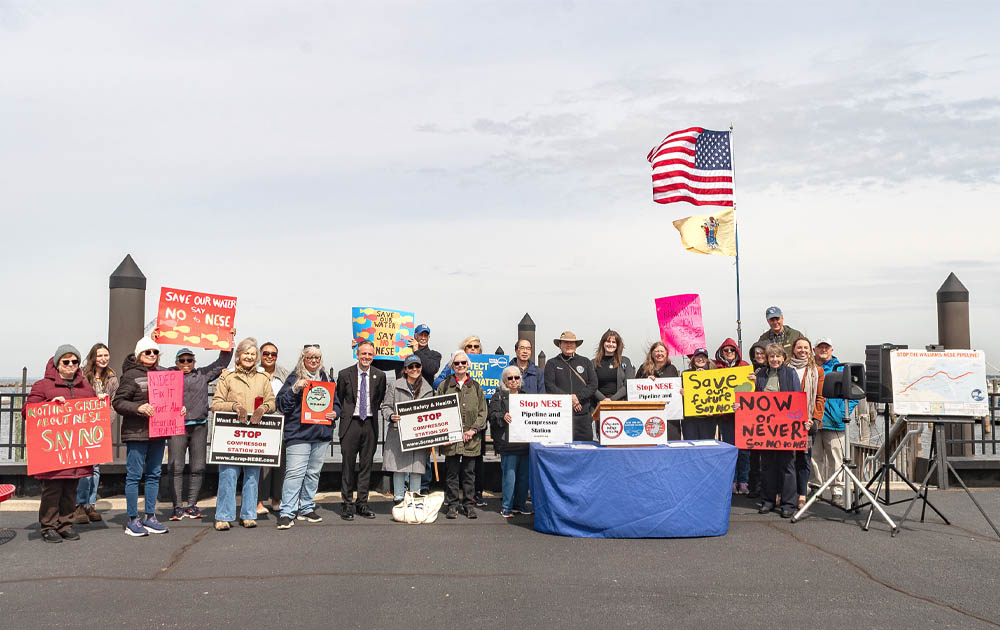
ATLANTIC HIGHLANDS – With Sandy Hook Bay and the New York City skyline as a backdrop, Clean Ocean Action led a coalition of nonprofit organizations in a press conference March 25 to voice continued opposition to the Williams Northeast Supply Enhancement (NESE) pipeline. Environmental activists and community leaders urged Gov. Mikie Sherrill and New Jersey’s Tidelands Resource Council (NJTRC), a divison of the state Department of Environmental Protection (NJDEP), to deny the licensing needed to start construction.
“The messy, unnecessary project, the Northeast Supply Enhancement project, was dead in the water,” said Cindy Zipf, Clean Ocean Action (COA) executive director since 1984. “We all fought so hard – New York and New Jersey residents – to stop this project, and were successful,” she said.
The project has been repeatedly denied licenses since 2017, but a revised application was approved by the NJDEP in November 2025. New York regulators also approved NESE the same month.
“Unfortunately, the governors betrayed us all, New York and New Jersey, so here we are at the last stand,” Zipf said.
The NJDEP seemed to approve the permits after the application was revised to comply with state water quality standards, but NJDEP officials did not respond for requests for comment by press time.
The proposed 23.4-mile fracked natural gas pipeline is “an expansion of the existing Transco (Transcontinental Gas Pipeline Company) natural gas pipeline system,” according to owner Williams Companies Inc., based in Tulsa, Oklahoma. If approved, it would run from Lancaster County in Pennsylvania, through Middlesex and Monmouth counties and into New York City. More than 9 miles of the pipeline would run underwater in the Raritan Bay, the New York Harbor and Cheesequake Creek tributary tidelands. Since the tidelands are state-owned, the project requires a utility license from the New Jersey Tidelands Resource Council.
There would also be a compressor station in Franklin Township in Somerset County.
According to the Natural Resources Defense Council (NRDC), fracking, or hydraulic fracturing, “involves blasting fluid (as much as 97% water) deep below the earth’s surface to crack sedimentary rock formations – this includes shale, sandstone, limestone, and carbonite – to unlock natural gas and crude oil reserves.” Many of the involved nonprofits, including the NRDC, are against fracking.
The NJTRC abruptly canceled its scheduled April 1 vote on NESE’s utility license and had not provided an update as of press time. Evan Leong, COA communications and marketing director, told The Two River Times the organization is in contact with both the NJDEP and NJTRC to determine next steps.
Community, Coalition Pushback
This is not the first time nonprofits and community members have expressed opposition to the pipeline.
During the March 25 press conference, organizations voiced opposition to the project on multiple grounds, including environmental impacts and public health concerns, the use of renewable energy versus fossil fuels, and concerns that the pipeline only benefits its owners and New York City customers of Williams-Transco, while New Jersey would face environmental and public health repercussions.
Williams Companies argues the pipeline will serve an important purpose.
“Families and businesses across the Northeast continue to face avoidable reliability and affordability strains because the region lacks adequate energy infrastructure. NESE expands the Transco system that serves customers across Pennsylvania, New Jersey and New York with new infrastructure that will strengthen energy reliability and supply. Once completed, the project is set to deliver enough natural gas equivalent to meet the daily needs of approximately 2.3 million homes, reinforcing the region’s energy resilience and supporting its continued growth,” said Cherice Corley, public relations and media representative for Williams Companies.
Greg Remaud, executive director of NY/NJ Baykeeper, said in a March 26 interview that Williams-Transco and Baykeeper have “diametrically opposed ideas.”
While Baykeeper is not anti-pipeline, it is against private pipelines, Remaud said. To the best of his knowledge, no discussions have taken place yet, but Remaud said he would be open to discussing the pipeline with Williams if it were beneficial to the entire region.
As it stands, however, NESE would only benefit New York, with New Jersey merely serving as the “pathway,” Remaud said. It is “not a necessity for the region,” but rather an “opportunity for Williams.”
This opportunity could potentially create “a double-digit return on their investment,” said Kin Gee, president of Consumers Helping Affect Gas & Electric (CHARGE). Gee, of Holmdel, questioned the point of the pipeline project, saying it “serves almost no purpose. There’s no shortage of gas that we know of.”
“Unfortunately, the Federal Energy Regulatory Commission, or FERG as we call it, has a very dated and misguided policy of enhancing and providing financial incentives for energy projects, and that’s really what’s driving a lot of the stuff there,” Gee said.
In a project overview titled “NESE Strengthens Energy Infrastructure—Delivering BIG Benefits Across the Northeast and U.S.,” Williams said the project will help match infrastructure construction, which has only grown by 26% from 2013 to 2024, with growing natural gas demand, which has grown by 49%. Williams also anticipates the project will create “$1.8 billion in economic development,” in addition to creating over 3,000 jobs and lowering utility bills “up to $6 billion over 15 years.”
Whatever the reasoning behind the pipeline, it is the consequences that concern coalition members the most.
The pipeline has the potential to disrupt aquatic habitats and wildlife, as well as resuspend toxic particles in the water, such as copper, lead, mercury and zinc (which are toxic to both humans and marine life), Remaud said at the press conference.
In the March 26 interview, Remaud added that he believes Williams-Transco is doing its best to reduce environmental impacts, but where the project currently stands, it won’t be enough. He also questioned the validity of tests and reports, pointing out that they were conducted by consultants from Williams Companies.
As of March 24, more than 31 environmental reports have been generated by the New Jersey Department of Environmental Protection and Williams Companies, with the most recent report dated Aug. 21, 2025, as cited on the NJDEP website.
As of March 30, no reports were found on the NJDEP website pertaining to public health risks, a concern among community members in attendance at the press conference.
A Franklin Township resident, who lives less than a mile from the potential compressor station, said fear of potential health risks means she will leave her home of over 12 years if the station proceeds. But not all her neighbors have the option of leaving.
Another Franklin Township resident expressed concern that the township does not have adequate infrastructure to handle such a station and wondered what would happen if a fire broke out at the station without sufficient water pressure.
Rachel Dawn Davis, public policy and justice organizer for the Rumson nonprofit Waterspirit, urged the crowd to consider how this pipeline will affect future generations. “Let us choose the water, let us choose the land, let us choose the air, and let us choose the future where our children don’t have to clean up the nasty nonsense of today.”
In addition to nonprofits and residents, many public officials also came out to express their resistance to NESE, including Atlantic Highlands Council member Kathleen Scatassa, Highlands Council President Jo-Anne Olszewski, Rumson Council President John Conklin, and Red Bank Council member Ben Forest.
“This project must be stopped. We are counting on the members of the Tidelands Resource Council and the governor to harness their love for our beautiful waters, protect our future, and do the right thing,” Scatassa said.
The March 25 rally was an “impressive and powerful show of opposition to something that is very bad for not just this area, but the entire state of New Jersey and planet Earth,” said Charlie Kratovil, Central Jersey organizer for Food & Water Watch. “Fighting for Safe Food, Clean Water, and a Livable Climate” is Food & Water Watch’s mission statement.
‘Zombie’ Pipeline Rises Again
The NESE pipeline has been dubbed the “zombie pipeline” because, despite years of permit rejections, it’s never stayed dormant for long. The first application was submitted in July 2017, with subsequent applications in June 2018, June 2019, October 2019 and January 2020, according to a June 10, 2025, letter from Williams Companies to the NJDEP. The most recent application was made May 30, 2025.
On Nov. 7, 2025, after almost a decade of attempts, the pipeline was granted approval. Under former Gov. Phil Murphy, the NJDEP’s Division of Land Resource Protection signed off on necessary permit approvals for Freshwater Wetlands, Coastal Wetlands, Flood Hazard Area, Flood Hazard Area Verification, In-Water and Upland Waterfront Development, and a Water Quality Certificate, according to the NJDEP’s website.
Six nonprofits filed suit against the NJDEP 11 days later for what they argued was an unjustifiable approval of the pipeline’s water quality certification. Simultaneously, the NRDC filed its own independent suit against the NJDEP. Both suits are ongoing.
The nonprofits involved in the lawsuit are NY/NJ Baykeeper, Princeton Manor Homeowners Association, Central Jersey Safe Energy Coalition, Food & Water Watch, New Jersey League of Conservation Voters Education Fund, and Sierra Club.
The NJDEP Division of Air Quality and Radiation Protection also approved an air pollution control preconstruction permit and certificate to operate for the Transco Compressor Station 206, Jan. 12, 2026.
If approved by the NJTRC, Williams expects to open the pipeline sometime in the end of 2027.
The article originally appeared in the April 2 – 8, 2026 print edition of The Two River Times.