By Stephen Appezzato
HIGHLANDS – A $130 million potential project was revisited in Highlands May 14 as officials look to bolster the borough’s flood resilience.
Members from the U.S. Army Corps of Engineers, state Department of Environmental Protection and borough government held a public information session to give the community an overview of the Raritan Bay and Sandy Hook Bay Coastal Storm Risk Management Project in its current pre-construction engineering and design phase. Whether the project is greenlit or not will be determined in a November ballot referendum.
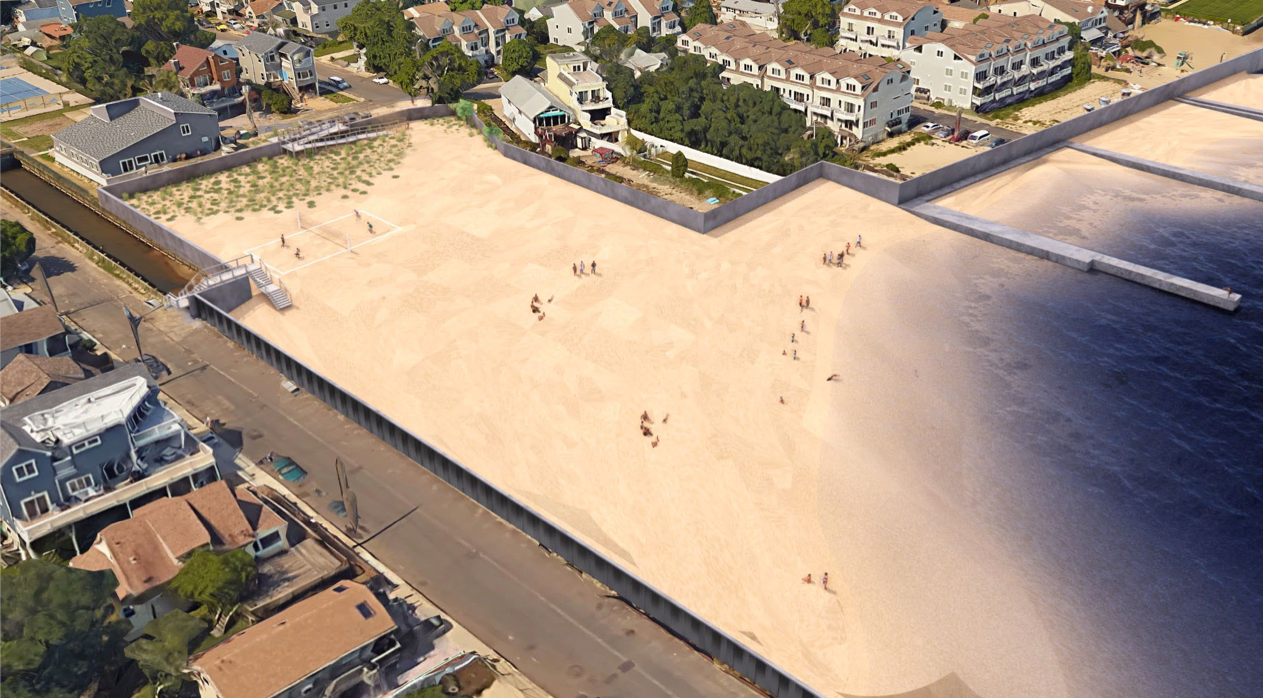
Facing a .7-foot sea level rise over the next 50 years and a history of recurring flooding, officials say the storm management plan will protect the community’s infrastructure, property and health by making the low-elevation borough more resilient. While in its early design stages, current plans indicate approximately 10,000 linear feet of flood walls, a floodgate, pump station, culverts and a detention pond could be constructed. If residents approve a referendum, specifications for the first element could be completed as early as fall 2025.
“I like to have these meetings to get public input,” to “engage with the public and get your opinions,” Mayor Carolyn Broullon said. “We should all be involved in this decision-making process.”
Army Corps project manager Bethany McClanagan said the borough has had flooding issues since the early 1800s and the goal is to reduce future damages and safety risks.
Possible project concepts presented to the public depicted a tall flood wall that lined the entire coast of the downtown district. While details on the exact placement of walls intersecting Snug Harbor and Veteran’s Park are not finalized, renderings depict the walls bordering the entrance to both open spaces. At Snug Harbor, residents might have to traverse stairs or ramps to get over the barrier.
If approved in November, Highlands would be responsible for raising $13 million to cover its share of the $129 million construction costs – more than the borough raises in taxes in one year – with the federal government and DEP footing the rest of the bill. Preliminary design costs would add another $2.4 million to the total price tag.
“It seems quite a bit of dollar per capita for an area that demands commercial fishing, other things, (and) we hear you,” Broullon said. “We just wanted to get everything together, put together this presentation. I will make sure that these dollars and cents are put out in a very readable way,” she added.
The federal plan to tackle Highlands’ coastal flooding began in the 1990s, following storm events and FEMA investing in the region, said U.S. Army civil engineer and planner Jason Shea. Shea said initially, the community wanted the Corps “to come and see what we could do,” but in the 2010s, borough officials approved a resolution to walk back the project. Since then, the council rescinded the resolution and requested the Corps complete the project study. “Why we’re back now is because Congress came out with the new infrastructure bills,” Shea said.
The project would require officials seek “voluntary easements” on residents’ properties bordering the proposed flood walls. If property owners do not willingly provide the easements, the borough would acquire them through eminent domain.
Broullon indicated there will be another public meeting on the plan in September ahead of the 2024 election. “We are going to put this on the ballot at this November’s presidential election where all registered voters will be able to vote,” she said. Broullon assured residents if the project is voted down, then it will not happen.
“There are some folks that want this, there are some folks that don’t want this,” she said.
As if to confirm this, the presenters were met with skepticism and concerns from some at the meeting.
Resident Tommy Stramka asked what material the flood walls would be made of; McClanagan confirmed it would be concrete.
“The cement industry is one of the most polluting industries in the world,” responded Stramka, who said it is responsible for almost 10% of global carbon emissions and also produces a variety of other pollutants. “Right there there’s a problem with the environment.”
Stramka also raised concerns regarding the local sea life and possible health and drowning dangers resulting from trapped flood water around the walls.
“You’re showing beautiful photos of the wall, distance away, blue skies and clouds in the background. Come on, that’s not really how it works,” he said. “Mother Nature will find a way, it’ll find a way (for water) to get over that wall,” he said.
Resident Mike Marchetti asked if visitors and residents could find bay views at ground level along the borough’s waterfront roads. The presenters said bay views would only be possible from elevated areas, raising residents’ concerns over tourism appeal and dollars.
“We’re here to give a comprehensive, large-scale solution (to flooding),” Shea said. “It doesn’t mean you have to accept it. We’re giving you an option – you have a choice for the future, you’re going to adapt to the flooding or you can adapt to the project. And we’re not here to sway you one way or the other,” he said.
The proposed project is separate from the Highlands and Monmouth Hills Flood Mitigation and Green Infrastructure Project, which was presented to the public in October 2022. Funded with a $12 million FEMA grant, the flood mitigation project will focus more on the borough’s interior flooding and stormwater issues, as opposed to the Army Corps project, which may focus more on bayside flooding issues.
Residents are encouraged to voice their opinions at future borough council meetings before the matter is voted on in November. The borough’s website has more information about the May 14 presentation.
The article originally appeared in the May 30 – June 5, 2024 print edition of The Two River Times.