By Sunayana Prabhu
RED BANK – Starting next month, residents and businesses in Red Bank will face higher utility bills. The borough council unanimously voted to increase water and sewer rates at its latest meeting, citing the need to fund critical infrastructure improvements and maintain fiscal stability.
According to the ordinance adopted July 11, the initial increase will raise current water rates $.68, from $7.11 per 1,000 gallons to $7.79, starting Aug. 5. The future incremental price increases, effective every Jan. 1 for the next five years, will bring the rate to $10.35 per 1,000 gallons by 2029.
Sewer rates will continue to be set by the borough at 125% of water consumption rates.
The gradual rate hikes are the result of a water rate study commissioned by the borough last year from ENGenuity Infrastructure and CDM Smith and presented at a public hearing in June. The study underscores the need for a rate increase after nearly a decade without changes.
The primary goal of the water and sewer rate hikes is to fund necessary improvements and maintenance of the borough’s water and sewer infrastructure.
“You have to be able to fund things to get things done. We have an aging infrastructure,” said borough manager Jim Gant during the study report discussion last month.
Specifically, the rate increase aims to support a $25 million capital improvement plan over the next five years. This plan includes upgrading aging components such as two water treatment plants, four wells and water mains, and replacing lead service lines, hydrants, eight sanitary lift stations, sewer manholes, sewer mains, pumps and generators.
Additionally, the rate hike is designed to prevent a projected $1 million deficit in 2024 from system maintenance and labor and ensure the utility remains financially stable with a 30-day operating surplus. By implementing this increase, the borough seeks to maintain local control of its water utility, ensuring reliable service and water quality for residents while avoiding privatization.
At last week’s borough council meeting, some residents raised questions about the study’s procurement process.
“Why wasn’t there any competitive bids? Why did you just pick one?” asked resident Cindy Burnham, inquiring about the bidding process for the water rate study.
Gant, who joined the administration in 2024, said professional services can sometimes be procured without competitive bidding through a non-fair and open process. However, he couldn’t confirm if this approach was used for the water rate study, which was conducted in 2023. “I can’t speak to that as it was in 2023 before my time,” Gant said. “But under professional services, as long as you do it as a non-fair and open process, you don’t have to do (competitive bidding).”
Earlier in the meeting, officials also noted the completion of phase one of the borough’s lead line replacement program, a critical step in ensuring safe drinking water for residents.
Gant also reported on the sewer pipe break last week, noting an infrastructure issue and underscoring the importance of maintaining and upgrading the system.
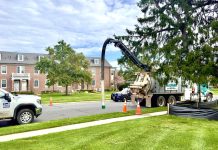
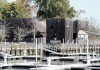
A sewer force main was struck by a contractor working at the train station parking lot, resulting in significant raw sewage discharge into the Navesink River through stormwater drains. The borough’s emergency mechanical contractor, Mark Woszczcak, clamped and repaired the pipe, stopping any further discharge of sewage from the area.
The situation has been mitigated and the New Jersey Department of Environmental Protection has cleared the Navesink River for public use. The NJDEP took water samples July 15 and confirmed in an email statement July 17 that the sewage spill was “not considered a risk for swimming or shellfish since the discharge into the Navesink River was determined to be minimal. Several tide changes have occurred since the spill, and any remaining contamination will already have been flushed,” said NJDEP spokesperson Vincent Grassi.
Since the nearest bathing beaches and unrestricted shellfish beds are distant from the spill site, “no additional sampling or advisories/closures were determined to be necessary,” Grassi noted.
The incident, while unrelated to the rate increases, called further attention to the vulnerabilties in aging infrastructure and the potential environmental and public health risks associated with system failures.
The article originally appeared in the July 18 – July 24, 2024 print edition of The Two River Times.