By Regina Molaro
The summer season is in full swing. There are lots of delightful sights to see at this time of year – colorful flowers blooming in our gardens, birds gracefully soaring above and waves crashing against the shoreline.
Many of us take our eyesight for granted. August marks Children’s Eye Health and Safety Month, a time dedicated to generating awareness about the significance of maintaining optimal eye health in young ones. Vision health isn’t just important to children; it is vital to all people regardless of age.

“Our eyesight is what connects us to the world,” said Alan Tsai, OD, FAAO, of Atlantic Eye in Little Silver. “From playing to learning to working, vision is our first line of understanding what is around us. It is important to get routine eye examinations to ensure that our eyes are healthy and our vision is at its potential.”
The eyes can reveal a lot about one’s health. The eye is the only part of the body where blood vessels can be seen without any imaging technology. This gives eye care providers a unique look at cardiovascular health, often leading to initial diagnoses of high blood pressure, high cholesterol and diabetes – all from a dilated eye examination.
Starting Young
Tsai advises parents and guardians to have infants’ and toddlers’ eyes checked at every wellness visit with their pediatricians. “By looking at the pupillary reflexes and reflections to light, ocular development can be assessed. Any unusual findings, especially in premature babies or those with strong family histories of eye diseases, should be evaluated by a pediatric eye care provider,” said Tsai.
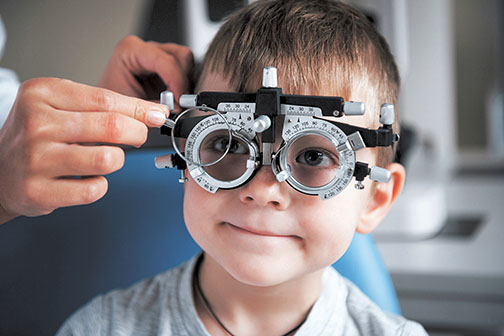
The American Academy of Ophthalmologists (AAO) recommends that all children have a visual acuity screening by age 5, followed by yearly exams after that. These visits can detect early visual impairment, from simple nearsightedness that can be corrected by a pair of glasses to complex retinal conditions in which early intervention is often crucial. Adults should be seen at least yearly for a comprehensive ocular examination performed by a local optometrist or ophthalmologist.
Screen Time
Most children and teens spend a lot of time looking at their screens, whether it’s their cellphones, tablets or laptops. “Technology has been quite a double-edged sword,” said Tsai. “While our digital world helps in countless ways, there are some drawbacks to our reliance on screens. In children, nearsightedness – or myopia – is commonly referred to as a global epidemic given how quickly its prevalence is rising.”
He explained that there is a strong correlation between prolonged “near” tasks (reading, writing, screen use, etc.) and increased myopia. In adults, screen use has been associated with decreased blink frequency and completeness, leading to dry eye, which is diagnosed many times daily.
“It is important for children and adults to take breaks during extended near tasks. We recommend the 20-20 rule – for every 20 minutes of near work we do, we take a 20-second break where we fixate on a target further away to relax our focusing system,” said Tsai. In addition, recent studies have found a very significant correlation between outdoor activity and decreased myopia progression in children.
A Learning Tool
Our vision also has a big impact on learning. “Many young patients come in frustrated that they’re struggling in school without realizing that their visual system is limiting their ability to keep up in class. Whether they’re having difficulty seeing the board from the back row due to myopia progression or getting fatigued from prolonged near work due to weak focusing muscles, the eyes can make or break a student’s learning ability,” said Tsai.
A comprehensive eye examination can identify and resolve many vision-related issues that can improve poor school performance, often blamed on lack of attention or interest in the subject rather than the fact that a student may be having a hard time seeing.
Take Simple Precautions
There still are several weeks of summer to look forward to. Sunglasses are encouraged for all patients – regardless of age. They are important for reducing UV exposure, which can lead to progressing conditions such as cataracts and macular degeneration. “It’s never too early or too late to protect your eyes from the sun,” said Tsai.
The article originally appeared in the July 1 – 7, 2024 print edition of The Two River Times.