By Stephen Appezzato
SANDY HOOK – Concrete from the soon- to-be-demolished Rumson-Sea Bright Bridge will be repurposed to create a fishing reef off the coast of Sandy Hook and Sea Bright, county officials announced recently.
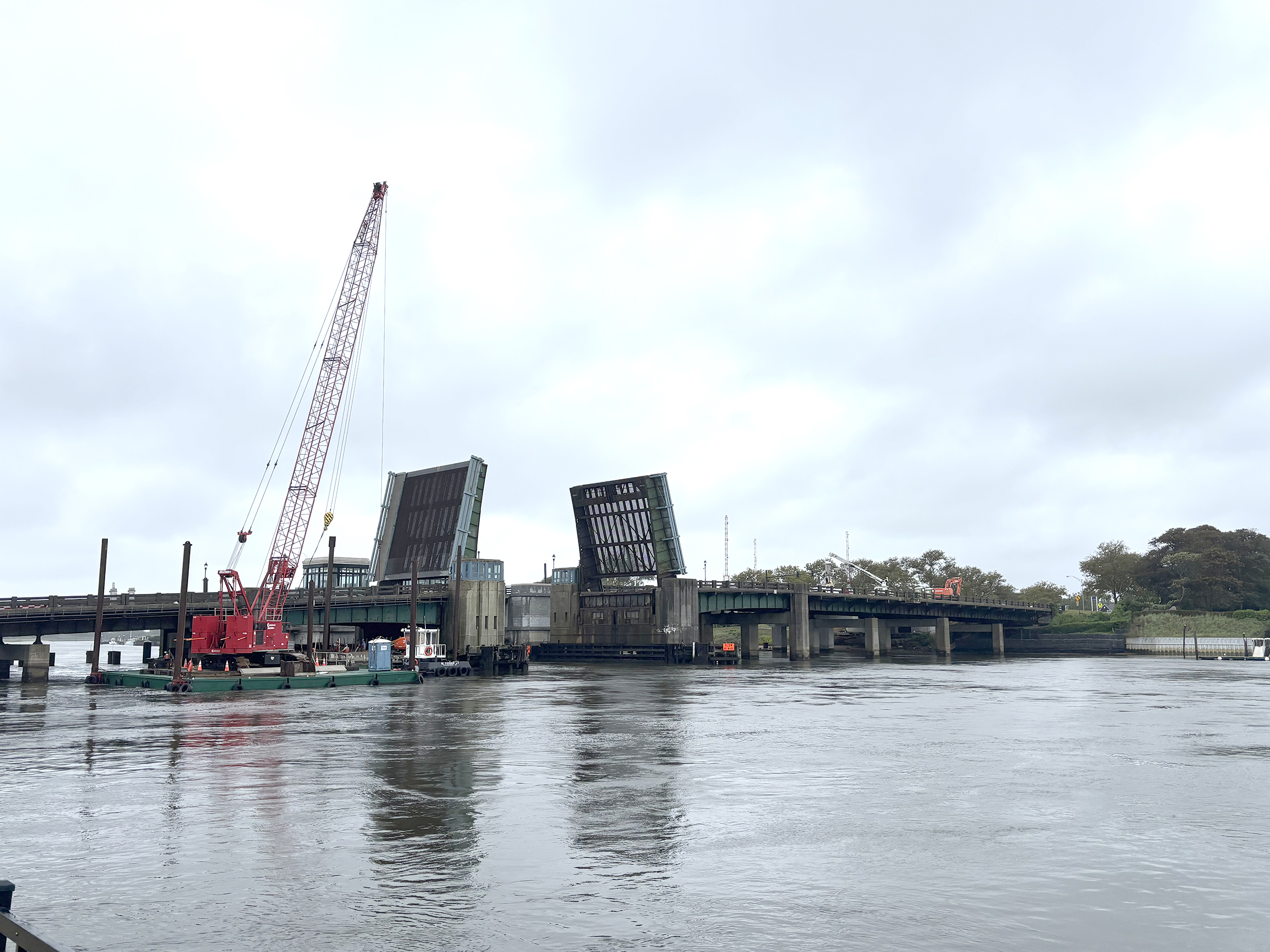
Now that the new $113 million Rumson-Sea Bright Bridge has opened, construction crews will begin demolition of the old bridge within weeks.
According to County Commissioner Director Thomas A. Arnone, demolition is expected to be completed before the end of 2025, “with fender removal and final cleanup completed by May 2026.” Fenders protect the bridge base from boats navigating the channel. As part of this process, the concrete components from the old bridge will be used to construct a fishing reef off Sandy Hook, as approved by the New Jersey Department of Environmental Protection, Arnone said. The reef construction will involve barges transporting the concrete to a designated site off Sandy Hook.
“Fishing reefs like the one to be constructed offer numerous ecological benefits such as creating habitat for marine life, providing protection for juvenile fish and offering recreational opportunities for anglers and reef divers,” Arnone said. “My fellow commissioners and I are excited to begin a new chapter with the Rumson-Sea Bright Bridge and to find a beneficial use for the old bridge that will enhance our coastal ecosystem.”
New Jersey’s coastline is already home to numerous man-made reefs composed of concrete, steel, retired ships, barges and other dense materials.
According to NJ Fish & Wildlife, the Marine Resources Administration has overseen an intensive artificial reef program since 1984. The goal is to create a network of reefs in ocean waters along the coast to provide a hard substrate (or foundation) for fish, shellfish and crustaceans, fishing grounds for anglers, and underwater structures for scuba divers.
The organization’s interactive map depicting all of New Jersey’s artificial reefs catalogs each deployment of material and its sponsor. The reef pertaining to Sandy Hook is located off the shore of Sea Bright.
In an interview, Cindy Zipf, executive director of the local environmental group Clean Ocean Action (COA), said the group is supportive of the artificial reef program.
“Of course, we want to make sure it’s going to be healthy, good material, not contaminated material,” she said.
“I’m kind of happy that it will have a place of purpose and not just get ground up and recycled into some other kind of material,” she said. “It’s great that it will have a place in New Jersey’s artificial reefs program, where it can help sustain and become habitat.”
Reef materials are donated and funded by outside organizations, with oversight from the NJDEP.
Currently, there are 17 artificial reefs off New Jersey’s coast, consisting of more than 4,371 deposits of debris and materials. Sites are strategically placed so that at least one is within easy boat range of 12 ocean inlets.
According to the state, reefs are used extensively by anglers targeting sea bass, blackfish, porgy and lobster, as well as divers exploring sunken ships and even subway cars.
The reef project follows the recent completion of the new $113 million Rumson-Sea Bright Bridge, the county’s most expensive infrastructure project to date.
The previous bridge was opened in the 1950s and replaced a steel swing bridge opened in 1901. The 1950s bridge will now be given its second life under the sea.
The article originally appeared in the August 21 – 27, 2025 print edition of The Two River Times.