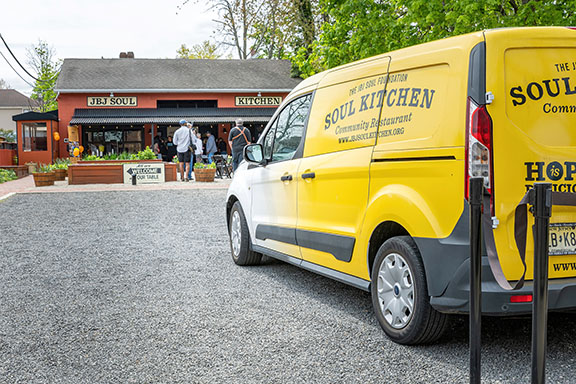
Monmouth Arts is recognizing Dorothea Bongiovi and JBJ Soul Kitchen with its Outstanding Community Service Award Oct. 29. The Red Bank location of the community restaurant is pictured. Emily Schopfer
By Mary Ann Bourbeau
RED BANK – In 2011, Dorothea Bongiovi and her husband, Jon Bon Jovi, wanted to start a unique place where those in need of a hot meal could be served with dignity. After witnessing families struggle in the aftermath of the 2008 financial crisis, they created JBJ Soul Kitchen, a nonprofit venture through the Jon Bon Jovi Soul Foundation, to combat hunger and poverty in their community.
Its pay-it-forward model is unique; instead of a traditional soup kitchen or a standard restaurant menu with set prices, paying customers donate to cover their meal and help pay for others, while guests who cannot afford to pay can contribute by volunteering.
As a founder, board member and program director, Dorothea Bongiovi remains heavily involved in the project. Monmouth Arts is honoring her efforts with the Outstanding Community Service Award at an event called “Bring on the Funk: Where the Arts Get Down” Thursday, Oct. 29. Other 2026 honorees include music legend George Clinton, singer-songwriter Nicole Atkins, bestselling author Harlan Coben and PNC Bank Arts Center.
“The idea for JBJ Soul Kitchen came from a simple belief that nobody should have to choose between dignity and a hot meal,” Bongiovi said. “We started in 2011 with the idea of a unique nonprofit: a pay-it-forward community restaurant, not a soup kitchen or pay-what-you-want model. You sit down, you’re served and you’re treated like a guest. You pay for your meal and donate toward someone else’s, or you give an hour of your time.”
Bongiovi stresses that JBJ Soul Kitchen offers so much more than a free meal.
“While those in need are volunteering, we are building relationships and trust and learning about the barriers keeping folks food insecure,” she said. “From there, we connect them to resources including IDs, employment and mental health support. We have held free expungement clinics for low-level criminal records that may be keeping them from education, jobs or housing opportunities. The impact I am most excited about is that, in the past two years, we were able to help 40 previously unhoused people obtain permanent housing, not shelters or motels, but permanent homes. That is huge.”
The first JBJ Soul Kitchen opened in Red Bank and the concept quickly caught on, with a second location in Toms River and a third at Rutgers University-Newark.
“We go where the need is and where a community is ready to embrace us,” Bongiovi said. “Red Bank is obviously a community that we know, having lived in the area for years. After (Super Storm) Sandy, Toms River gave us a chance to serve a different part of the Jersey Shore and increase our impact with a resource area, food pantry and culinary training program under one roof. Rutgers University-Newark let us reach students and shine a light on food insecurity on college campuses.”
Bongiovi hopes to see more Soul Kitchens open wherever the need is greatest.
“My goal is always to go out of business,” she said. “Unfortunately, the need is bigger than three locations, and we see it continue to grow. I am happy to work with people and share our knowledge and lessons learned over the years.”
Another aspect of The JBJ Soul Foundation is its effort to combat homelessness. Over the past two decades, it has funded community grants and built nearly 1,000 units of supportive, affordable housing across the United States. The couple is also a longtime supporter of the Parker Family Health Center in Red Bank, 180 Turning Lives Around and the Hope and Comfort Center at Pilgrim Baptist Church in Red Bank, which provides overnight respites for homeless individuals on Code Blue (cold) or Code Red (hot) days.
Bongiovi said she is looking forward to accepting this award at the event and sharing it with the people at Soul Kitchen who work hard every day – the chefs, volunteers and the outreach and support staff.
“I’m deeply honored and humbled,” she said. “Monmouth Arts reminds us what makes community. It’s about human connection. Singing together, dancing, watching a play or a movie, going to an art show or sharing a meal creates a sense of ‘we.’ Art can create a better understanding of someone else’s world; it can be healing and eye-opening. In a world where our creativity is being censored, it is more important than ever to support all the arts.”
See page 17 for more on the upcoming Monmouth Arts award program Oct. 29.
This article originally appeared in the October 22-28, 2026 print edition of The Two River Times.