By Sunayana Prabhu
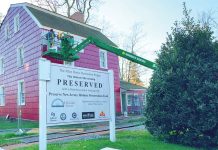
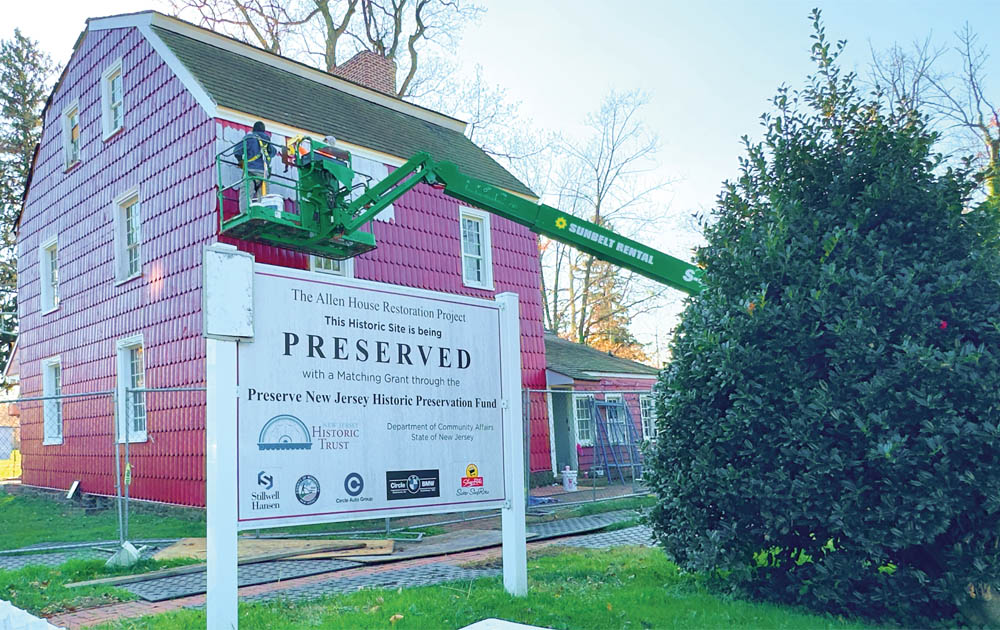
SHREWSBURY – The historic Allen House received a fresh coat of its familiar rustic red paint last week, as its years-long restoration continues.
The brighter Allen House looks a bit more ready for the holidays, but it’s not there yet. Full restoration of the borough’s landmark at the Four Corners intersection of Sycamore Avenue and Broad Street (Route 35) is expected to take over a year. The restoration by the Monmouth County Historical Association (MCHA) began in 2019 and has now reached Phase 3 of a four-phase plan. Phase 3 is expected to be complete by spring 2027 and Phase 4 is expected to begin by the end of 2027.
As with most historic structures, construction workers hit unexpected roadblocks during the restoration. Most recently, workers found burned timbers left in place after a 1941 roof fire, said Shannon Eadon, executive director of MCHA.
Workers have since stabilized the roof beams.
As part of the ongoing restoration, the exterior of the building, which once served as a tavern and community gathering place, has been meticulously stabilized, primed and painted. Phase 3 of the restoration also includes work on the foundation to stabilize the sill plate between the foundation and the house, as well as work on the roof, chimneys, siding and windows. An ADA-compliant (Americans with Disabilities Act) ramp will also be installed at an estimated cost of $400,000, according to the MCHA.
During Phase 4, the interior and windows will be restored, plaster will be repaired and new lighting, electrical and plumbing systems will be installed. Plans also call for an ADA-compliant bathroom and entrance, along with ramps to improve access between rooms.
MCHA plans to apply to the New Jersey Historic Trust for funding for the final phase of the restoration.
According to Eadon, the full restoration is estimated to cost $1 million. MCHA has raised nearly $500,000 through its fundraising activities, Eadon said, and the remaining $500,000 is funded through a matching grant from the New Jersey Historic Trust, disbursed in phases timed with the restoration.
Several philanthropists and community members have participated in the rehabilitation of the historic building. MCHA has credited its donors, including Circle BMW, Chevrolet and Hyundai, Saker ShopRite, the Monmouth County Board of County Commissioners and Shrewsbury Borough for their contributions to the Allen House restoration. Eadon also noted some individual and anonymous donors.
Allen House Through History
The history of Allen House goes back centuries, but the significance of the space that birthed a sense of community in Revolutionary times keeps it alive and relevant even today.
According to the New Jersey Historic Trust website, the two-story structure reflects early Dutch influences and building practices and is “quite rare.”
The house’s two-story frame displays many Dutch elements that are “typical for structures erected in Monmouth County during the first half of the 18th century, even if the owner was not of Dutch descent,” the website says. The framing, with widely spaced anchor beams spanning the entire depth of the building, clearly reflects Dutch building practices.
The Allen House sits on the northwest corner of the historic Four Corners in Shrewsbury, sharing the intersection with Christ Church (1769), the Presbyterian Church (1821) and Shrewsbury Religious Society of Friends (Quakers) Meetinghouse (1816). The Shrewsbury Historical Museum is nearby at the borough municipal complex.
The house was notably a tavern but also served as a town hall, post office, dance hall and courthouse where a visiting judge made legal decisions. The property has even served as a local store and welcomed a visit from President and Mrs. Woodrow Wilson in 1916. The rich history of Allen House also includes, among other events, a Revolutionary War massacre (1779).
The house was built in the 1680s by a Quaker named Judah Allen. It was later sold to Josiah Halstead in 1754. Halstead turned the house into a tavern and, during the period he occupied it, served as a tavernkeeper.
Allen House “offers dynamic opportunities to interpret the American Revolution, conflict between Monmouth’s patriots and loyalists, themes of slavery and indentured servitude and impact of colonial economics on Monmouth County residents,” according to details on the MCHA website.
The structure is also located on the “Burlington Path,” Eadon added, which was part of an Indigenous people’s travel corridor used by the Lenape for seasonal journeys. The historic Burlington Path “ran north and south and east and west of Route 35 and Sycamore Avenue, from Philadelphia to Sandy Hook, and that was used by the Lenape for thousands of years,” Eadon said.
She noted the primary purpose of the restoration is education, giving visitors an opportunity to learn about the building and the community’s past. “Once the house has been completed, we will then do an interpretation of the house – talking about the building as the Blue Ball Inn and the significance of that building in Shrewsbury,” Eadon said. “The inn really represented a big part of the culture of the town.”
The article originally appeared in the November 26 – December 2, 2026 print edition of The Two River Times.