By Sunayana Prabhu
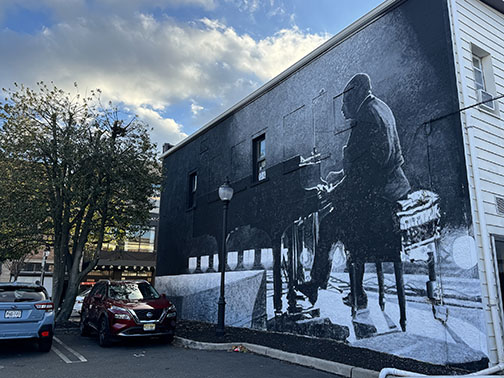
RED BANK – Artist and borough resident Michael White has brought the legacy of jazz icon William James “Count” Basie to life with a striking new mural in the heart of Red Bank. The large-scale black-and-white painting covers the wall of a building facing borough hall on Monmouth Street, across from the eponymous Count Basie Center for the Arts.
The mural depicts borough-native Basie in a powerful performance pose at the piano. The image is based on a dramatic backstage photograph that captures the bandleader in an intense, focused moment. “I wanted to honor Basie in a way that showed him in his element, performing and creating the music that made him a giant in the jazz world,” said White, who worked on the mural for a few weeks.
“This photograph had such a strong sense of atmosphere and mood that I knew it would translate beautifully to a large-scale public artwork,” he said.
The mural project is a collaboration among White, the local nonprofit Red Bank RiverCenter, and Monmouth Meats, the longtime borough business whose wall serves as the canvas. RiverCenter has a dedicated mural program that provides funding for approved public art projects in the downtown business district. Under this program, the organization is covering 50% of the cost of the Count Basie mural. Monmouth Meats is contributing the rest of the funding for the project.
Stewart Goldstein, owner of Monmouth Meats, said he was approached by RiverCenter members to convert the wall into a mural and instantly agreed, thinking it was a “great idea. (It cost) some money but so what? It’s nice.”
“I think it’ll look good for the whole town of Red Bank,” Goldstein said. “It’s beautiful. It’s art, and we support the arts.”
According to the Count Basie Center for the Arts website, Basie was born Aug. 21, 1904, at 229 Mechanic St. His father, Harvey Lee Basie, was a coachman and caretaker; his mother, Lillian Childs Basie, was a laundress, taking in washing and ironing. A brother, James, died when Basie was a young boy.
The family always owned a piano and Lilly Ann paid 25 cents per lesson for Basie to learn to play. He went on to become a pioneering bandleader and pianist, helping to shape the sound of big band jazz. In a career spanning over 60 years, Basie won nine Grammy Awards, including two trophies at the very first Grammys ceremony in 1959.
For White, the project holds special meaning as his first major mural in his adopted hometown.
When he first started thinking about the mural, he knew he wanted to capture Basie in a way that showcased his artistry and connection to Red Bank. “I looked at a lot of photos of him,” he said, holding the black-and-white image in hand that he’s been painting on the nearly 20-foot stucco wall using outdoor latex paints. The photograph White chose for the mural is from a backstage shot with “a powerful, almost cinematic quality to it. The contrast of the stage lighting, the intensity in his expression – it really drew me in. I felt like I could almost hear the music just looking at that image.”
White hopes the mural will inspire people to learn more about Basie’s illustrious legacy.
Since this was White’s first time painting directly on an outdoor wall, rather than his usual method of painting in the studio and installing the finished piece, it presented some new challenges. He had to start by thoroughly pressure washing the wall to remove any dirt, grime, mold or other buildup on the surface – a full day’s work on its own.
After pressure washing, White primed the wall twice with a concrete primer to ensure the best possible surface for the paint to adhere to.
White has been using a boom lift to access different areas of the mural, which has provided flexibility and ease of movement as he works. He decided to render the mural in high-contrast black and white, to give it a timeless, monumental quality that suits Basie’s iconic status.
Interestingly, while painting, White has been listening to a “lot of Basie’s classics,” as well as other jazz from that era, to help him capture the spirit of the music visually.
The artist, who previously created murals in New York and Long Island, has lived in the Red Bank area for over five years. “I’m honored to be able to bring this tribute to Count Basie to life right here in Red Bank,” White said. “He’s such an important figure, not just in jazz history, but in the history of this town.”
The mural joins a growing collection of public art installations throughout Red Bank’s vibrant downtown district.
The article originally appeared in the December 5 – 11, 2024 print edition of The Two River Times.