By Emily Schopfer
NEW JERSEY – New Jersey’s Tidelands Resource Council (NJTRC) unanimously approved a final utility license needed for the controversial Williams Northeast Supply Enhancement (NESE) pipeline May 6.
The pipeline has been a longtime source of contention for environmental activist groups, community leaders, and residents since it was first proposed nearly a decade ago.
The state Department of Environmental Protection (NJDEP) has repeatedly denied the project licenses since 2017. A revised application was approved by the NJDEP in November 2025, and New York regulators approved NESE the same month. The NJTRC, a division of the NJDEP, was scheduled to vote on the final utility license April 1, but that vote was abruptly canceled.
Pipeline History
The NESE project consists of a new 23.4-mile fracked natural gas pipeline that would extend existing infrastructure. The existing natural pipeline system, as well as the new NESE project, is owned by Transco (Transcontinental Gas Pipeline Company), a wholly-owned subsidiary of Williams Companies Inc., based in Tulsa, Oklahoma.
There is also a planned compressor station in Franklin Township in Somerset County.
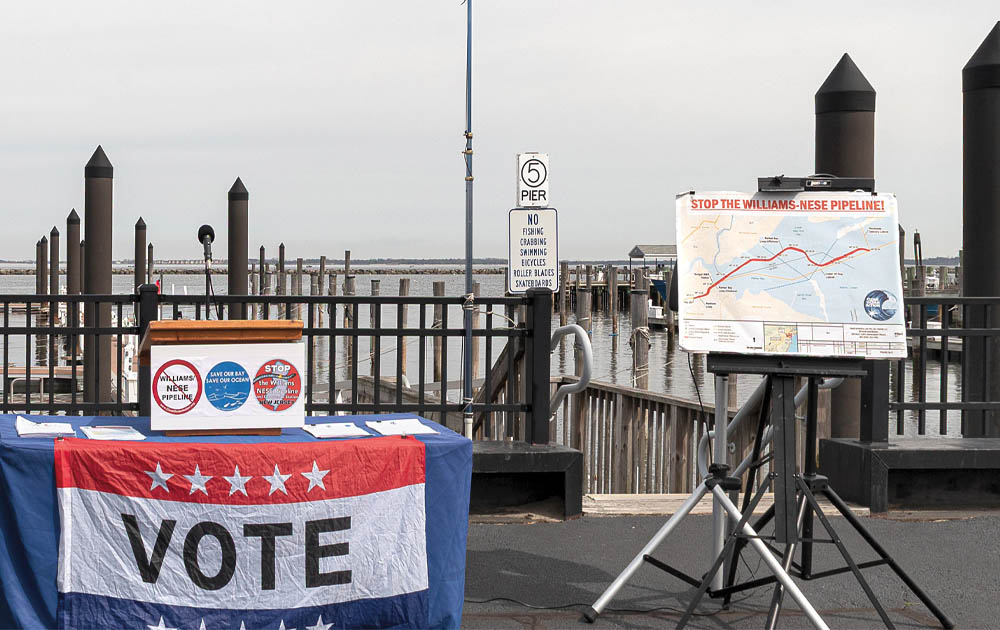
The expanded pipeline would stretch from Lancaster County, Pennsylvania, through Middlesex and Monmouth counties, all the way to New York City. More than nine miles of the pipeline would run underwater in the Raritan Bay, the New York Harbor and Cheesequake Creek tributary tidelands.
These tidelands are state-owned, and the NJTRC requires that any “pipes, cable lines, storm water outfalls, etc. that cross over or under state-owned tidelands” require NJTRC approved utility licenses.
According to the Natural Resources Defense Council (NRDC), fracking, or hydraulic fracturing, “involves blasting fluid (as much as 97% water) deep below the earth’s surface to crack sedimentary rock formations – this includes shale, sandstone, limestone, and carbonite – to unlock natural gas and crude oil reserves.”
The NESE pipeline has been referred to as the “zombie pipeline” because of its pattern of permit rejections and reapplication. The first application was submitted in July 2017, with subsequent applications in June 2018, June 2019, October 2019 and January 2020, according to a June 10, 2025, letter from Williams Companies to the NJDEP.
On Nov. 7, 2025, the NJDEP’s Division of Land Resource Protection granted approval for the pipeline under former Gov. Phil Murphy. Six nonprofits filed suit against the NJDEP 11 days later for what they argued was an unjustifiable approval of the pipeline’s water quality certification.
The nonprofits involved in the lawsuit are NY/NJ Baykeeper, Princeton Manor Homeowners Association, Central Jersey Safe Energy Coalition, Food & Water Watch, New Jersey League of Conservation Voters Education Fund, and Sierra Club. The NRDC, an international nonprofit, filed an independent suit against the NJDEP, as well. Both suits are ongoing.
Despite the active lawsuits in New Jersey, NESE officially broke ground April 14 in Brooklyn, starting construction at Floyd Bennett Field.
The Fight Continues
Waterspirit, a Rumson based organization involved in the coalition against NESE, put out a statement May 7 on the license decision. “Waterspirit is heartbroken by yesterday’s Tidelands Resource Council’s unanimous approval of a utility license for the Williams/Transco Northeast Supply Enhancement (NESE) project,” the statement reads. “This decision advances a thrice-denied, risky Liquified Natural Gas (LNG) pipeline and compressor station that would do nothing to lower New Jersey’s energy costs while saddling us with excessive air and water pollution for generations.”
“Greenlighting the NESE Project is tantamount to sacrificing of our children’s future on the altar of greed,” said Blair Nelsen, Waterspirit executive director. Nelsen added that the decision to grant the license is a “deep wound to our shared watersheds” and is “treating our waterways as mere resources to be exploited.”
Greg Remaud, executive director of NY/NJ Baykeeper, said the approval was disappointing but not unexpected. Remaud was present at the almost five-hour-long May 6 virtual meeting where the vote was held and said it was “some of the best testimony I ever heard,” describing it as “smart, passionate, thoughtful.” He also said information presented by Williams/Transco and NJDEP was “very rosy” but contained misinformation presented as fact.
“There’s a lot at stake and it’s all for an unnecessary pipeline,” Remaud said. NESE is a “needless pipeline that’s going to be carving out 23 miles of clam beds and subaquatic habitat across Raritan Bay… resuspend contaminated sediment with metals and other toxic materials,” and, “despite what they claim, is very close to some very environmentally sensitive areas along Cheesequake Creek.”
Kin Gee, president of CHARGE (Consumers Helping Affect Regulation Gas & Electric), expressed similar disappointment about the license approval. “Yesterday’s meeting was supposed to be the last stand,” Gee said. Even though the fight against NESE is “unfortunately not going the way we want it,” Gee said he saw an “amazing group, amazing commitment and devotion” from over 40 advocacy groups at the NJTRC meeting.
A total of 12 volunteer appointees sit on the NJTRC, but only seven members were present at the virtual meeting. All seven voted in favor of the license. When asked if the council acknowledged the dozens of testimonies given in opposition at the meeting, Gee said “they loosely addressed the environmental concerns and defended their decision that it is a ‘public necessity’ and that ‘environmental impacts have been adequately assessed.’ ”
“The NJDEP, like many agencies, are stretched thin,” Gee said, “so the NJDEP will rely on experts from the applicant.”
NESE’s environmental studies, most recent of which is dated May 2025, were conducted by Transco consultants.
This is a “fox in the hen house” situation, according to Gee. “The applicant’s experts are being paid by the applicant,” which is a “really biased conflict of interest.”
Cindy Zipf, executive director of Clean Ocean Action (COA), said that while the NJTRC allowed over 40 testimonies at the meeting, she felt the decision had been made before the meeting even started, and public comment was “pro forma,” done to satisfy minimum requirements. While she gives the NJTRC credit for letting everyone speak, “it’s just been complicated; not good and fair in the due process realm of public comment,” Zipf said, adding that it’s been “twisted” and “challenging” for the public to voice their concerns.
Madison Wurst, COA’s ocean policy advocate, said COA put out a call for the public to voice their concerns, and received 117 individual comments that were ultimately not allowed to be included in the meeting’s record.
Of the 45 testimonies given at the May 6 meeting, only two were in favor of the project, those from the New Jersey Business & Industry Association and the Chemistry Council of NJ, according to Zipf.
The goal of the NJTRC is to “protect public interest,” Zipf said, “not the Chemistry Council.”
Zipf said the big question should be what changed; what changed between the rejected applications and the approved one. “As we know, Transco did no new studies, so what changed? What changed was politics,” Zipf said.
In addition to the over 40 nonprofits and organizations that testified, Rumson Borough Council President John J. Conklin III provided testimony against NESE from the perspective of both a resident and local elected official.
Conklin told The Two River Times that “one of the most appalling aspects of this pipeline is that New York gets all of the benefit of the pipeline and is back-dooring their pledge that there would be no new pipelines in New York. If the pipeline is so vital, then run it directly from Pennsylvania to New York.”
Conklin asked members of the NJTRC whether, if they owned property on Sandy Hook or in the Bayshore area, or lived in Franklin Township near the future compressor station, they would be in favor of the project.
Neither the NJDEP nor the NJTRC responded to requests for comment about the decision by press time.
What the Future Holds
Williams/Transco officials report construction will start in the third quarter of 2026 and wrap up at the end of 2027. In a project overview titled “NESE Strengthens Energy Infrastructure—Delivering BIG Benefits Across the Northeast and U.S.,” Williams said it anticipates the project will create “$1.8 billion in economic development,” in addition to creating over 3,000 jobs and lowering utility bills “up to $6 billion over 15 years.”
Final approval of this billion-dollar project now passes to Attorney General Jennifer Davenport, Gov. Mikie Sherrill and NJDEP officials.
Zipf noted that this process can take over a year, but she feels this case will be expedited due to external pressures.
Gee said that while it’s “hard to read the tea leaves sometimes” on how Sherrill will vote, he noted that she is “under pressure with utilities,” and she has made it clear she is in favor of clean energy, specifically nuclear energy. “Gas is not clean energy, it is fossil fuel, and it is dirty,” Gee said.
Gee and CHARGE took the fight to Sherrill before the license was even approved, submitting a letter March 31 urging the governor to deny the project. The letter notes that CHARGE organized a petition against the project with over 4,000 signatures, and that the pipeline serves no public interest in New Jersey. Gee added that the pipeline benefits private for-profit companies more than it benefits New York.
“Unfortunately, people living near and downwind of the regulator station, marine life, fishermen and clammers, and recreational users of the Raritan Bay could all become collateral damage,” the letter from CHARGE to Sherrill said.
The waters surrounding NESE have long been muddied by concerns of environmental and health impacts, debates on conflicts of interest, potential money grabs, political agendas, and who this pipeline truly benefits. The recent utility license approval did not shut down these concerns; it resurfaced them.
“This is very consequential to our region,” Zipf said. When asked if she felt this approval meant the fight was lost, Zipf said it is “not done, not quite.”
“We need to keep the pressure on.”
“This is certainly grim, but it’s not unforeseeable that our new governor would stand up,” Zipf said.
A coalition meeting was held May 12 to plan next steps in the fight against NESE.
The application will now go before the NJDEP. The agency’s acting commissioner is Ed Potosnak, who served for 14 years as executive director of the New Jersey League of Conservation Voters (NJLCV), an organization involved in both the nonprofit coalition and active litigation against Williams/Transco and the pipeline. Potosnak was against both the pipeline and the Franklin Township compressor station while with the NJLCV.
The article originally appeared in the May 14 – 20, 2026 print edition of The Two River Times.