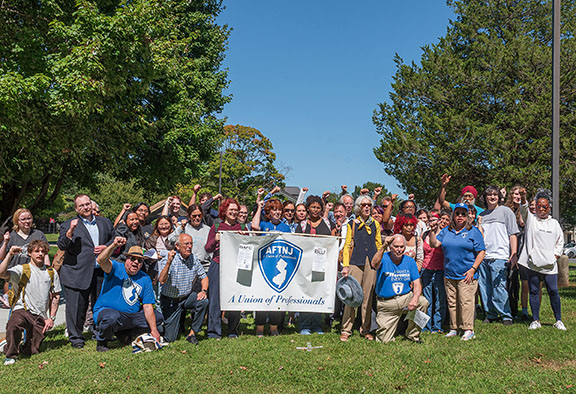
Brookdale Community College students, faculty and union representatives gathered on campus in Lincroft Sept. 15 to rally for contract negotiations involving the school’s adjunct professors. EMILY SCHOPFER
By Emily Schopfer
MIDDLETOWN – On the day Brookdale Community College adjunct professors were set to celebrate finalizing their contract, members of the Brookdale Adjunct Faculty Chapter (BAFC) instead rallied on campus as negotiations stalled.
Union members gathered under the gazebo by Bankier Library Sept. 15 to “inform students and the community about the status of their prolonged contract negotiations,” according to a Sept. 10 news release by the American Federation of Teachers New Jersey (AFTNJ), a union representing over 30,000 pre-K to grade 12 and higher education professionals. The BAFC is a local chapter, officially unionized in 2018.
Contract negotiations between Brookdale Community College and the union have been underway since April 2025, according to the release. Some concessions have been made, including “increases to a per-credit-hour rate that does not keep up with inflation,” the union said. It will not agree to such an increase, however, until it resolves stipulations regarding seniority and priority for longtime adjuncts.
AFTNJ and BAFC are calling for long-serving adjunct faculty members to receive hiring priority for courses over newer or less experienced faculty, known as “priority course assignments.”
“We fully recognize the financial constraints currently placed on the college,” Chris Pflaum, a former Brookdale student, current adjunct and vice president of BAFC, said. “In a gesture of profound compromise, we agreed to forego further negotiations with financial compensation. In exchange, we asked for a simple, non-financial agreement. A system to offer available classes to our most senior, experienced adjuncts before assigning those classes to new hires.”
This new system, according to Pflaum, would not only benefit adjuncts by providing more job stability, but it would benefit full-time educators who work “hand-in-hand” with their adjunct colleagues. For students, this system could provide experienced faculty and consistent access to professors for letters of recommendation or simple advice, Pflaum said.
According to Pflaum, Brookdale representatives said they were unwilling to establish this system because it was “too much work.”
The “financial constraints” Pflaum mentioned likely include rising healthcare benefit costs and declining enrollment. Laura Oncea, Brookdale’s director of communications and college relations, said the school has “been transparent with the employees and unions as the College is working on solutions to the cost of health benefits which increased from $11 million in 2025 to $17.7 million in 2026 with a projection to increase to $24.3 million in the next fiscal year.”
While Brookdale’s enrollment has somewhat recovered from the hit taken during the 2020 COVID-19 pandemic, it remains about 6% below pre-pandemic levels, according to Brookdale president David M. Stout.
Utility costs have also risen nearly 90% from 2020, Stout said.
“These increases have created sustained and growing pressure on the College’s operating budget,” he said, but a tuition increase is not a “sustainable solution.”
The Brookdale Board of Trustees also announced in August plans for staff layoffs. “We wil also be working closely with the unions to minimize the impact of the RIF (reduction in force) while achieving the savings we need. We won’t know for sure the number of impacted employees and those who may voluntarily separate until the end of September or early October,” Oncea said. No programs impacting the present fall semester are being cut, according to Oncea.
Pflaum began teaching as an adjunct professor in Brookdale’s biology department in 2021, while also enrolled in Brookdale’s nursing program. It was Pflaum’s “journey from an adjunct professor to a nursing student, and now a healthcare professional” that “fuels my unwavering fight for the educators who make such a transformation possible.”
According to rally flyers provided by BAFC, 72% of teachers at Brookdale are adjuncts, meaning they are paid per course rather than a salary and go without benefits such as health insurance or retirement plans. Brookdale’s adjuncts also make less than half (48.7%) of what full-time professors make per credit hour, according to the flyer.
For the past 17 months of contract negotiations, AFTNJ staff representative Jennie Shanker has served as lead negotiator. The negotiations are now at a “stalemate,” Shanker said, as Brookdale has rejected the union’s proposal. “It would be good for students, it would be good for the institution, and it would be good for the education here at Brookdale,” she said.
Shanker also stressed that this system of assigning courses to professors who have been with the institution for five years or more is already in place for full-timers.
While the Sept. 15 rally was the first for this particular contract, it is not the first rally AFTNJ and BAFC have held on Brookdale’s campus, according to AFTNJ’s communications director, Chris M. Junior. “We were here five years ago on a very cold day in March,” Junior said, but Tuesday’s rally was a “whole different scenario.”
“The whole seniority thing, full-timers have it, why can’t the adjuncts?” Junior said.
“What was it like before we had a union?” Joan Carroll, president of BAFC, asked. “We were happy with our jobs, but we had some concerns, and we met with the administration several times. They agreed, but nothing ever changed. They never did anything.”
SUPPORTING ADJUNCTS
Since the unionization, Carroll said there has been a real change. “We can now work together and fight for what is right,” she said. In fall 2022, Brookdale Community College “decided not to pay the seven-and the 11-week term adjuncts retroactive pay. We filed a grievance. They got their pay. It worked.”
The pipeline from adjunct to full-time is not clear, as adjuncts are not automatically promoted after a certain number of years with an institution. They must wait and apply for full-time positions when one opens, often competing with outside candidates.
Regardless of industry standards, “people should be rewarded for being loyal educators at an institution,” AFTNJ president
Jennifer S. Higgins said. Adjunct faculty often work in multiple schools to make a living, Higgins said. “Why do they do that? Because they love teaching, even though they are paid a fraction of what a full-time faculty member receives,” she said.
Higgins emphasized that implementing this seniority system for adjuncts would cost the institution nothing but would improve working conditions for adjuncts.
“A teacher’s working conditions are the students’ learning conditions,” she said.
Many Brookdale students also came out for the rally. Several told The Two River Times they were education majors, had parents who were educators, or just wanted to support their professors. “I do love all the teachers here, and I wasn’t even aware of this issue,” said one student.
Rae, who did not provide a last name, is a first-year Brookdale student working toward becoming a music teacher. She said a former middle school band director inspired her to pursue a career in education.
Many adjuncts also came out as self-advocates. Steve Peterson, a Brookdale adjunct in the mathematics department, said that the distinction between the titles of adjunct and professor is a “touchy” subject. “Colleges are the most hierarchical place I’ve ever worked at,” he said.
Peterson has taught for over 40 years and holds a Ph.D. in mathematics, but still technically does not hold the title of “professor.”
The system focuses on titles rather than qualifications or experience, a fellow adjunct who teaches English as a Second Language agreed.
Carroll said the union was happy with the turnout of students and others at the rally. “We made some noise,” she said. “We rattled their cage a little bit.”
“Unfortunately, this is what makes them act.”
“Brookdale Community College values the important contributions of our adjunct faculty and made a comprehensive negotiations proposal in the Spring of 2026, which the adjunct faculty union rejected,” said a representative from the college Sept. 22. “While the adjunct faculty union is free to ‘rally’ for a contract, the public should be aware that the adjunct faculty union continues to reject the College’s reasonable and generous settlement offer. In fact, the adjunct faculty union filed for impasse and rejected the State-appointed mediator’s recommendations for a settlement. The matter has now proceeded to fact-finding before a State-appointed fact-finder. The College remains willing and open to the adjunct faculty union accepting the College’s last best offer.”
This article originally appeared in the September 24-30, 2026 print edition of The Two River Times.