By Jamie Jablonowski, MPH, BSN, RN, CPH
NEPTUNE – In 2020, Julie Zgola swabbed the inside of her cheek. A few years later, that action would save a stranger’s life. By providing a sample from the inside of her mouth and mailing it into the National Marrow Donor Program (NMDP), Zgola joined the donor registry to help those suffering from blood cancers find transplant donors. Zgola, an assistant nurse manager in the Stem Cell Transplantation and Cellular Therapy Program at the John Theurer Cancer Center at Hackensack Meridian Jersey Shore University Medical Center, has firsthand experience caring for transplant patients.
A nurse since 2017, Zgola has spent her career in oncology. In 2020, she completed her first transplant with a patient, and the experience inspired her to consider registering. “As nurses, especially in transplant, it’s very personal because we work very closely with them from diagnosis to transplant… it’s an easy thing to do to help,” said Zgola.
Zgola explained that it’s a simple process to register. She went to the NMDP website and completed an online form. She received a kit in the mail, swabbed the inside of her cheek, sent it back, and then waited for a call. In October 2024, that call came.
Once contacted, Zgola found herself in the seat many of her patients have sat before. The donor screening process included a physical, lab work and pregnancy tests. Throughout the process, Zgola had a coordinator provided through NMDP who helped set up appointments and lab draws, book travel accommodations, provide education, and remain in constant contact. Injections were also required to help stimulate white blood cell production prior to donation. Zgola was offered a nurse through NMDP; however, she chose to administer these shots herself.
While solid organ transplants, such as a liver or kidney, require invasive surgery for both the patient and donor, the process is different for those who receive a stem cell transplant. Patients who qualify for stem cell transplants suffer from blood cancers or bone marrow failure syndromes such as leukemia, lymphoma, myeloma or aplastic anemia. Stem cells are usually collected from the bloodstream through apheresis (a process similar to blood donation), and less commonly through a surgical procedure to collect marrow directly from the pelvic bone.
There are two types of transplants: autologous and allogeneic. Autologous involves using the patient’s own cells. Allogeneic stem cell transplants involve receiving someone else’s cells, and these can be from someone related to the donor or from an unrelated donor found through the registry. According to NMDP, 70% of stem cell transplants are from unrelated donors.
Sukhdeep Kaur, M.D., is a hematologist-oncologist at John Theurer Cancer Center and passionate about her work with cancer patients. “There’s the aspect of that human connection with oncology patients, it’s just so strong,” she said. “You are not only their doctor, you really become their friend.”
She described the challenging process of telling a patient they have blood cancer and the emergent nature of the disease. Once abnormal cells are present in your bone marrow, they enter your bloodstream and spread quickly through the body. “One of the hardest things I’ve had to do is tell a 22-year-old that they were healthy right before coming into the hospital and now their life has completely changed because now, they have a disease that can kill them. And it could kill them rapidly.”
Kaur explained that as soon as a patient presents at her office, the search for a donor begins. The option of potential matches within the patient’s family is discussed, as well as reviewing matches on the registry. It can take up to three months from beginning the search to preparing the patient for transplant. When asked about the moment a patient is told there is a match for a donor, Kaur described the scene as emotional for both her and the patient. “Patients get just ecstatic and they’re just relieved, and it’s just always so exciting to tell a patient.”
Occasionally, individuals have to wait for a match. “Very rarely do we actually have to tell a patient now that we do not have any donor for them. However, we have run into those occasions even within the last two years where we have had to tell someone that we’re going to wait.”
Patients scheduled for a stem cell transplant undergo chemotherapy and sometimes radiation to destroy the diseased bone marrow. This process also suppresses the patient’s immune system to prevent rejection of the donor cells. The actual transplant looks similar to a blood transfusion and will hopefully result in the donor cells growing healthy red bloodcells, white blood cells, and platelets for the patient. This process takes several weeks, during which close monitoring is needed due to the high risk of infection.
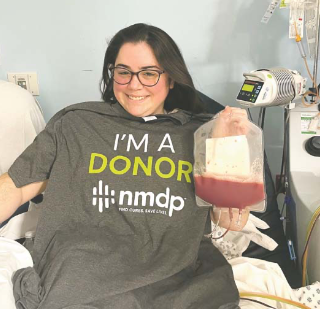
On the day of her donation, Zgola drove up to Hackensack University Medical Center. While many patients can donate through a needle in their arm, Zgola required a central line catheter because of unfavorable veins. She described this as the most challenging part. Following this procedure, she rested for eight hours while hooked up to a machine that identified the different components of her blood, harvested her stem cells, and returned the rest of her blood back to her body in a continuous process.
Once the collection process was completed, Zgola watched as a carrier came to collect her donation. “For that, I was just very emotional. I was like, OK, this is it. We’ve done it – the ultimate act of nursing,” said Zgola. She later added, “You become a nurse because you want to help people, and I figured if I work in stem cell and I donate my stem cells there’s nothing more I can do for my patients.”
Following the transplant, Zgola described feeling fatigued, but had no other long-term effects of donation. When asked about potential complications, Kaur assured potential donors. “If someone becomes a donor, there’s going to be no longterm effects on their own bone marrow. It doesn’t put them at risk for anything.
They should fully recover, and their body and their bone marrow will go right back to normal functioning as if nothing ever happened.”
Zgola believes joining the registry is a very personal choice; however, wants people to know that donation is an option and the difference being a donor can make. “You could be the one person that makes a difference. At the end of the day, you’re that one person that matches, and you are that person’s chance at a second life. We call it a rebirth day, the day of their transplant, because we’re rebirthing their immune system.”
Kaur echoes this sentiment and encourages anyone under the age of 45 to consider donation. “You are about to give someone a chance to live and chance to cure the disease. If you end up being their donor, you are pretty much the reason they’re about to get a second chance.”
To learn more about the NMDP and the donor registry, visit nmdp.org.
The article originally appeared in the September 4 – September 10, 2025 print edition of The Two River Times.