By Sunayana Prabhu and Stephen Appezzato
RED BANK – Over the past five years, a surge in development in Red Bank has left officials and residents dealing with a changing landscape as they seek a balance between growth and preservation in the wake of state-mandated affordable housing obligations.
From boutique condominiums to large-scale mixed-use projects and the proposed transit village redevelopment around the train station, the borough has approved or completed hundreds of new housing units, many of which include affordable options.
But the pace and scale of change have sparked growing concerns among residents. While those who hope for affordable housing have fiercely advocated for these new projects, several others have refuted the very concept of affordable housing in a rising property market. Some fear development could further erode the small-town historic charm of Red Bank and worsen traffic congestion.
At the June 11 planning board meeting during which the board voted in favor of the proposed train station redevelopment plan, residents had their own, often differing opinions. Linda Cohen, who has lived in Red Bank for 26 years, said, “I love the quality of life here… but now it’s becoming more and more difficult, and every time I walk to work or walk anywhere, I see more multifamily dwellings going up, and some are not very attractive, and some of them impinge on shade and green spaces and architecture and a lot of other things. I’m very disappointed.”
However, many residents at that same meeting argued that increasing housing supply through new developments will help control rents and provide more affordable options.
“People want to live in Red Bank and so if there’s not more places for them to live, the prices will go up. Increasing density and market-rate housing is a way to alleviate displacement of current residents. Making sure that we include affordable housing in those new developments is a way to alleviate the gentrification,” said resident Jonathan Gilday. “I think we have an opportunity to increase housing supply that will help with affordability, which is top of mind for many people.”
The debate has sharpened in recent months, as work on certain sites progresses. Saxum Real Estate is advancing its project at the former VNA site at the gateway of Red Bank. The five-story, 212-unit building at 175 Riverside Ave. is now under construction with an expected opening in 2027. Denholtz’s multiuse train station redevelopment will have an estimated 351 units, with 70 affordable, and is moving through the borough council approval process.
In addition to these two major developments, dozens of other new projects have either broken ground or entered planning since 2019, part of a broader effort to meet housing demand and revitalize areas like the train station corridor.
According to public records gathered from borough agendas and developer testimonies during planning and zoning board meetings between 2019 and 2025, more than 800 new apartment units – with more than 80 designated as affordable – have been approved in the borough.
Among some of the completed projects are The Rail at Red Bank at 118 Chestnut St., which was completed in 2022 and has 57 units (eight affordable) and Bridge Avenue Apartments at 72 Bridge Ave., a four-story building with 20 units, including two affordable units. The development was approved in 2024 and is now being leased.
Several other projects are in various stages of development. Thrive Red Bank, a supportive housing project located at 273 Shrewsbury Ave., offers 32 units and five affordable apartments. It received zoning approval in 2023 and is targeting a 2025 opening. The Sax, a 45-unit mixed- use building located at 121 Monmouth St., was approved in 2022. It includes one affordable unit, preserved through the restoration of a historic home on Oakland Street, and is currently in the permitting phase. Another nearby project by Kalian Companies, the Mechanic Street Apartments at 19-29 Mechanic St., was approved in late 2022 and will bring 40 apartments, including eight affordable units, though construction has not yet begun.
Additional developments include Park Valley’s 32-unit project at 120 Monmouth St., which received approval in 2021 and awaits permits; Azalea Gardens at 36 Harding Road, a 14-unit townhouse community with two affordable cottages, currently under construction; Rivermark condo- miniums at 110 W. Front St., offering 10 units with payment to the borough in lieu of the affordable units, is currently under construction.
An Identity Crisis?
With these developments reshaping the town, the question is whether Red Bank can accommodate growth without losing the identity that made it desirable in the first place.
According to Mayor Billy Portman, Red Bank’s status as a transit hub means congestion is inevitable, regardless of how much new development is approved. Even if there is no development or a single unit built in Red Bank, congestion will remain the same because the town is a transit hub, Portman said during a recent planning board meeting at which the train station redevelopment plan was approved.
But the scale and architectural character of some of these projects has drawn criticism.
“I’ve been inspired by Red Bank my entire life,” said Highlands-based architect and planner Peter Bontempo at the June 11 planning board meeting. “To see this development and this architectural character is a little bit disappointing, and the fact that it’s gotten this far is a little bit troubling.”
Bontempo questioned the transit village plan’s family-friendliness and design authenticity, citing the predominance of studios and one-bedroom units, as well as the lack of traditional detailing. “There’s 351 units in this project, eight of which are three-bedroom units,” he said. “A lot of families need units.” He added that the proposed development “does not reflect the spirit of Red Bank.”
Maintaining Red Bank’s historic identity is a growing concern for the borough’s Historic Preservation Commission, which has undertaken an architectural survey and established design guidelines to help developers adapt to the community’s character and preserve its historic significance in future projects.
“The Historic Preservation Commission’s area of direct oversight is limited to our two historic districts – Washington Street and Broad Street – plus certain designated sites across the town,” said Kristina Bonatakis, a borough council and planning board member who also serves on the commission. “However, they are currently engaged in an architectural survey and creation of design guidelines that can serve as a basis for design decisions in any area which are consistent with a historically cohesive look and feel.”
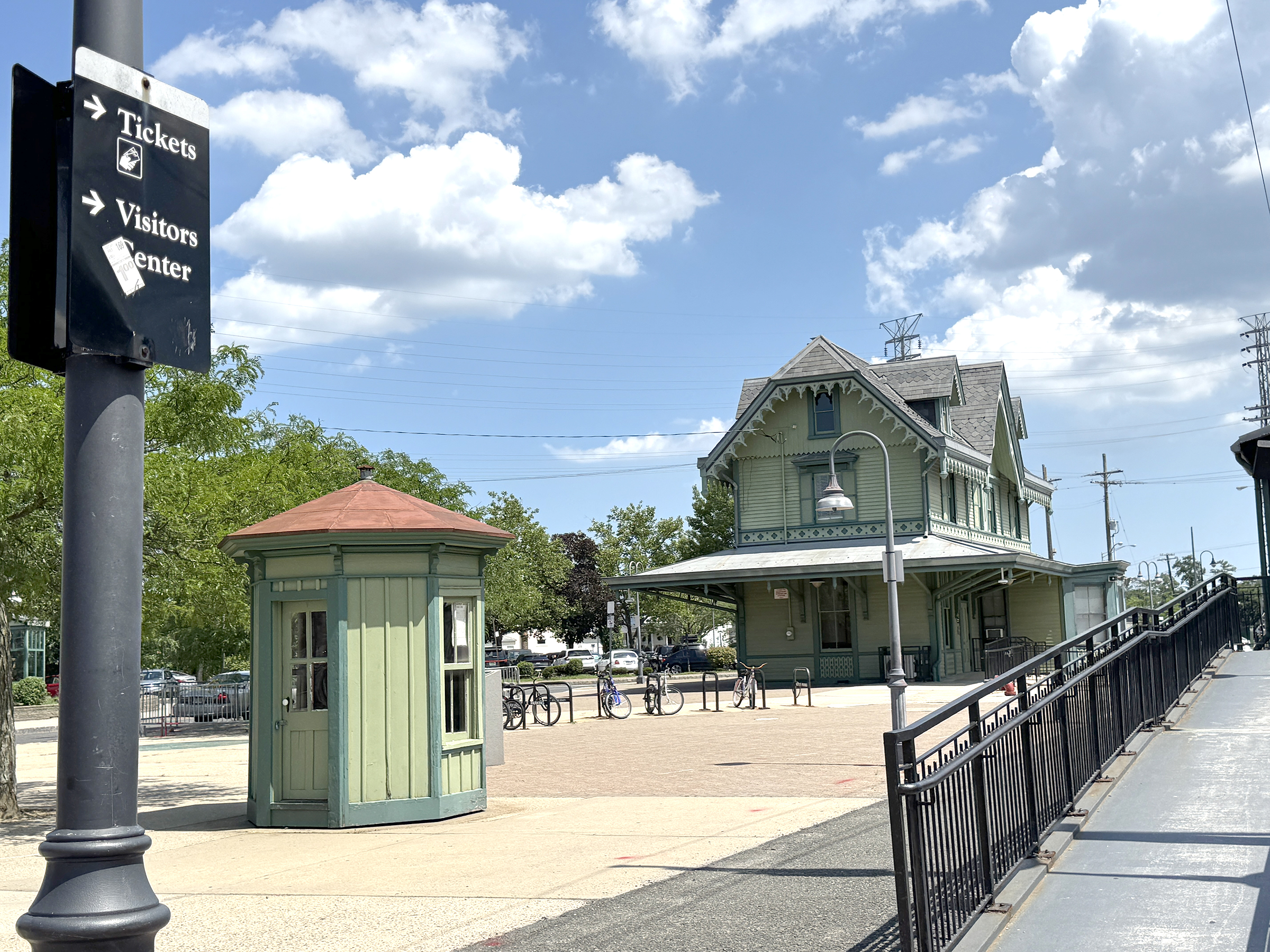
Bonatakis emphasized the importance of the train station as both a historic site and a potential focal point of revitalization. “The historic train station is a cornerstone asset in the redevelopment area, whose preservation is required and can likely be enhanced if a true transit village takes shape,” she said in response to questions from The Two River Times.
She also stressed that Red Bank’s identity is rooted in its architectural variety and historical layers. “For such a small town,” Bonatakis said, “Red Bank has historically encompassed a diversity of architecture and land uses. That includes elegant family estates, walkable business corridors, as well as significant industry, including the former Eisner factory. I believe that all of these elements play into the charm of the town today.”
Whether that charm can withstand the wave of redevelopment is a question residents continue to ask.
As more mixed-use and high-density housing developments rise – from the Denholtz and Saxum projects to the boutique Rivermark near the Navesink River – the borough faces mounting pressure to accommodate growth while preserving what makes Red Bank unique.
“We need to acknowledge all of these elements in a balanced, harmonious way,” Bonatakis said, “to maintain the unique, sometimes quirky, appeal that Red Bank offers.”
A Master Plan
Red Bank’s Master Plan, which was adopted in 2023, contains the following vision: “That Red Bank continues to evolve as a diverse, inclusive, and vibrant place for people of all ages and walks of life to call home as well as visit, embracing creativity and innovation while treasuring the elements that make it such a special and attractive community. “
To achieve this, various goals and objectives are laid out. One of which is ensuring Red Bank is balanced.
“Negative impacts on residential quality-of-life and the loss of historic assets are real issues. At the same time, continued reinvestment in Red Bank is a critical part of maintaining a thriving local economy, and smart development can provide opportunities to revitalize underutilized and unattractive properties – and in some cases undo poor planning decisions of the past,” the plan reads.
The Master Plan notes that, through the use of “thoughtful public-private partnerships,” new development can help the borough achieve goals such as streetscape enhancements, waterfront access, affordable housing, and improvements to municipal facilities.
Strategies to maintain a balance also include adopting a “smart growth mentality” and targeted infill development, preserving quality of life by addressing nuisance issues and preventing incompatible development in adjacent areas and protecting Red Bank’s historic and cultural resources.
Equitability is another long-term goal highlighted in the plan. “Everyone who lives in Red Bank should have strong access to high-quality and affordable housing, jobs, and municipal services; and that land use decisions should be carefully considered so as not to disadvantage any one area or neighborhood,” the plan reads.
To achieve this, objectives include creating affordable housing opportunities with comparable levels of quality and amenities to market-rate options, as well as ensuring access to parks, waterfronts, and transit.
The article originally appeared in the June 26 – July 2, 2025 print edition of The Two River Times.