Photo by Fred Yahn
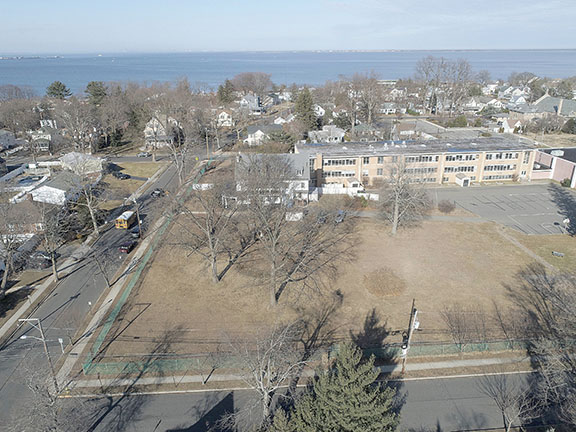
ATLANTIC HIGHLANDS – At a recent borough council meeting, residents brainstormed ideas for the St. Agnes property, a 3.6-acre plot of land near West Highland Avenue and Avenue D.
The site, owned by the Diocese of Trenton, includes the vacant Mother Teresa Regional School and lots of rare open space in a fully developed town.
Discussion ranged from creating an active environment with soccer fields and a swimming pool that can convert to an ice rink in the winter, to the establishment of a peaceful passive green or even senior housing.
Since it would be an investment, some were thinking about timing.
“I’m wondering if we should get the property first and then decide what to do with it. I don’t think any of us want this to fall into the hands of a developer. So do we get it and then figure it out?” asked borough resident Seth Herman.
The property under discussion is located across South Avenue from Our Lady of Perpetual Help – St. Agnes Church.
The Mother Teresa school, a former pre-K through eighth-grade school that closed its doors in 2016 due to declining enrollment, sits on the site. Also located on the property is the St. Agnes thrift shop in an old mansion that nods to Atlantic Highlands architectural history.
Borough administrator Adam Hubeny said the Diocese of Trenton has been paying about $2,000 a month in taxes and fees on the facility. And although the property is not yet on the market, it is being eyed by real estate developers.
“The biggest thing is that they’ve had a developer come in and make an offer, a big offer,” said Hubeny. “We’re afraid the Diocese will sell it from under us and it’ll be developed into 40 or 50 town homes. Nobody wants that,” he said.
Hubeny noted the property is assessed at about $6.5 million but the borough could acquire it at a much more reasonable cost. “The property is not yet listed on the market, so we haven’t negotiated yet. And the price is something the governing body is struggling with right now in executive session,” Hubeny said.
Council member Jon Crowley, who with council member James Murphy first hinted at the borough’s interest in acquiring the property in a March interview with The Two River Times, said there is $2 million in the town’s 2019 budget for a down payment.
“What we don’t need is a soccer field on this property,” borough resident Stacey Smith-Velez said. “Plant some trees. Make it a real park. But please don’t put a soccer field on this property.”
She was referring to an idea proposed by Sonnenfeld and Trocchia Architects of Holmdel, a firm contracted to complete conceptual designs.
Andrew F. Trocchia Jr. said there were “myriad possibilities” for the property and a soccer field was just one of them.
He also noted the school could potentially be used for senior housing.
“The bones of this building are good, so it’s not something you would necessarily want to tear down. The demolition would be costly,” Trocchia said. “But to turn it into 20 to 22 senior living dwellings, you’re probably looking at $150 to $200 a square foot.”
Hubeny said if the property is acquired, the borough would not be responsible for the development, but rather hire a developer to lead the project. According to Hubeny, the diocese has granted the borough the right of first refusal beginning Oct. 31, but a 30-day extension can be requested.
An additional concept submitted by Trocchia included the placement of six to eight single-family residential lots, with revenues from the sale of those lots offsetting costs of any other recreational or senior-living development taking place on the property.
According to Crowley, though the St. Agnes property was not included in the borough’s court-approved affordable housing plan, any senior living dwellings could potentially be credited toward the municipality’s future unmet need total.
Hubeny said any sale of the property would not include the church-owned Charles J. Hesse III Parish Center, a gymnasium located near the school that continues to serve Atlantic Highlands youth for recreational sports use. According to Hubeny, the facility is deed restricted and the church has “no intention of breaking that deed.”
Murphy described the potential purchase as a “short-term cost to aid generations to come,” but fellow council member Roy Dellosso offered a much more ominous sentiment.
“It’s a great idea if it all goes to plan, but what if we get it and we can’t flip it (to a developer)? Then we’re screwed. This is not tax neutral no matter what we do. So any way you look at it, we’re rolling the dice,” Dellosso said.
The council agreed it wanted residents to have the final say on whether or not the borough should pursue the property and, if so, what should be done with the parcel.
Hubeny said adding a referendum to the November election ballot would take time the borough did not have.
“If you don’t have it on the ballot, a referendum can only happen certain times of the year, so you’re talking about going deep into 2020. And I don’t think the diocese is going to hold this piece of property for the municipality in 2020,” Hubeny said.
Instead, Hubeny said the borough will work to create and circulate a survey for residents to voice their opinions.