By Emily Schopfer
SEA BRIGHT – U.S. Rep. Frank Pallone Jr. (D-6) announced Aug. 4 that $37 million in federal funding will be allocated toward beach replenishment projects in Sea Bright, Long Branch and Monmouth Beach this winter. The funding will be matched by state and local funds.
“Thanks to months of partnership between the Army Corps of Engineers (U.S. Army Corps of Engineers, New York District), state and local leaders, and my office, critical sand replenishment work will begin later this year in Monmouth County,” Pallone said in a news release. “These projects are essential to protecting our coastal communities, strengthening storm resilience, and preserving the Jersey Shore for future generations.”
The 3-mile-long, less-than-a-quarter-mile-wide peninsula that is Sea Bright is not new to beach erosion, storm surges or flooding. Storms from the 2025-26 winter season, coupled with a handful of severe storms during the spring and early summer months, have severely eroded several oceanfront beaches.
Sea Bright Mayor Brian Kelly thanked Pallone in the release. “Over the last year, Sea Bright has seen alarming erosion of its beaches with the ocean in some places rising all the way to the sea wall,” Kelly said.
“I want to thank Congressman Pallone for his efforts to secure funding for this critical beach replenishment project to protect our residents, their homes, and our businesses.”
The project’s base contract area is expected to span from the Ship Ahoy beach club north but could also include the area from Ship Ahoy south to the Sea Bright Public Beach; from the Monmouth Beach Bathing Pavilion north to the Monmouth Beach Bath and Tennis Club; as well as the area in Long Branch north of Pier Village. The precise areas to receive replenishment will be determined once bids are submitted. Contractor bids are due by Aug. 25, according to the release.
The project is expected to begin in late fall and finish by March 2027. This will be the first time in six years that this area will be replenished.
Sand Movement is Natural
Erosion, although “alarming,” as Kelly put it, is not completely unnatural. “Before we built on the beach, the beach and the sand, it moved,” said Danielle McCulloch, executive director of the American Littoral Society. “These are barrier islands; these are meant to be dynamic systems, and they built homes, businesses and communities. So, the sand still wants to move around, but because we have that fixed line, we have to consider community resilience and protection for the people we built homes for.”
The American Littoral Society is a nonprofit based at Sandy Hook that has been promoting education, protection and conservation of marine wildlife and coastal habitats since 1961.
“I think beach nourishment is an important tool in the toolbox for protecting communities like Sea Bright. But I don’t think it should be treated as a permanent fix or an exclusive ‘stop asking how we can do coastal protection better,’ ” McCulloch said. She has 20 years of coastal conservation experience, having worked with the U.S. Fish and Wildlife Service to monitor and manage coastal resilience projects post-Super Storm Sandy.
Anti-Erosion Options
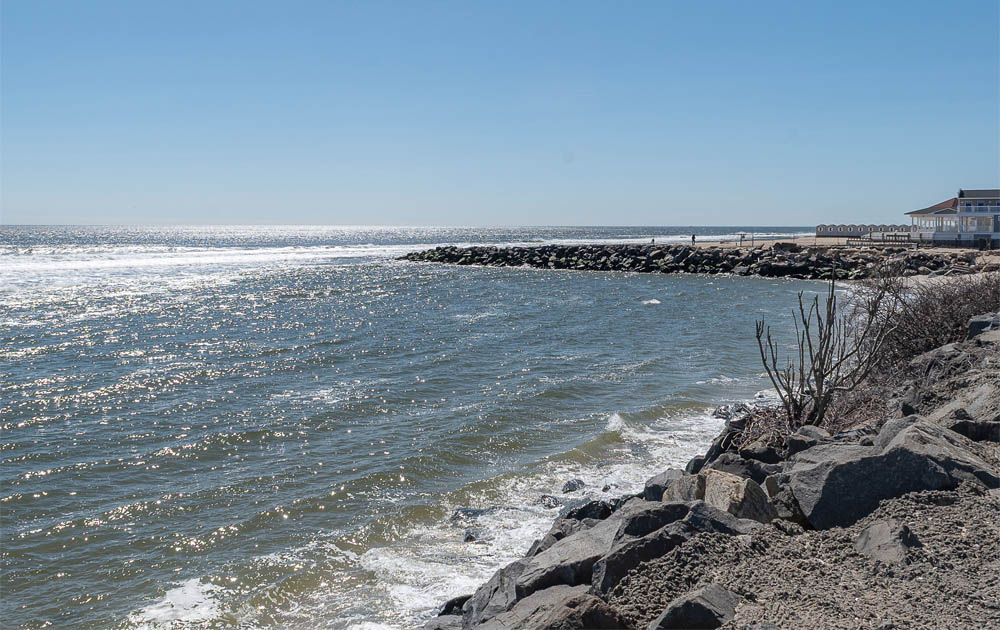
Just north of the private Ship Ahoy Beach Club is a rock jetty.
This jetty is about 250 feet long, with about 150 feet extending into the ocean. Jetties, manmade structures built perpendicular to the shoreline, act as both wave barriers and erosion controllers. The jetties reduce the impact of incoming ocean waves and help “minimize sediment deposition within the inlet,” according to the National Park Service (NPS). Although helpful in reducing how much sand flows down the coast, “jetties may significantly destabilize the coastal system and disrupt natural sediment regimes,” the NPS website notes.
McCulloch referred to jetties as another tool in the toolbox but asked whether a better tool was available. The American Littoral Society prefers nature-based solutions, according to McCulloch, but also recognizes that engineering components must be considered when implementing them.
One such solution is beach dunes. “I think dunes are a fantastic strategy,” McCulloch said. “Naturally planted dunes that increase resilience by maybe putting a backbone of a maritime force behind it. I think all of these are great strategies.”
Even with tools such as beach replenishment, jetties and dunes, McCulloch stressed that every site is unique. “You can’t just have a blanket template necessarily for every beach because every situation is a little bit different,” she said. Even dunes, a type of living shoreline, are not a black-and-white solution. “Getting extra sand for dunes means that that sand is going to have to be harvested from somewhere,” McCulloch said.
This idea also applies to beach replenishment. Much of the sediment and sand used for replenishment is harvested from offshore floor deposits, and the removal of that sand could impact aquatic habitats of fish and other wildlife.
While there is no perfect solution, McCulloch said asking the right questions won’t hurt. “How do we keep the sediment here longer? What natural solutions in our toolbox can increase how long sand stays here? What’s going to affect us under these storm scenarios? These are all questions that should go into a beach project,” she said.
Each replenishment cycle should also be used to inform the next cycle and improve it, she said. Planning for future replenishment cycles may become necessary as worsening erosion calls for more frequent nourishment. While beach erosion is a natural occurrence, the increase in severity seen in recent years has been attributed to climate change. “I think we all can see with our eyes that the tides are rising. You don’t have to be a scientist to understand that we’re seeing more flooding and we’re seeing higher tides,” McCulloch said. When water levels rise, there is a noticeable impact on how long sand stays in place and where it moves to. “The Atlantic Ocean is a dynamic and forceful beast,” she said.
In Sea Bright, where some areas of the beach have eroded to the point where the ocean meets the seawall, those beaches are not beyond saving, she said. Just because a beach hasn’t been there before doesn’t mean it can’t be there in the future, leaving some hope for Sea Bright’s beaches, she said.
The article originally appeared in the August 13 – 19, 2026 print edition of The Two River Times.