By Sunayana prabhu
HOLMDEL – The township has joined 25 other New Jersey municipalities in a lawsuit challenging the state’s fourth round of affordable housing mandates. The coalition, Local Leaders for Responsible Planning (LLRP), led by Montvale Mayor Mike Ghassali, is asking the state’s Superior Court to pause the decade-long obligations, set to begin in 2025.
The state Department of Community Affairs (DCA) recently released nonbinding estimates for the 2025- 2034 fourth round of affordable housing mandates. Municipalities have until Jan. 31 to adopt the DCA’s calculations or propose their own estimates and until June 30 to submit specific plans to meet those numbers.
In Holmdel, the DCA has calculated a need for 133 affordable housing units. Holmdel Mayor Rocco Impreveduto has argued that accommodating these units could require nearly 700 new homes, given a typical 20% set aside for affordable housing in developments. “That’s a state-mandated 12% increase in homes in Holmdel and an 8% population increase,” Impreveduto said during a Dec. 6 virtual press conference attended by coalition counsel Michael Collins and Ghassali.
According to Impreveduto, Holmdel has complied with the three previous rounds of affordable housing requirements. While he acknowledged the state’s “intent is noble as it’s always been,” he said the density that comes with the fourth-round mandates “is simply untenable for a town like ours.”
Legislative and Legal Backdrop
The controversy centers on S50/A4, a bill signed into law by Gov. Phil Murphy in March 2024, which aims to strengthen the Mount Laurel doctrine, a supreme court decisionfrom 1983 to address housing equality and accelerate the creation of affordable housing each decade.
The new law transferred affordable housing oversight from the now-defunct Council on Affordable Housing (COAH) to the DCA, which calculates each municipality’s obligations. It also introduced an affordable housing dispute resolution program that removes decisions from local elected officials and places them in the hands of appointed professionals.
According to the nonprofit Fair Share Housing Center, the calculations are based on population growth and local housing needs. However, the LLRP argues the data is flawed and the mandates are overly burdensome.
“Who’s going to fund roads and infrastructure improvements? Who’s going to fund additional resources for our schools?” Impreveduto said during the Friday conference.
Ghassali noted that Montvale’s compliance with the previous three housing obligations required significant infrastructure investments, including a second water tower, additional police officers and a $30 million referendum for classroom space. “We’re challenging the high-density housing,” he said. “There’s just no way for us to find a space for it.”
Ghassali clarified that the coalition is not against affordable housing.
Broader Concerns
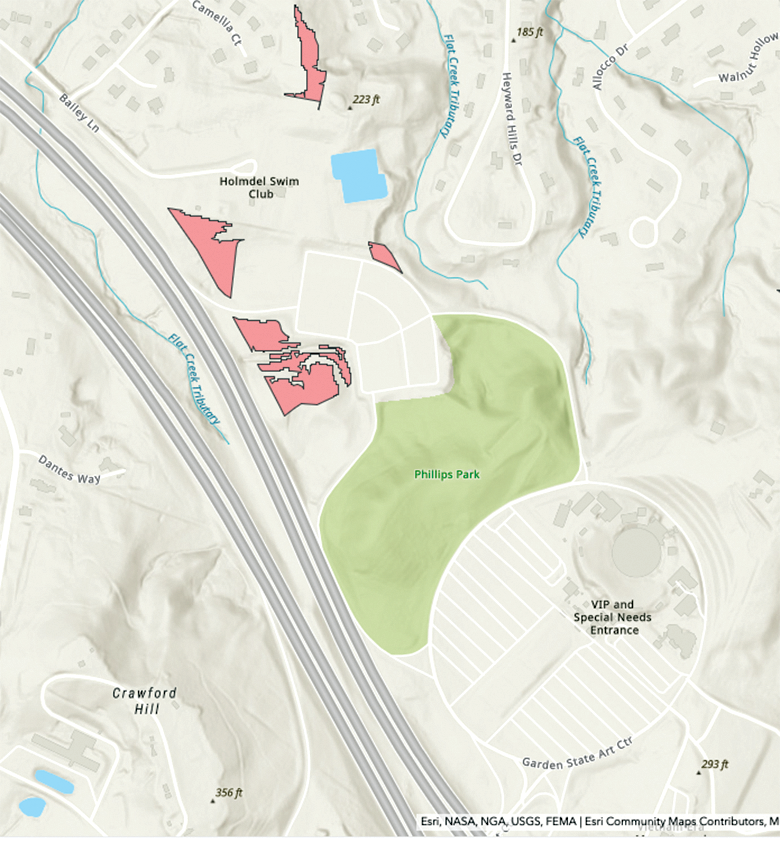
“We want to build on our own terms and see where it’s reasonable to build,” Ghassali asserted. “The state recently issued the GIS (Geographic Information System) imagery… used to calculate developable land, which was used to calculate the fourth-round numbers. And a lot of our municipalities in the consortium are finding errors with that data,” said Collins, the coalition’s attorney.
The GIS data, published on DCA’s website about a week ago, identifies potential development sites within each municipality, which is meant as a guiding tool for municipal officials to meet their respective affordable housing targets for the next decade. However, some of the areas highlighted on the map “lack logic,” Impreveduto said, noting the PNC Bank Arts Center commuter lot and the Holmdel municipal swim club were marked as potential development sites on the GIS data map. “It’s ludicrous to think those locations would be within our purview to even support affordable housing.”
In Montvale, Ghassali said the GIS mapping included certain parcels “on the median of the parkway” to raise affordable housing.
“We intend to address these issues as part of the litigation that Holmdel, Montvale and 24 other municipalities are a part of,” Collins said.
The lawsuit, docketed as Borough of Montvale v. State of New Jersey, Superior Court of New Jersey, MER-L-1778-24, challenges the state law as “unconstitutional,” citing the shift in decision-making authority and the targets for affordable housing units to be provided within 10 years go beyond constitutional mandates.
Implications
A hearing on the coalition’s request for a stay is scheduled for Dec. 20 before Judge Robert Lougy in state Superior Court. At that hearing, the 26 municipalities will be asking the court to place the fourth-round affordable housing law on hold until they have an opportunity to litigate their claims, challenging the law in court over the course of 2025.
The hearing is expected to be live-streamed by the court for the public. Coalition members, including Wall Township, Denville, Florham Park, Millburn and others seek to address inequities in the current law and ensure municipalities have a voice in determining realistic and appropriate affordable housing obligations.
“The municipalities are certainly hopeful that the court will see the issues that are present here, including what has been highlighted today with this (PNC) art center example that has come to light and place the law on hold,” Collins said.
The lawsuit’s outcome could have a far-reaching impact on New Jersey’s affordable housing policy and municipal control on future development.
“There are 26 towns here, but we represent about half a million residents,” Impreveduto noted. “It’s a sizable portion of our state that not only understands now the impact of these things, but is united against how it’s being executed. So, this is a hell of an undertaking, but we’re ready for it.”
The article originally appeared in the December 12 – December 18, 2024 print edition of The Two River Times.